A Phrase That Changed a Business's Fate .. Electric Cars Will Never Become a Mass Industry
A Phrase That Changed a Business's Fate .. Electric Cars Will Never Become a Mass Industry
When Chinese chemical engineer Wang Chuanfu founded BYD in 1995, his goal was clear and specific: manufacturing mobile phone batteries. Despite his exceptional success in this goal, the shock that shook the financial circles came in 2003.
Instead of enjoying his secure success, Chuanfu suddenly decided to buy a collapsed state-owned car company called Qinchuan for $84 million, drawing ridicule from financial market experts.
Making matters worse, the Chinese engineer announced that his goal was not to build conventional vehicles, but to dominate the electric car industry globally.
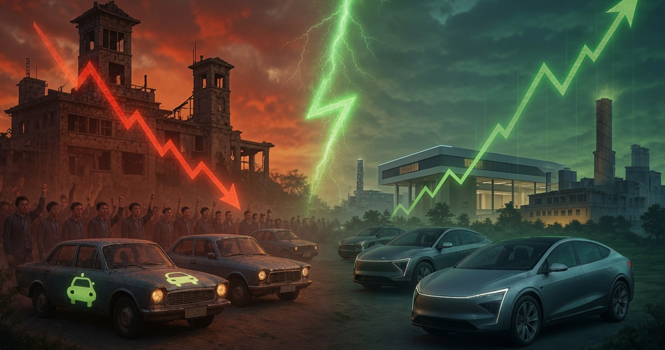
Investors quickly punished this ambition by liquidating their shares, causing the company's stock to drop 21% in just three days, convinced by the phrase: "Electric cars will never become a mass industry," which seemed very logical at the time.
Electric cars were expensive, had limited driving range, took hours to recharge, and relied on a nearly nonexistent charging infrastructure.
Today, this investment dream has become one of the greatest stories of industrial transformation in modern history.
From a Battery Factory to a Car Company
BYD, an acronym for Build Your Dreams, was founded in 1995 by Wang Chuanfu with an estimated capital of 2.5 million Chinese yuan (then about $300,000) and a team of no more than 30 employees.
Entering the automotive world was not part of the company's initial plan; it initially focused on manufacturing rechargeable batteries used in mobile phones and consumer electronics.
Although the company lacked the financial capacity to buy advanced Japanese automated machinery and equipment for nickel-cadmium battery manufacturing, which cost millions of dollars at the time, Chuanfu's innovation of a different operational model enabled the company to reduce manufacturing costs.
Chuanfu relied on breaking down the difficult automated processes in this industry into very simple manual steps, leveraging China's abundant and cheap labor, which allowed him to reduce costs by over 40% compared to Japanese competitors such as Sanyo and Sony.
By 2002, BYD had already captured 25% of the global mobile phone battery market and listed its shares on the Hong Kong Stock Exchange, raising $400 million.
However, this stable financial success faced a violent shock when Chuanfu decided to redirect the surplus cash flow toward the electric vehicle sector, which had not yet proven its commercial viability, drawing investor anger.
They considered directing profits from the successful battery division to fund an unknown car industry a suicidal gamble threatening the entire company's survival.
Going Against the Trend .. The Electric Car Gamble
At the turn of the new millennium, the prevailing view of electric cars was pessimistic, leading many experts to believe that internal combustion engines would dominate for decades to come.
Even the world's largest carmakers preferred to invest in developing gasoline engines or hybrid cars rather than betting on fully electric vehicles.
Toyota, for example, cemented its position with the Prius hybrid, while electric car programs at most companies remained very limited.
BYD, however, chose a completely different path. It adopted a strategy of developing and manufacturing batteries, electric motors, and power electronics in-house, and even the chips used in its cars, giving it a significant competitive advantage.
But in return, this strategy required massive investments and many years before it reflected in profits.
Warren Buffett's Investment Changed Investor Perception
BYD's journey saw a notable turning point in 2008 when MidAmerican Energy, a subsidiary of billionaire Warren Buffett's Berkshire Hathaway, invested about $230 million for a roughly 10% stake in the company.
The deal was driven by famed investor Charlie Munger, who described company founder Wang Chuanfu as "a combination of Thomas Edison and Jack Welch," referring to his ability to blend innovation with industrial management.
The investment sparked global market interest, as Berkshire Hathaway rarely invested in emerging Chinese technology companies.
Over the following years, Berkshire Hathaway gradually reduced its stake until it exited the investment entirely, earning huge profits that made the deal one of the most successful investments in automotive history.
Mass Production Changed the Game
The real turning point in BYD's journey was not tied to the launch of a specific model, but to its ability to achieve mass production.
Instead of focusing only on luxury electric cars, as Tesla did initially, BYD moved to produce cars covering multiple price segments, allowing it to increase production volumes and gradually reduce the cost of batteries and cars.
This coincided with rapid development in battery technologies, as the company unveiled the Blade Battery in 2020, offering higher levels of safety and operational life, with lower production costs compared to many traditional lithium batteries.
At the same time, the global market began changing at a much faster pace than most analysts had expected.
According to the International Energy Agency's 2026 report, global electric car sales exceeded 20 million vehicles in 2025, equivalent to one in every four new cars sold worldwide.
Thus, sales recorded growth for the fifth consecutive year, a clear indicator of the accelerating shift toward electric vehicles.
BYD Enters the Big League
With the accelerated spread of electric cars globally, BYD transformed from a company focused on the Chinese market into one of the largest car companies in the world.
The company surpassed its targets in 2024, selling over 4 million vehicles, including fully electric cars and plug-in hybrids, capturing about 15% of total passenger car sales in China.
The financial results also reflected the scale of this transformation; the company recorded revenues of about $107 billion in 2024, while its net profit exceeded $5.6 billion, with annual sales reaching about 4.27 million vehicles.
BYD's activities are not limited to manufacturing passenger cars; it also produces batteries, electric buses, trucks, chips, and a large number of key components used in its vehicles.
This high level of vertical integration has given it a significant competitive advantage and helped it cope with supply chain disruptions that have affected many global carmakers recently.
From Local Player to Global
After BYD's sales were concentrated in China, foreign markets have become one of the most important growth drivers for the company.
Original source: Argaam


Comments (0)
Be the first to comment.