European Sanctions Target Sudan's Gold and Test the Hidden War Economy

Summary: Estimates indicate that around 100 kilograms of gold leave Sudan daily through smuggling channels, equivalent to tens of tons since the outbreak of the war, in an illicit flow that has become one of the most important sources of financing the war economy.
In a war that is no longer fought only on the front lines, gold has emerged as one of the most important sources of funding that keeps the conflict going in Sudan. The yellow metal, which for decades was a pillar of the Sudanese economy and a main source of foreign currency, has turned since the outbreak of the war in April 2023 into a financial lifeline that fuels it and prolongs it, amid the collapse of state institutions and the expansion of smuggling networks and informal trade.
Gold has exceptional importance in the Sudanese case, as its high value, ease of transport and liquidation, in addition to increasing global demand, have made it a resource that is difficult to track. UN and international reports indicate that control over mining areas and gold export routes has become fraught with dangers, especially with the Rapid Support Forces using its proceeds to buy weapons, secure supply lines, and finance networks of influence.
In this context, the Council of the European Union approved a ban on the purchase, import, or transport of gold of Sudanese origin, and also banned the sale, supply, transport, or export of mercury and cyanide to Sudan, two essential substances used in gold extraction processes, with the aim of restricting supply chains linked to the sector.
By restricting trade in Sudanese gold and limiting access to the chemicals used in its mining and extraction, the European Union aims to reduce the available resources that contribute to the continuation of the war. The decision includes specific exceptions, as the restrictions on mercury and cyanide do not apply to goods intended for humanitarian purposes, public health emergencies, or disaster response.
The decision represents a notable shift in European sanctions policy, moving from targeting individuals and entities in the Rapid Support Forces to targeting its entire activity that funds military operations. According to the decision, these two bans are accompanied by a prohibition on providing related services, including technical assistance, brokerage services, and financial assistance. The European Union says these measures aim to reduce the financial resources that contribute to prolonging the fighting, in a war that has created one of the largest and most complex humanitarian crises in the world, leading to the displacement and refuge of millions of Sudanese and widespread violations of international humanitarian law.
Independent estimates indicate that the actual gold production in Sudan is much higher than officially announced due to widespread smuggling and weak oversight (Independent Arabia - Hassan Hamed)
Consolidating Status
Sudan has been associated with gold since the dawn of civilizations that flourished on the banks of the Nile, until it became part of its historical identity before becoming one of the pillars of its modern economy. Since the times of the Kingdom of Kush, which arose in northern Sudan more than 3,000 years ago, gold mines scattered between the Nile and the Eastern Desert formed one of the most important sources of wealth in the region, and contributed to consolidating the status of the Nubian kingdoms as an influential economic and political power in the ancient world. Writings of Greek and Roman historians indicate that these lands were among the most productive regions for gold, and that caravans of the precious metal set out from them to ancient Egypt before making their way to Mediterranean markets. A number of Egyptologists and historians believe that the name 'Nubia' may be derived from the ancient Egyptian word 'Nub' which means gold, a common historical interpretation that reflects the depth of the connection between the region and its mineral wealth. Areas such as Wadi Allaqi and the Eastern Desert have been associated in historical records with tales of the 'Land of Gold', and over the centuries attracted travelers, merchants, and prospectors, becoming part of the caravan routes network that linked the Nile Valley to the Red Sea coast and Central Africa.
Gold was not just a commercial commodity, but a strategic resource that financed armies, contributed to the construction of temples and palaces, and strengthened the influence of ancient kingdoms, while archaeological discoveries have uncovered hundreds of mines, wells, and grinding and smelting tools. Archaeological studies indicate that gold extracted from the land of Nubia supplied Pharaonic Egypt with a large part of its needs for the metal, which explains the strong presence of Nubian gold in royal treasures, including the artifacts from Tutankhamun's tomb, before the metal retained its status during Islamic times as a main resource for trans-Saharan trade, and later as a deeply rooted element in Sudanese culture, as gold remained a symbol of social status, given as gifts on occasions and inherited across generations.
The huge profits from the illegal gold trade are generated not only inside the mines, but through a complex financial and logistical system (AFP)
Expansionist Project
This fame associated with gold for centuries has been an influential factor in the calculations of regional powers seeking expansion south of the Nile Valley. When Muhammad Ali Pasha launched his campaign against Sudan in 1820, after consolidating his power in Egypt, the search for gold was one of the most prominent economic motives underlying his expansionist project. Reports and accounts circulating at the time spoke of great mineral wealth in the lands of Nubia, Sennar, and Kordofan, and the governor of Egypt aspired to harness these resources to finance his ambitious project of building a centralized state and a modern army, at a time when his wars and military and administrative reforms were draining treasury resources. However, gold was not the only goal; the campaign also sought to recruit thousands of Sudanese slaves to form a regular army to reduce reliance on Albanian and Turkish soldiers, pursue the remnants of the Mamluks who fled to Dongola after the fall of their state in Egypt, tighten control over trade routes extending between Egypt and Central Africa, benefit from Sudan's agricultural and animal resources, as well as secure the course of the Nile and enhance Egyptian influence towards its sources.
Official correspondence and reports of the Turkish-Egyptian administration show that the search for gold mines remained present in Muhammad Ali's directives, even if the results of exploration were lower than the expectations fueled by accounts of Sudan's mineral wealth. Nevertheless, gold did not lose its status as a strategic resource that attracted rulers and colonial powers throughout the 19th and 20th centuries, before returning in the 21st century to the heart of the Sudanese scene, not only as a pillar of the national economy, but as one of the most important sources of war financing.
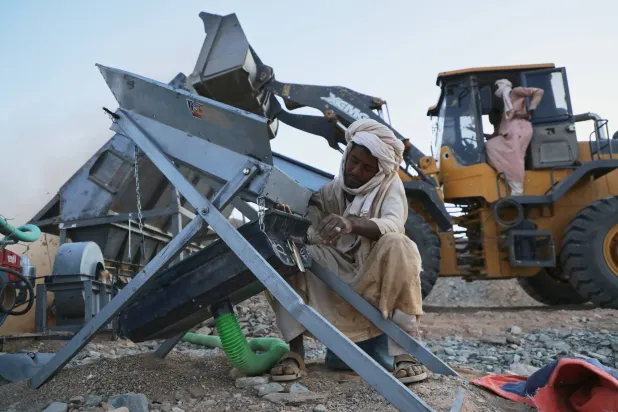
Artisanal mining dominates the gold sector, providing between 85 and 90 percent of total production in Sudan (Getty)
Gold Deposits
Since Khartoum lost about three-quarters of its oil production following the secession of South Sudan in 2011, gold has become the primary source of foreign currency, and a pillar relied upon by both the formal and informal economies.
Original source: Independent Arabia





Comments (0)
Be the first to comment.