Record Drop in SK Hynix Stock Raises AI Bubble Fears

A sharp sell-off in Korean chip stocks has sparked investor concerns about the sustainability of massive gains fueled by artificial intelligence, after SK Hynix shares posted their biggest daily decline ever, triggering widespread turmoil in the Korean market.
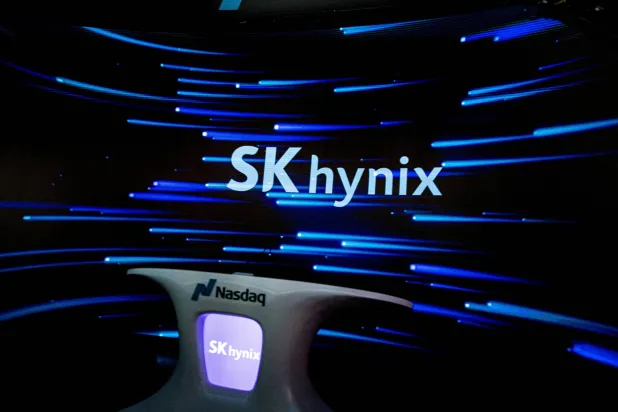
SK Hynix shares fell 15% on Monday, the largest daily drop on record, amid fears that the high expectations surrounding the AI sector may have been overdone. Traders cited concerns over the company's earnings, as well as a shift by some investors toward its American depositary receipts (ADRs), which surged 13% in their first trading session last Friday, according to Bloomberg, as reported by Al Arabiya Business.
The sell-off dragged the KOSPI index down 9%, triggering a market-wide trading halt. Samsung Electronics also fell about 11%, while foreign investors sold 1.7 trillion won ($1.1 billion) worth of Korean stocks, with SK Hynix shares accounting for the bulk of the sales.
The recent developments highlight the volatility that has hit the Korean market after the AI-fueled boom. Less than two months after SK Hynix joined the trillion-dollar market cap club, its value fell to $875 billion by the close, while Samsung also dropped below the trillion-dollar threshold, with both stocks down more than 30% from their peaks last month.
"The stock is now in a 'post-euphoria' phase," said Hebe Chen, market analyst at Vantage Global Prime, explaining that a 30% decline does not necessarily mean the bottom has been reached, given ongoing pressures from leverage and the concentration of investments in a limited number of stocks.
The decline came despite the huge success of the company's $26.5 billion ADR offering, which was oversubscribed more than seven times, according to sources. However, analysts said the success was already priced into the stock before the listing.
The company's ADRs fell about 9% in pre-market trading in the US, while losses spread to US chip stocks, with Micron Technology down 5.8% and SanDisk down 6.8%.
Chan H. Lee, managing partner at Petra Capital, said the stock's weakness primarily reflects a 'sell the news, take profits' strategy, rather than a fundamental change in the company's performance or operational outlook.
Pressure mounted after a report from Korea Investment & Securities predicted that SK Hynix's quarterly operating profit would be about 8% below the average market estimate. The report attributed this to the company's heavy reliance on high-bandwidth memory (HBM) chips, whose prices are rising at a slower pace compared to some traditional chip types.
The recent developments show that the AI boom has raised investor expectations to levels that are hard to beat. Even strong preliminary results announced by Samsung last week were followed by a stock decline, casting a shadow over the global technology supply chain.
SK Hynix has attracted global investor attention due to its pivotal role as a key supplier of HBM chips used with Nvidia's AI processors. Despite recent losses, the stock is still up more than 500% over the past year, driven by a sharp rise in memory prices and record profits.
The influx of retail investors and leveraged ETFs has amplified volatility in the Korean market, with daily KOSPI moves of 5% up or down becoming more common. Some of the largest funds linked to SK Hynix have fallen about 50% since their launch in Seoul in late May, while the Korea Exchange has triggered seven trading halts this year alone, out of a total of 13 since 2000.
Richard Tang, head of research at Julius Baer in Hong Kong, predicted continued high volatility until late July as foreign investors rebalance their positions, pointing to profit-taking and a technical shift toward ADRs as key factors behind the recent pressure.
Despite continued memory price increases supported by supply shortages, some HBM supply contracts are based on less flexible long-term agreements, partly supporting the view that AI has created an exceptional growth cycle beyond the traditional chip industry pattern.
SK Hynix CEO Kwak Noh-Jung has said that memory chip shortages could persist beyond 2030, but the rush by companies to expand production capacity still raises investor concerns about future profit declines when demand ebbs.
Despite the recent sell-off, technical indicators show the stock has shed the overbought levels it saw earlier this year. Niko Rosti, analyst at MRM Research, said the stock is now in 'deeply oversold' territory, suggesting any further decline would be a buying opportunity rather than a cause for concern.
Advertorial
Advertorial
Original source: Al Arabiya


Comments (0)
Be the first to comment.