China in a Tough Economic Bind After Internal Crises and External Pressures
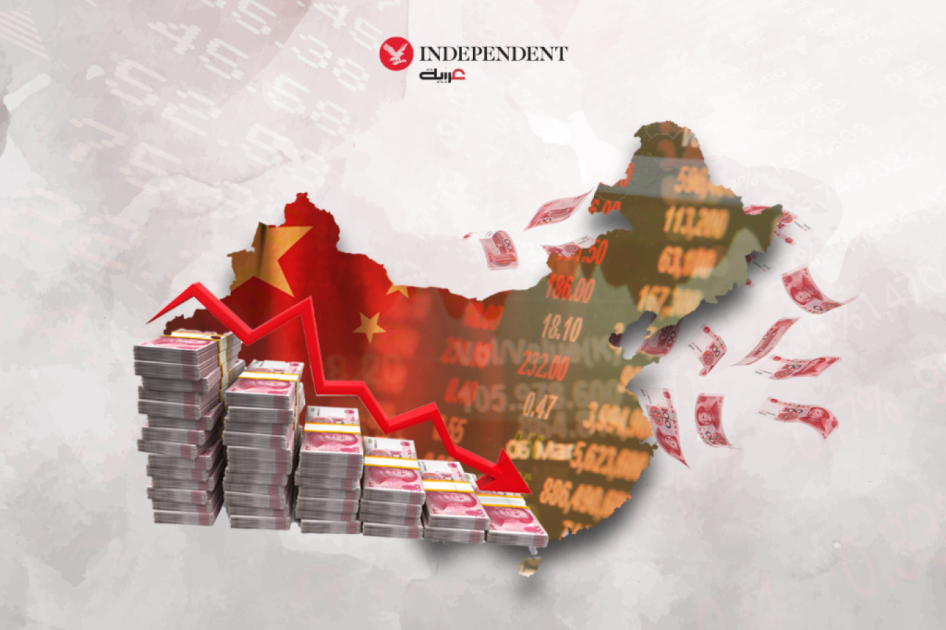
Summary: Analysts see that the persistence of this structural weakness raises the question of whether Chinese authorities will resort to more fiscal stimulus measures in an attempt to boost domestic spending.
China is facing difficulties in confronting economic challenges domestically and externally, as its economy grew at a slower-than-expected pace in the second quarter of the year.
A few days ago, the National Bureau of Statistics of China announced that the economy grew by 4.3 percent in the quarter ending June 30, compared to the same period last year.
These figures, which came below expectations of 4.5 percent growth, are a rare admission of economic weakness in China, which has long worked to boost industrial activity through investment in infrastructure and support for exports.
This comes despite China targeting growth between 4.5 and 5 percent this year, the lowest target since Beijing began announcing such figures in the early 1990s, noting that officials decided not to set a growth target in 2020 during the COVID-19 pandemic.
These weak economic data indicate that the recession in domestic consumption is outweighing the strength recently seen in Chinese exports, and also show that the country is not immune to the economic disruptions caused by the war in Iran.
Sharp decline in fixed asset and real estate investments
In her comment, Alicia Garcia-Herrero, chief economist for Asia-Pacific at Natixis, said, 'The absence of domestic demand and total reliance on exports... frankly, this is an absolutely unsustainable situation.'
The slowdown in the housing sector and the difficulty of the labor market have led Chinese consumers to refrain from spending, despite the economy continuing to grow at a relatively steady pace.
Earlier last week, Beijing unveiled its first five-year plan aimed at boosting consumption and raising annual retail sales to about $9 trillion by 2030.
The first half of the year saw a sharp decline in industrial and real estate investments, indicating that these pillars that have long supported the Chinese economy have become less able to compensate for weak consumption. Fixed asset investment fell by 5.7 percent year-on-year, while real estate investment fell by 18 percent.
Garcia-Herrero said, 'It is indeed the worst possible data regarding investment... Although infrastructure investment has helped save the situation, it is really not enough.'
Will Beijing resort to more stimulus?
The weak growth data comes after a strong and unexpected start for China this year, as the economy grew by 5 percent in the first quarter.
Chinese exports jumped by 27 percent in the second quarter, exceeding analysts' expectations thanks to strong business activity in the semiconductor and computer components sectors.
Despite increasing international demand for Chinese goods, domestic consumption remains a fundamental weakness in the country's economic development path.
This contrast highlights the phenomenon of a 'dual-track economy' that is becoming more apparent in China, as advanced technologies lead the booming export sector, while demand for daily consumer goods stalls in the domestic market.
Analysts believe that the persistence of this structural weakness raises the question of whether Chinese authorities will resort to more fiscal stimulus measures in an attempt to boost domestic spending.
In this context, Ho Woei Chen, economist at UOB and specialist in Greater China markets, said, 'Although the adoption of a large-scale stimulus package is ruled out, taking selective and targeted measures to support consumption and investment may help stabilize China's economic momentum.'
Recent data indicates that retail sales - a key indicator of consumption - rose by 1 percent year-on-year in June, as this monthly figure recovered after the decline seen in May, which was the first such decline since December 2022.
The rise in energy costs during the war in Iran helped pull China out of one of its longest periods of deflation, at a time when the country is struggling to cope with industrial overcapacity and slowing domestic demand.
Global crude oil prices stabilized at high levels of $114 per barrel in May, as strikes in the Middle East and the effective closure of the Strait of Hormuz disrupted the flow of supplies from the Gulf region.
However, the continuation of mutual attacks between the United States and Iran could pose challenges to the Chinese economy. While Beijing has succeeded in insulating itself against broader supply shocks, rising fuel and commodity prices could cast a negative shadow on consumer confidence and hinder manufacturing operations.
In its report last month, the International Monetary Fund stated that 'the possibility of renewed conflict in the Middle East looms large, and could lead to continued volatility in commodity prices, increase threats to supply chains, raise prices, and pressure financial conditions.'
Earlier this month, the IMF raised its forecast for China's economic growth this year from 4.4 percent to 4.6 percent, driven by the strength of the high-tech manufacturing and export sectors. In contrast, the financial institution lowered its global growth forecast from 3.1 to 3.0 percent.
Beijing Vulnerable to New Shocks
China's energy flexibility and its ability to produce goods for other countries quickly and at low cost have helped mitigate some of the economic effects of the war in Iran. With massive investments in artificial intelligence and data centers stimulating demand for computing devices, Chinese manufacturers are capitalizing on this opportunity.
However, in the absence of strong domestic spending activity, heavy reliance on exports makes China particularly vulnerable to any negative shift in sentiment regarding the AI sector, which could harm sales of high-tech products.
In a recent research note, Macquarie pointed out that electronic chips, computer components, and power equipment accounted for about half of China's export growth in the first half of the year.
Read more
How is China's economy shifting to consumption-driven growth?
Silicon instead of cement... New changes emerging in China's economy
China's economic slowdown warns of Beijing sliding into recession
Macquarie analysts wrote, 'External demand has been the strongest point in China's economy so far in 2026. The strength of this external demand will, in turn, determine the scale of measures Beijing will need to take to support domestic demand.'
Original source: Independent Arabia






Comments (0)
Be the first to comment.