Chinese Stocks Fall to 3-Month Low
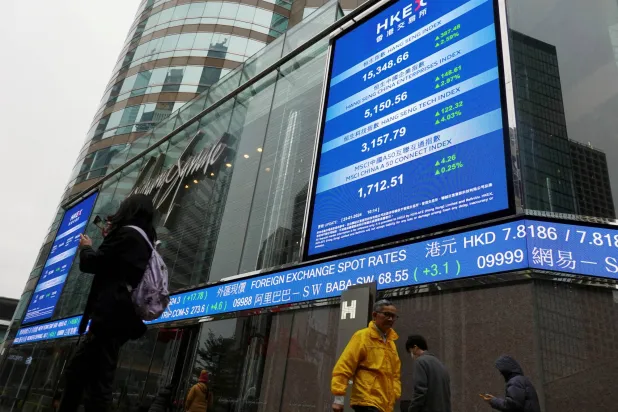
Chinese stocks broadly fell on Monday, dragging major indices to their lowest levels in three months, as rising US-Iran tensions weighed on risk appetite and prompted profit-taking in some sectors.
The Shanghai Composite Index closed down 2.1 percent at 3,913.79 points, its lowest since April 7. The CSI 300 index of leading stocks also fell 1.8 percent, hovering near a three-month low.
Losses were broad-based, with the defense sector index falling 6.9 percent, rare earths down 6.7 percent, and satellites down 7.6 percent. Technology stocks also gave back some of their big gains, with the CSI AI index falling 3 percent and the CSI Semiconductor index dropping nearly 4 percent.
Small-cap stocks in the CSI 2000 index fell 5.7 percent, their biggest daily drop since April 2025. In contrast, defensive sectors including banks, energy, and consumer staples rose between 0.2 percent and 1.7 percent.
US and Iranian forces exchanged intensive missile and drone attacks, with Tehran targeting US assets in six countries and announcing the closure of the Strait of Hormuz again, dragging Asian stocks lower.
"With weak domestic demand, coupled with strong profit-taking in some sectors, a sharp and sustained market recovery is unlikely, and range-bound fluctuation will remain the dominant trend... Large-cap stocks are likely to maintain their relative advantage given their notable defensive characteristics that offer certain benefits during market corrections, while small and mid-cap stocks are likely to see further valuation adjustments," Nanhua Futures said in a note.
In Hong Kong, the Hang Seng Index rose 0.2 percent, while the Hang Seng Tech Index fell 1 percent.
Investors are awaiting Chinese trade and Q2 GDP data this week, which will provide further clues on the health of the world's second-largest economy.
China's June exports are expected to rise 18.2 percent year-on-year in dollar terms, according to a Reuters poll of 20 economists, slowing from 19.4 percent in May.
Yuan Falls
The yuan weakened from a two-week high against the US dollar on Monday, as the dollar strengthened after escalating Gulf tensions, although the midpoint fixing still supported the Chinese currency.
The yuan traded at 6.7819 per dollar, down 0.07 percent, retreating from a two-week high of 6.77 hit on Friday. In offshore markets, it traded at 6.7855 per dollar, down about 0.05 percent in Asian trading.
The US dollar rose against most major currencies on Monday, as higher oil prices fueled expectations of Federal Reserve interest rate hikes. Iranian forces exchanged heavy fire over the weekend, and Tehran announced the closure of the Strait of Hormuz again.
"Short selling of the USD/CNY pair is likely to come under pressure, and the price could rise toward the 6.90 level if stress occurs," Bank of America analysts said in a note. They added that the bank remains bullish on the yuan in the medium term but prefers to short the euro or the Singapore dollar against the yuan in the offshore market to express that view.
Before the market open, the People's Bank of China set the midpoint at 6.7972 per dollar, its highest since February 10, 2023, although it was 122 pips below Reuters estimates. The spot yuan is allowed to trade 2 percent above or below the daily midpoint.
The yuan has been hitting new highs steadily over the past two weeks despite dollar strength, suggesting policymakers have become more comfortable with the currency's appreciation path, according to Goldman Sachs analysts.
"Although the pace of yuan appreciation has slowed recently, we do not think this signals the end of the uptrend," the analysts said in a note. They added that monthly trade data due Tuesday is likely to reinforce the overall picture of strong exports and a weaker currency.
Original source: Asharq Al-Awsat





Comments (0)
Be the first to comment.