Economic Security: Why Are Governments Returning to Nationalizing Companies?
Economic Security: Why Are Governments Returning to Nationalizing Companies?
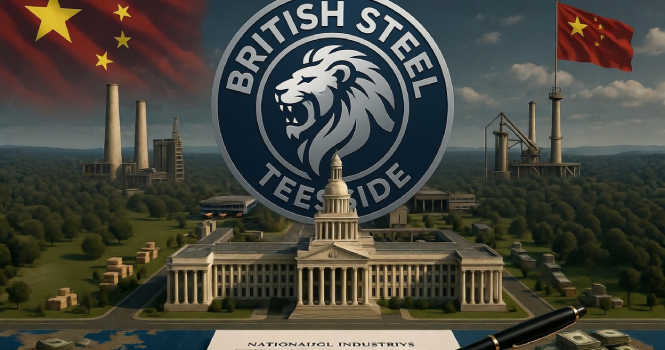
With a single stroke of the pen behind closed doors in Whitehall, London, Chinese investments exceeding one and a half billion US dollars evaporated on British soil.
On July 16, the law (nationalizing the iron and steel industry) came into effect, as the British government seized ownership of British Steel, which employs about 2,700 workers, from the Chinese Jingye Group and turned it into a government asset.
Beijing's response was not delayed; China's Ministry of Commerce issued a sharp statement accusing London of stabbing free investment rules and destroying them "under the guise of national security."
But the issue was not just a dispute between a foreign investor and a host government; it reflected a broader shift in the way governments think about the economy.
After decades of privatization and reducing the role of the state, many countries have begun to return to owning strategic companies or imposing control over them, under the guise of economic security, continuity of supply chains, and protection of vital industries.
Britain was not an exceptional case; in recent years, France, Germany, and other countries have taken similar steps to control companies operating in the energy, transport, and industry sectors.
This came after the COVID-19 pandemic, the European energy crisis, and rising geopolitical tensions revealed the fragility of excessive reliance on global markets for providing essential products and services.
Amid this shift, a fundamental question arises: Are governments retreating from the free market when the strategic interests of the state are at stake? Or is nationalization a tool that governments resort to for achieving private goals under the pretext of national security?
Economic Security Takes Precedence over Market Efficiency
The concept of economic security is no longer limited to protecting borders or securing foreign exchange reserves, but has expanded to include maintaining vital industries, supply chains, and domestic productive capacity.
The COVID-19 pandemic and then the Russian-Ukrainian war contributed to revealing the fragility of major economies' dependence on foreign sources for strategic products, from semiconductors to energy and steel.
The OECD indicates that recent years have seen a notable expansion in governments' use of industrial and investment tools to protect vital sectors.
In contrast, the World Trade Organization confirms that trade restrictions and measures related to national security have reached unprecedented levels compared to a decade ago.
British Prime Minister Keir Starmer did not hide the strategic dimension of the decision, affirming that the nationalization of the company came to "protect the future of the British steel industry and protect skilled jobs."
The United Kingdom was threatened with becoming the only G7 country without operational capacity to produce primary steel using blast furnaces, which the government considered a risk to industrial security and the country's defense capability.
Before the British government imposed full public ownership of British Steel, the government injected £377 million (the pound equals $1.34) to support operations until January 2026, according to the UK National Audit Office.
This came amid expectations that costs would exceed £1.5 billion by 2028, just to avoid the sudden and chaotic closure of its industrial base.
Allowing the iron smelting furnaces in Scunthorpe to collapse would have made the UK entirely dependent on foreign markets for structural steel needed for its railways, defense equipment, and vital civil infrastructure.
Energy: The Sector That Brought the State Back to the Fore
The energy sector has witnessed a broad wave of the state's return to direct ownership in recent years. In France, the government in 2023 acquired all shares of Électricité de France, the largest electricity producer in the country, after already owning about 84% of the company.
The cost of buying the remaining stake was about €9.7 billion (the euro equals $1.1), in a move that came within French President Emmanuel Macron's vision to enhance his country's economic sovereignty and reduce exposure to energy market disruptions.
This company provides about 70% of France's electricity through its nuclear fleet, which made the government consider full control of the company necessary to ensure the implementation of its long-term energy strategy, especially after the European energy market disruptions following the war in Ukraine.
Germany took a similar path, though under different circumstances. At the end of 2022, the German government acquired about 99% of Uniper SE, the former largest importer of Russian gas, after it suffered huge losses due to the halt of Russian supplies.
The value of the government bailout package exceeded €50 billion, making it one of the largest bailouts in the history of German companies.
Berlin saw that the collapse of the company would threaten energy security in the largest European economy, and therefore preferred to bear a huge cost to protect the stability of the electricity and gas market, rather than letting the company face bankruptcy.
In Latin America, Argentina took a similar approach when it nationalized oil company YPF in 2012, justifying the decision by the need to achieve sovereignty over energy resources. The state still owns a controlling stake in the company to this day, while the decision remains subject to economic and legal debate.
Financial Rescue: Another Motive for Intervention
In some cases, state intervention does not reach full nationalization, but rather takes the form of temporary government ownership to rescue companies considered "too big to fail."
In the United States, despite its embrace of a market economy, the government intervened during the global financial crisis in 2008 to rescue giant companies it deemed "too big to fail."
The US government provided a total support package to AIG amounting to about $182 billion, and also supported General Motors and Chrysler as part of the $700 billion financial sector rescue program.
Although the US government later sold most of its stakes, the experience established the principle that the state may become a temporary owner when it sees that the collapse of a certain company would threaten the entire economy.
Despite the increasing resort of governments to nationalization or temporary control of companies, the success of this policy does not enjoy economic consensus.
While supporters see that it provides the state with the ability to protect vital sectors during crises, critics warn that continued government ownership for long periods may weaken operational efficiency and increase burdens on public finances.
The World Bank affirms that state-owned enterprises play important roles in many economies, especially in the energy, transport, and public utilities sectors, but their performance depends largely on the quality of governance, clarity of commercial objectives, and their non-subjection to political interventions.
Therefore, nationalization in itself is neither a guarantee of success nor a cause of failure; rather, its outcomes are determined by the management method and the regulatory framework under which the company operates.
Selective Nationalization: Narrower Intervention, Broader Scope
Governments are no longer moving towards comprehensive nationalization as occurred after World War II; instead, their intervention has become focused on specific sectors related to economic security.
Original source: Argaam





Comments (0)
Be the first to comment.