Egypt: Sisi inaugurates 'Octagon' amid debut of new military system

President Abdel Fattah el-Sisi inaugurated the new Strategic Command headquarters 'the Octagon' in the New Administrative Capital, showcasing new military systems including the long-range air defense system S-300VM Antey-2500 and the Ka-52 attack helicopter. The move aims to enhance combat readiness and crisis management, moving state institutions away from congested areas to ensure security and efficiency.
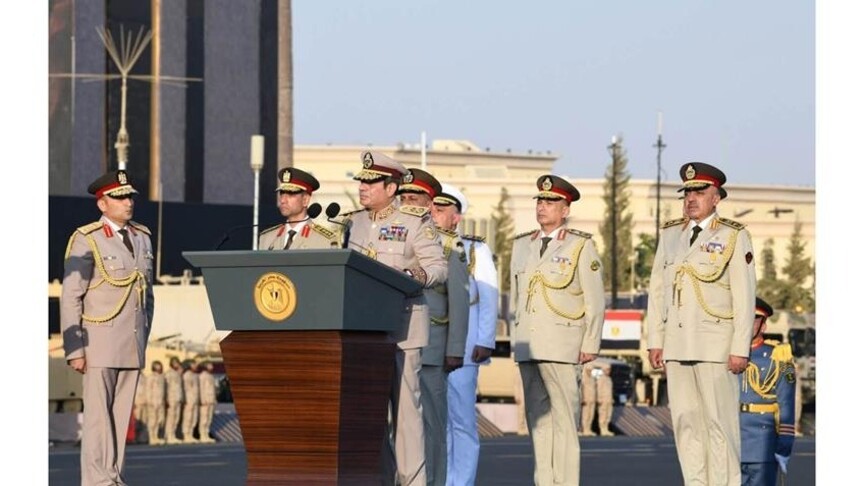
Egyptian President Abdel Fattah el-Sisi on Saturday inaugurated the new Strategic Command Headquarters 'Octagon' in the new administrative capital, with the aim of 'raising the combat and administrative readiness of the state,' according to the State Information Service affiliated with the presidency.
The two-hour inauguration ceremony featured a display of new military systems, including the first official appearance of the long-range air defense system S-300VM Antey-2500, which experts describe as 'the most powerful in the Middle East' and operated by the Air Defense Forces, as well as the attack helicopter Kamov Ka-52, known as the 'Nile Crocodile,' belonging to the Air Force.
In his speech, Sisi discussed the reasons for establishing the state's strategic command headquarters in the administrative capital and relocating state institutions such as the cabinet, parliament, Ministry of Defense, and others to the new capital, noting that these institutions 'were besieged during the events after 2011, as happened with the Supreme Constitutional Court and the Media Production City.'
Antey-2500 System
In an interview with Al-Ashraq, military expert Brigadier General Samir Ragheb explained that the first appearance of the Russian S-300VM system known as Antey-2500 was during the official celebration of Egyptian Air Defense Day, where the system's control room was displayed.
Ragheb noted that 'the system entered Egypt in 2014 and its delivery was completed in 2016, according to available information, then entered actual service in 2018, and Egypt did not officially announce its existence for many years despite its entry into service.'
According to Ragheb, the new system can intercept and cover a distance of 350 kilometers, detect targets from 500 kilometers away, and intercept medium-range ballistic missiles launched from up to 2,500 kilometers, with a maximum interception altitude of 30 kilometers.
Egypt possesses three batteries and one command and control vehicle, making it the first country in the Middle East and North Africa to operate the export version of this famous Russian system.
The Antey-2500 is an advanced development of the S-300V system, specifically designed to provide broad protection against fighter aircraft, strategic bombers, early warning aircraft, stealth aircraft with low radar signatures, as well as cruise missiles and tactical and medium-range ballistic missiles.
Military expert Samir Ragheb believes that the new system will be an addition to Egypt's multi-layered air defense system, which relies on integrating short, medium, and long-range systems to provide an integrated defense umbrella protecting the airspace and strategic targets.
"Outside Downtown"
The Egyptian president stated during his speech that 'crisis management – whatever it may be – takes place under immense pressure, and therefore the decisions made under these circumstances could cause great harm or great destruction to our country Egypt. From this standpoint, it was necessary for the state to move to the new capital to ensure that this siege does not happen again.'
He stressed that the role of this headquarters is not limited to managing military operations, but extends to being one of the main pillars of the state's ability to manage exceptional circumstances and deal with various crises.
The new administrative capital is located east of Cairo, between the Suez and Ain Sokhna roads, about 50 kilometers from Cairo. It includes a government district housing the headquarters of all ministries and sovereign institutions (judicial, military, and economic). Ministries and government agencies have already begun working from their new headquarters in the administrative capital.
Advisor to the Military Academy for Postgraduate and Strategic Studies, Air Vice Marshal Dr. Hisham al-Halabi, explained that the location of the Octagon outside densely populated residential areas makes it 'less vulnerable to security challenges and cyber intrusions.'
In an interview with Al-Ashraq, al-Halabi noted that the new headquarters' site 'enjoys high levels of security and fortification, unlike the previous location which was inside a densely populated residential block, making it more vulnerable to security challenges and cyber intrusions, in addition to the possibility of being affected by traffic during crises.'
He said that having all branches of the armed forces alongside civil crisis management departments, communications sectors, emergency services, and strategic goods within one complex 'saves the time and effort previously spent on coordination processes, which aligns with the nature of modern threats requiring immediate response and rapid movement, in addition to direct linkage with various state agencies and institutions.'
Al-Halabi pointed out that 'integrating military and economic command centers suits the nature of threats facing states now and in the future, as they have become hybrid threats combining military, political, economic, and social dimensions, which requires that all state institutions be part of the confrontation system, not only the armed forces.'
He continued: 'The strategic command center represents the pinnacle of the command and control system, as it links the armed forces with various political, security, and economic state institutions, aiming to achieve integration in crisis management and dealing with threats.'
Al-Halabi considered that 'to deal with this trend, the state should adopt a proactive approach,' especially since 'the occurrence of a threat and then dealing with it means draining part of the state's capabilities and losing one of the most important principles of war, which is the element of surprise.'
He pointed out that the Octagon is considered the most important point in the power system that includes four main axes: modernizing the armament system, developing military bases, upgrading the qualification, training, and preparation system, in addition to the command and control system, which he described as 'the most important element' in capacity building.
The advisor to the Egyptian Military Academy noted that the strategic command center relies on an early warning system to predict threats before they occur, enabling proactive plans to prevent them or mitigate their effects, according to him, 'within the framework of what is known as the concept of defense anticipation,' stressing that the accelerating developments in the nature of risks 'no longer grant states the luxury of waiting until the threat occurs.'
"Octagon".. The New Strategic Command Headquarters
The State Information Service described the Octagon headquarters as 'ensuring the continuity of the decision-making process and managing the country's affairs with full efficiency even in extreme crisis situations, thereby enhancing Egypt's status as a regional power possessing an integrated defense system that is impenetrable and cannot be disrupted.'
It considered that the headquarters 'represents a qualitative and unprecedented leap in the history and system of the Egyptian Armed Forces,' and that the strategic command reflects 'the Egyptian state's vision for the future, developing its strategic capabilities in line with the latest global systems, and ensuring integrated management and oversight of all vital state sectors and institutions from one center with high technical and security readiness.'
It pointed out that the headquarters adopts the octagonal engineering design 'Octagon' as a symbol of 'strategic strength and close interconnection between all branches and systems of the sovereign state, supporting the efficiency of joint institutional work and enhancing the speed of control and successful management of emergency situations.'
Original source: Asharq News



Comments (0)
Be the first to comment.