Egyptian government excludes thousands from subsidy system
In a move that excludes thousands of Egyptians holding ration cards (for goods), the government has set a list of those excluded under its plan to direct subsidies to those entitled.
In a decision that excludes thousands of Egyptians holding ration cards (for goods), the government set a list of those excluded as part of its plan to direct subsidies to those entitled.
The government is scheduled to implement 'cash subsidies' instead of 'in-kind subsidies (ration goods)' this month, a step that escalates fears among some citizens of being excluded from receiving commodity subsidies.
According to Prime Minister Mostafa Madbouly, 'The cash subsidy system will begin implementation with the start of the fiscal year in July.' He added in statements earlier last month that 'The proposed system relies on dividing subsidy beneficiaries into segments according to economic and social need level.'
The Ministry of Supply and Internal Trade states that it 'continues the work of reviewing and purifying the databases of beneficiaries of the ration card system to ensure that subsidies reach the most deserving groups and exclude the undeserving.'
It said in a government statement on Thursday evening that 'The review work is carried out according to objective criteria based on indicators that reflect the economic and financial capacity of beneficiaries, relying on integrated official databases from state agencies.'
These indicators include 'owning modern or high-value cars, owning more than one car, importing cars from abroad, residing in luxury housing complexes, paying international or private education expenses, owning companies, paying value-added tax for companies, paying customs fees related to import or export operations, or owning agricultural land exceeding ten feddans in area.'
Meeting of the Egyptian Cabinet chaired by Mostafa Madbouly last Wednesday (Cabinet's Facebook page)
The Ministry of Supply affirms its full commitment to 'guaranteeing citizens' right to appeal, where appeals have been available since mid-June for anyone who was excluded and believes that none of the social justice criteria apply to them.'
Economic expert Wael An-Nahas believes that 'The government called on the excluded to submit complaints for consideration, but it should have explained to them the reason for exclusion accurately and in detail.'
According to An-Nahas, 'The government has set specifications for who receives subsidies,' suggesting that 'their number will eventually, after exclusions, reach only 10 million citizens.'
The government has been implementing the ration card system for decades to subsidize basic commodities with the aim of reducing living costs for 'the most deserving groups.' About 68 million citizens benefit from this system, according to the Ministry of Supply.
The economic expert asserts that 'The Ministry of Supply has set databases for the next phase.' He points out that 'Mistakes may occur, as happened recently with the exclusion of some from receiving the subsidized loaf of bread for the first time.' He illustrates this by saying, 'A citizen may be excluded from obtaining goods, but they still receive subsidized bread.'
About 70 million citizens benefit from 'subsidized or popular bread' according to the latest government estimates in 2022. The state currently provides a daily quota of 5 loaves for each individual registered on the ration card.
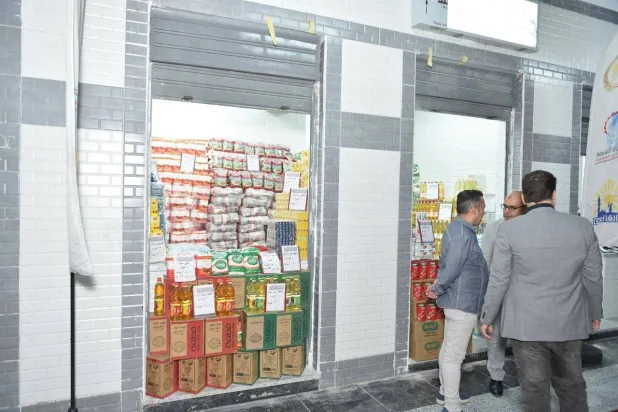
Egyptians in front of a shop selling beans and falafel (Reuters)
On Thursday evening, tweeters on social media platforms rejected their removal from the bread subsidy system after receiving messages on their mobile phones stating that their card for obtaining 'subsidized bread' had been suspended. They demanded 're-examining the files of those excluded from bread subsidies and reconsidering the automatic deletion mechanisms that wrong deserving families,' according to them.
The same thing happened with sixty-year-old Nabila Hassan, who lives in the Ghamra area in central Cairo, when she went on Friday morning to buy bread from the bakery she usually buys from. She said that 'The bakery official told her that the ration card is not registered.'
Meanwhile, member of the Economic Affairs Committee in the House of Representatives, Mohamed Beltagy, stressed 'the need to reconsider the mechanisms for removing citizens from ration cards.' He said that 'The ration card represents for millions of families a basic means to secure their daily needs, foremost among which is obtaining a loaf of bread.'
According to Beltagy, 'Combating any violations in the subsidy system should not lead to harming deserving citizens.'
For its part, the Ministry of Supply affirms that 'All work to purify the databases of those entitled to commodity and bread subsidies is carried out without harming the poorest groups and the most deserving groups, with full commitment to examining all appeals with full transparency and impartiality, in a way that achieves social justice and preserves the rights of citizens entitled to subsidies.'
'Egyptian Supply' confirms that the review work of 'ration cards' is carried out according to objective criteria (Ministry of Supply Facebook page)
According to a statement from the Ministry of Supply on Thursday evening, 'Suspending some cards in cases related to violations such as building encroachment on agricultural land, illegal construction, electricity theft, or unjustified pension disbursement, is a temporary measure that continues as long as the violation persists, and does not represent a final cancellation of the citizen's right to benefit from the subsidy system.'
The Economic Affairs Committee in the House of Representatives had recommended last Sunday to 'stop removing citizens from ration cards based on building and electricity violations, among others.'
Nevertheless, the Ministry of Supply indicates that 'Once the citizen regularizes their status and removes the reasons for the violation, the necessary procedures are taken to reactivate the ration card according to the rules and regulations in a way that ensures the preservation of citizens' rights.'
Assistant Minister of Supply and Foreign Trade for Digital Services, Mohamed Sheta, says that 'The Ministry of Supply's decisions regarding the subsidy system are implemented according to specific criteria to ensure that subsidies reach those entitled.' He points out that 'The citizen who is excluded from the ration card despite their entitlement to the subsidy does not lose their right; they can reclaim it after filing an appeal and proving their entitlement.' He stresses that 'Their dues are disbursed retroactively within the following month after the appeal is accepted.'
"); googletag.cmd.push(function() { onDvtagReady(function () { googletag.display('div-gpt-ad-3341368-4'); }); }); }
Original source: Asharq Al-Awsat



Comments (0)
Be the first to comment.