Employment Opportunities in Egypt Resist the 'Revolution' of Artificial Intelligence
Although international estimates indicate that artificial intelligence will reshape jobs more than eliminate them, the scale and nature of this impact vary from one country to another depending on economic structure, level of technological development, and the nature of prevailing skills in the labor market, especially in developing countries, according to the World Bank, which based its estimates on data from 25 countries comprising approximately 3.5 billion people and representing nearly 80 percent of the global workforce.
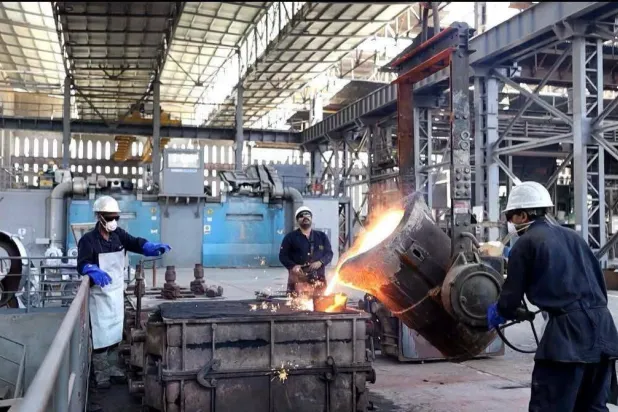
These estimates concluded that the impact of AI in developing countries will be less severe and slower-paced compared to high-income countries, due to the nature of labor markets in these economies, which rely more heavily on manual jobs and professions based on direct human interaction—jobs that remain relatively beyond the reach of current automation.
Manual professions withstand the AI revolution (Egyptian Cabinet).
Egypt is not isolated from this scene; AI imposes a new and decisive variable in the employment equation, especially given the gap between the number of new entrants to the labor market and available job opportunities. According to World Bank estimates, about 1.3 million young men and women enter the Egyptian labor market annually, while the number of newly created jobs does not exceed half a million in the same year.
Faced with this widening gap, does AI become a threat in this context, or an engine for economic growth?
Between these two possibilities, Engineer Walid Gad, a digital transformation expert and former chairman of the Board of Directors of the Information Technology Industry Chamber at the Federation of Egyptian Industries, recalls a historical precedent he believes illuminates the path. The introduction of computers to Egypt in the late last century was accompanied by similar fears about their impact on the labor market and rising unemployment.
But reviewing what that era yielded reveals a striking paradox: 'Despite the disappearance of some jobs due to the spread of computers, other jobs emerged and thrived under it, in addition to a productivity leap of tenfold.'
Artificial intelligence has begun to impact office and digital work (Egyptian Smart Village Facebook page).
Gad adds to Asharq Al-Awsat: 'AI, although it will reshape the features of the labor market, also represents a real opportunity to enhance productivity; it will lead to the emergence of entirely new labor markets that were not anticipated.'
However, this conditional optimism does not negate, in the view of Dr. Abu al-Ela Atteya, professor of artificial intelligence at the Faculty of Computers and Artificial Intelligence at Cairo University, that Egypt is undergoing a fundamental transition from what he calls 'technological margin' to 'deep structural impact' on the structure of jobs and required skills.
Atteya summarises the essence of the current moment to Asharq Al-Awsat: 'The question is no longer whether AI will affect the Egyptian labor market, but rather when, to what degree, and in what pattern this impact will manifest.'
But Dr. Ahmed Tantawy, supervisor of the Applied Innovation Center at the Ministry of Communications and Information Technology, warns against 'excessive fear of scientific development or fighting it to avoid all potential risks that may accompany it; rather, societies and economic institutions seeking growth must adopt realistic planning to benefit from technology, and develop innovative tools and systems that benefit various segments of society.'
Developing countries rely on manual and agricultural industries (Egyptian Cabinet).
Tantawy stresses in statements to Asharq Al-Awsat that 'historical experiences confirm that technological leaps are not limited to making changes in the structure of existing productive activities, but also lead to the emergence of new industries and activities as a result of creative innovation in employing emerging technologies and benefiting from their feasible applications and uses.'
The Most Affected
A study issued by the Egyptian Center for Economic Studies in April 2026 reveals that generative AI has become an uneven threat to sectors of the Egyptian labor market, warning that the jobs most susceptible to replacement are precisely those that represent the traditional gateway for new graduates to formal employment. The center describes its study, titled 'Redefining Work in Egypt: How AI is Reshaping Skill Requirements,' as 'the first empirical quantitative estimate of AI's impact on the Egyptian labor market,' as it relied on analyzing more than 28,000 electronic job advertisements across major digital platforms.
Topping this list is the category of clerical and administrative workers, with an average task automation index of about 52 percent, which researchers described as 'substantial substitution,' meaning AI targets the core of these jobs, especially in data processing, appointment scheduling, and record management.
Egyptians look forward to keeping pace with technological development (Egyptian Cabinet).
However, this high percentage does not mean, in the opinion of Dr. Mohamed El-Mogy, head of the Information Technology Department at the Faculty of Computers and Information at Mansoura University in Egypt, the sudden and complete disappearance of the job title, but what he calls 'massive integration'; a small number of employees using AI tools will be able to manage huge volumes of transactions, which reduces new hiring and generates severe transitional unemployment pressures.
A New Pattern
El-Mogy expects to Asharq Al-Awsat that this integration will produce a new pattern: the 'multi-skilled employee; AI will not eliminate the job as much as it will take over peripheral and routine tasks, fundamentally changing its nature.'
In contrast to this threatened category, the study reveals that manual, craft, and agricultural jobs are the most resilient in the face of the current wave of automation, due to their reliance on precise physical skills and changing work environments that AI cannot yet simulate. El-Mogy confirms this by saying: 'Jobs such as agricultural workers, fishermen, construction workers, and craft professions, as well as fields based on human interaction like medical care and social work, remain immune to this wave in its current stage.'
Artificial intelligence imposes a new and decisive variable in the employment equation (Egyptian Smart Village Facebook page).
As for the segment between these two ends, the category of professionals, the deepest impact will not come in the form of complete replacement, but rather in reshaping the nature of their roles from within, according to the Egyptian Center for Economic Studies study. Legal and social professions, such as lawyers and social workers, face automation affecting about 45 percent of their core tasks, while the rate is 41 percent for IT technicians, and 37 percent for engineers and scientists. This means that the role of these professionals will shift from performing cognitive tasks to directing and supervising AI systems.
Original source: Asharq Al-Awsat





Comments (0)
Be the first to comment.