Exports Rescue Chinese Stocks from 3-Month Low

Chinese stocks rebounded from a three-month low on Tuesday, supported by strong export data that boosted investor sentiment, while energy stocks rose amid escalating tensions in the Middle East.
The CSI300 index of China's largest companies closed up 2.2%, while the Shanghai Composite Index rose 1.4%. Both indices hit their lowest levels since early April in morning trading. In Hong Kong, the benchmark Hang Seng index rose 0.5%.
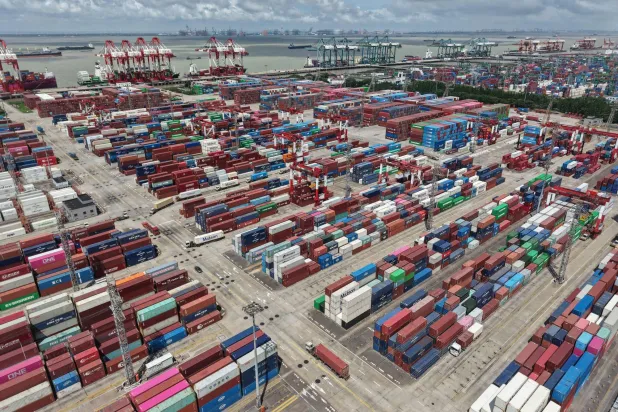
Chinese exports surged in June, driven by orders for electronic chips and computing units to support the global artificial intelligence boom. Customs data showed exports rose 27% year-on-year in US dollar terms, their best performance in four months.
Chuichang Zhang, chief economist at Pinpoint Asset Management, said: 'The export boom has been a key driver of the Chinese economy so far this year.' Exports are expected to remain strong in the second half of the year. The easing of selling in South Korean technology stocks also supported the market.
Sector-wise, shares of 5G telecom and artificial intelligence companies rose 6% and 2% respectively, leading gains. Energy stocks jumped as renewed fighting in the Middle East pushed oil prices higher.
Kelly Chung, chief multi-asset investment officer at Value Partners, said in a note: 'The semiconductor sector is expected to find some support at current levels after recent deleveraging, and earnings are expected to be strong.'
China will release second-quarter GDP data on Wednesday, which is expected to show economic growth slowing to 4.5% from 5% in January-March, according to a Reuters poll. Risk appetite was also partly affected by the upcoming IPO of CXMT, a Chinese memory chip manufacturing giant. In Hong Kong, shipping and energy stocks rose, while technology stocks were stable.
• Yuan stability
The Chinese yuan stabilized against the dollar on Tuesday, as strong trade data offset new signs of escalating tensions in the Middle East, helping to stabilize market sentiment. The US military launched airstrikes on Iran for the third consecutive night on Monday, as President Donald Trump reimposed a blockade on Iranian navigation and proposed a 20% tariff to protect the Strait of Hormuz.
Currency traders said Chinese import and export data came in much better than market expectations, helping to mitigate the impact of a broadly stronger US dollar. The yuan traded at 6.7820 against the dollar in the domestic market at midday, three points lower than the previous night's close, and at 6.7833 in the offshore market.
Before the market opened, the People's Bank of China set the midpoint at 6.7990 yuan per dollar, 18 points lower than the previous fixing of 6.7972. The spot yuan is allowed to trade within a 2% band above or below the daily fixed midpoint.
The central bank has set a weaker-than-expected midpoint since November 2025, a move investors interpreted as an attempt to maintain market stability and prevent excessive yuan appreciation.
The gap between the official fixing and market expectations has narrowed significantly in recent sessions. Tuesday's official fixing was 63 points below Reuters' estimate of 6.7927, compared to the highest estimation error margin of 544 points in mid-June.
The Chinese central bank has shown more flexibility than expected in the face of developments in the Gulf war, and sees the yuan comfortable with its appreciation against the US dollar, according to a note from Maybank analysts.
The Chinese central bank is loosening its grip on the yuan as the pace of its appreciation slows. The yuan is no longer outperforming most G20 and Asian currencies as it did in the first half of 2026. The yuan has risen 3% against the dollar so far this year, slightly less than the 3.85% gain of the Australian dollar over the same period.
Separately, market participants are eagerly awaiting second-quarter GDP data and other economic activity indicators due on Wednesday, which may provide a clearer picture of the overall economy. Analysts at Nanhua Futures said in a note: 'A lot of key economic data will be released domestically, and it is necessary to check whether the economic fundamentals will continue the slight improvement trend reflected in the PMI data.'
Original source: Asharq Al-Awsat





Comments (0)
Be the first to comment.