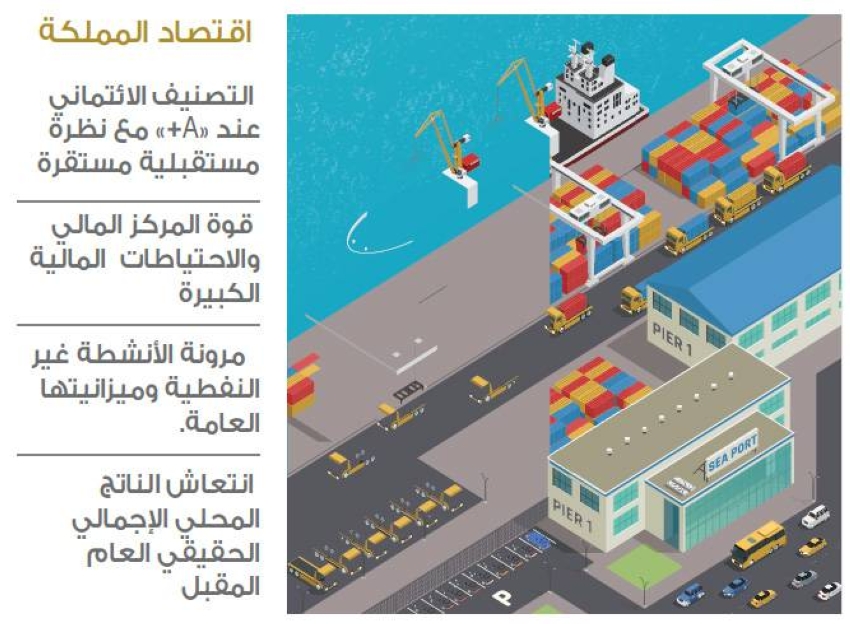
Integration helped the Kingdom maintain a strong credit rating despite global fluctuations

"Investment Law" and privatization laws gave investors a stable legal foundation
Integration helped the Kingdom maintain a strong credit rating despite global fluctuations
Dr. Ibrahim Ahmed Al-Ghamdi, an expert in human capacity development and entrepreneurship, emphasized the importance of governance contributions in enhancing investor confidence and attracting investments in the Kingdom. He said, 'Investment only moves where there is trust, and governance is what created this trust in the Saudi market. Through the publication of budgets and performance reports via initiatives such as the "Citizen’s Budget," the state’s financial picture has become clear and transparent, which Al-Ghamdi sees as a fundamental step to reassure investors. He adds that clarity of regulations, updating the Investment Law and privatization laws have provided foreign and local investors with a stable legal foundation. Meanwhile, the role of the "Nazaha" authority in fighting corruption has been pivotal in creating a fair and competitive environment. Furthermore, obligating listed companies to comply with Capital Market Authority standards has raised the quality of disclosure and transparency. Al-Ghamdi believes that the reflection of all this was evident in the rise of the Kingdom’s ranking in global competitiveness indicators and market attractiveness.'
Regarding the future of governance in the next 5-10 years, he expects the Kingdom to enter a phase of 'smart governance' that relies on data and artificial intelligence to make more accurate and faster real-time decisions. Al-Ghamdi affirms that environmental, social, and governance (ESG) criteria will be strongly present in evaluating institutional performance, alongside the emergence of flexible governance models in new economic cities such as NEOM and Qiddiya as a model where the state tests new concepts. He also pointed out that linking senior management bonuses to real performance indicators will become the norm rather than the exception, which will strengthen a culture of accountability.
He said, Saudi Vision 2030 sees good governance as an indispensable pillar for transforming national ambitions into measurable economic reality. From Al-Ghamdi’s perspective, governance is no longer a routine administrative procedure in our time; it has become the tool that ensures turning plans into results, enhances trust in the market, and guides resources to achieve real financial sustainability. Regarding the relationship between governance and credit rating, Al-Ghamdi directly links the quality of governance to the strength of the state’s credit rating. He said: 'Policy stability reduces political risks that rating agencies fear, financial transparency gives credibility to public debt figures, and institutional efficiency proves the state’s ability to meet its obligations.' He believes that this integration is what helped the Kingdom maintain a strong credit rating despite global economic fluctuations. Al-Ghamdi affirms that governance is the most important tool to ensure that every riyal spent creates impact. This is evident in linking the budget to performance through the 'Ada'a' center, and in the digital transformation via 'I'timad' and 'Furas' platforms which reduced bureaucracy, emphasizing that rationalizing spending and stopping project duplication was a direct result of clearer governance, which contributed to diversifying income sources and reducing dependence on oil as a strategic goal of Vision 2030. Regarding the role of governance in enhancing the competitiveness of the Saudi economy, Al-Ghamdi explains that half of the global competitiveness index measures 'institutional efficiency,' which is the core of governance. The improvements in ease of doing business, quality of commercial judiciary, and speed of procedures did not come from nothing. He points out that this accumulation is what led the Kingdom to reach 17th globally in competitiveness, a leap reflecting the impact of governance on the economy’s attractiveness.
From the perspective of measuring economic returns through governance, he sees that the return on governance is not measured by slogans but by numbers. At the financial level, it appears in cost reduction and increased return on investment; at the operational level, in reduced completion time and error rate; at the risk level, it is reflected in a decline in lawsuits and fines; and at the market level, in improved stock prices and lower borrowing costs.
Regarding the role of governance in reducing waste and increasing productivity, Al-Ghamdi stresses that separation of powers, continuous auditing, and electronic competitions created a barrier that prevents waste before it occurs. On the other hand, clarity of performance measurement indicators and linking them to accountability has doubled the productivity of entities and accelerated the pace of project implementation. He believes that this equation is what turned governance from theory into a tangible impact on the economic scene.
Regarding aspects that need development, he points out that the governance journey is not yet complete. There is an urgent need to develop governance for family businesses and business succession mechanisms to ensure their continuity. Also, measuring the social return of projects has become a necessity. Al-Ghamdi adds that the issue of data governance and artificial intelligence will be the next biggest challenge, along with building special governance models for mega projects 'Giga Projects' to ensure their management with efficiency matching their scale.
Al-Ghamdi concluded by emphasizing that governance is no longer an administrative option that can be postponed; it has become an urgent and inevitable national economic necessity. It is the real engine that transforms the vision’s targets from numbers on paper into growth, investment, jobs, and sustainability.
Original source: Al-Riyadh




Comments (0)
Be the first to comment.