NATO Summit in Ankara: Issues and Tensions Testing the Alliance Across the Atlantic

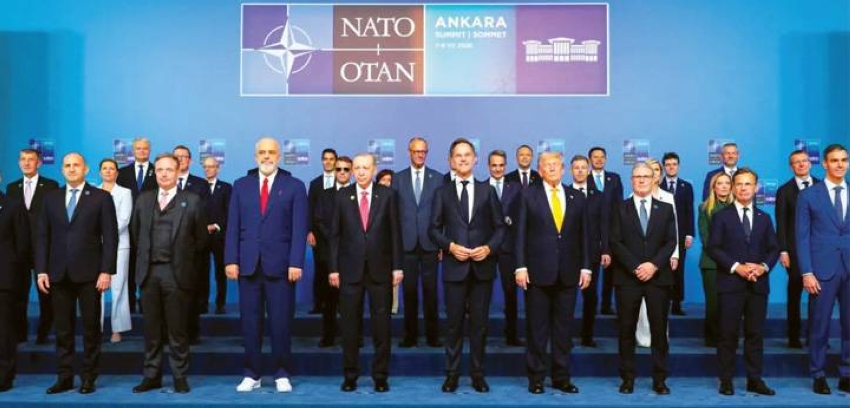
Ankara hosts the NATO leaders' summit amid one of the most sensitive periods in the alliance's history.
Security preparations in Ankara for hosting the North Atlantic Treaty Organization "NATO" leaders' summit. July 2, 2026 - Getty ImagesSecurity preparations in Ankara for hosting the North Atlantic Treaty Organization "NATO" leaders' summit. July 2, 2026 - Getty Images
Al-Sharq and agencies
The Turkish capital Ankara is hosting the NATO leaders' summit on July 7-8, amid one of the most sensitive periods in the history of the alliance, which dates back to 1949, with rising tensions between the United States and its European allies over the Iran war, and continued US pressure to redistribute defense burdens within the alliance.
Days before the summit, US President Donald Trump escalated his rhetoric towards the alliance, describing the current relationship between Washington and NATO as 'one-sided' and 'not reciprocal.'
He wrote on Truth Social that the United States spends billions of dollars to protect alliance members 'without getting any benefit,' adding: 'They were not there for us.'
Trump's statements came amid his dissatisfaction with the stance of several European countries during US military operations against Iran, as some countries imposed restrictions on the use of their military bases or airspace, which the US administration considered 'a failure of allies to support US operations.'
US Secretary of State Marco Rubio said the US president is disappointed with the performance of some NATO members, indicating that these differences will be at the top of the summit's agenda, describing the meeting as 'among the most important NATO summits in 77 years.'
European efforts to contain tensions
In contrast, NATO Secretary General Mark Rutte seeks to show the alliance's cohesion despite differences, noting that European countries and Canada have already begun to take on greater responsibility for defending the continent, in response to repeated US demands.
Rutte said the summit will focus on converting increases in defense spending into actual military capabilities, with the announcement of billions of dollars in arms deals, along with expanding European defense industries.
Read also
Read also
Before NATO summit: US initiative to link defense spending to political and military advantages
The United States proposed an initiative to grant political and military advantages to NATO countries with the largest defense spending in the alliance, ahead of the annual summit scheduled next week in Ankara.
He also revealed that defense spending by European countries and Canada rose by about $90 billion in 2025, reaching over $570 billion.
NATO leaders had agreed at the previous summit to gradually increase defense spending to the equivalent of 5% of GDP by 2035, split between 3.5% for direct military spending, including forces and weapons, and 1.5% for defense-related investments such as cybersecurity and military infrastructure.
European capitals hope this commitment will help ease Trump's criticism, who believes the United States has borne the brunt of Europe's defense for decades.
Alliance leaders are expected to renew their commitment to continue funding and arming Ukraine in its war with Russia, as Ukrainian President Volodymyr Zelensky participates in an official dinner hosted by Turkish President Recep Tayyip Erdogan, who will also hold a bilateral meeting with Trump on the sidelines of the summit.
NATO officials say one of their main goals is to maintain unity and the US commitment to Article 5 of the alliance, which states that an attack on one member is an attack on all.
The US president described the alliance as a 'paper tiger' and said he is considering withdrawing from NATO. Meanwhile, NATO Secretary General Mark Rutte sought to calm tensions, using a mix of flattery and statements to convince Trump that European NATO members are keeping their promises.
Disputes beyond the Iran war
Tensions within the alliance are not limited to the Iran file, as last year saw escalating disputes between Washington and its allies after Trump hinted at the possibility of annexing Greenland, part of the Kingdom of Denmark. The United States also announced a reduction in its military presence in Europe and the withdrawal of some capabilities allocated to NATO defense plans, including an aircraft carrier, fighter jets, refueling aircraft, and drones, in addition to a comprehensive review of the deployment of US forces on the continent.
European diplomats believe the alliance 'is still alive and functional, but it has emerged burdened with differences,' warning that any new escalation in the confrontation with Iran or a political attack by Trump on allies could overshadow the summit.
European capitals rely on the good relationship Trump has with Turkish President Recep Tayyip Erdogan and NATO Secretary General Mark Rutte to make the summit a success and avoid an open confrontation across the Atlantic.
Read also
Read also
Washington announces review of its forces' deployment in Europe and threatens to stop NATO funding
US Secretary of Defense Pete Hegseth announced on Thursday a new review of the deployment of US forces in Europe and threatened to stop paying some US dues to NATO.
Despite the anxiety, NATO officials hope the Ankara summit will send a message of unity reaffirming the commitment to collective defense, while reshaping the balance of responsibilities within the alliance in a way that satisfies Washington and maintains the cohesion of the world's largest military alliance.
NATO officials also say the vast majority of allies have fulfilled their commitments to allow the United States to use their airspace and bases on their territory, although the war has been highly unpopular in Europe and many leaders there have not supported it.
Deterring Russia
NATO leaders meeting in Ankara are expected to reaffirm that Russia poses a long-term threat to Euro-Atlantic security. Meanwhile, alliance officials say Russia is suffering from major economic problems, and that Ukraine has strengthened its position, as Rutte warned that nearly half of the Russian state budget is now allocated to defense, and that the alliance cannot ignore Moscow.
The United States is the largest NATO member and has the strongest military among the 32 member states. At least 70,000 US troops are currently deployed in Europe as part of deterrence missions against Russia and other adversaries, while the US nuclear arsenal provides a strong security umbrella for the continent.
Since Trump returned to the White House in 2025, some allies have sought to reduce their reliance on US military support.
French President Emmanuel Macron has spoken about Europe's need for 'strategic autonomy' in defense, and EU officials have expressed similar positions.
Categories
Politics, NATO, Donald Trump, Russian invasion of Ukraine, European Union, Details, Turkey, United States, Europe
Stories you may like
Politics
Cost disputes hinder renewal of NATO fuel pipeline network
Politics
Reduction of US forces in Europe: Hegseth's 'surprise plan' faces White House rejection
Politics
Resignation of US forces commander in Europe amid Trump's pressure on NATO
Politics
Canada looks to announce establishment of global 'defense bank' during NATO summit
Politics
How did Turkey transform from a 'rebel member' in NATO to an indispensable partner?
Original source: Asharq News

Comments (0)
Be the first to comment.