Nikkei closes at 4-week low as tech stocks fall
Japan's Nikkei closed at its lowest level in nearly four weeks on Wednesday, with technology stocks falling
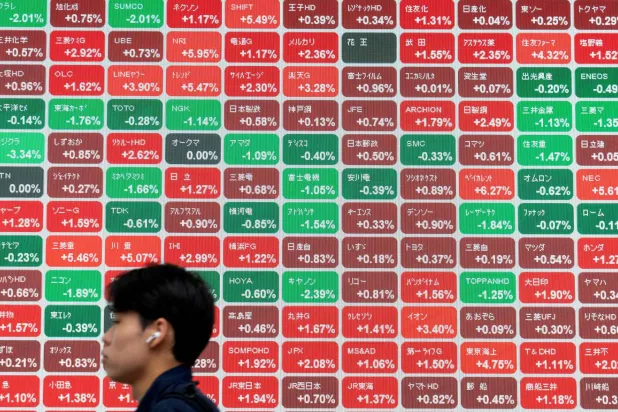
Japan's Nikkei closed at its lowest level in nearly four weeks on Wednesday, with technology stocks falling after the U.S. tech-heavy Nasdaq index suffered sharp losses overnight.
The benchmark Nikkei dropped 2.11% to 66,819.05 points, its lowest closing level since June 12. The index fell for the third consecutive session. The broader Topix index declined 1.37% to 4,006.43 points.
The Nasdaq ended sharply lower on Tuesday, weighed by Micron Technology and other chipmakers amid growing concerns about the sustainability of Wall Street's AI-driven rally.
Semiconductor stocks in Asia and the U.S. retreated after Samsung Electronics, the memory chip giant, reported earnings on Tuesday that fell short of high investor expectations, prompting profit-taking in the sector.
"Investors cannot fully restore their confidence in AI stocks," said Daisuke Hashizume, chief strategist at Daiwa Securities. He added, "Samsung Electronics indicated strong guidance, but the market was not convinced of continued price increases."
South Korea's benchmark Kospi index fell on Wednesday, declining more than 20% from its previous record close on June 22, a level typically considered an indicator of entering a bear market.
Shares of Tokyo Electron, a chip-making equipment manufacturer, fell 3.05%, while Advantest, a chip-testing equipment maker, lost 4.69%. Taiyo Yuden, which produces multilayer ceramic capacitors for power regulation in AI servers, dropped 8%, and memory maker Kioxia, after earlier gains, ended down 0.73%.
In contrast, KDDI, a telecom company, rose 1.04% as investors shifted focus to domestic demand-sensitive stocks. Among more than 1,500 stocks traded on the Tokyo Stock Exchange's main board, 36% rose, 61% fell, and 2% were flat.
Yields rise
Japanese government bond yields hit 30-year highs on Wednesday, as investors worried that rising inflation and massive spending plans could strain public finances.
The climb came after local media reported that the government is considering revising some monetary policy wording in its plan unveiled last month.
The 10-year JGB yield rose 2.5 basis points to 2.865%, and the 20-year yield climbed 4 basis points to 3.85%, its highest since September 1996.
Yields have climbed since the government outlined massive spending plans in its monetary policy plan last month. The plan called on the Bank of Japan to align monetary policy with growth efforts, which analysts say implies the central bank may hesitate to raise interest rates as inflation pressures build.
"The change in wording appears to be a cheap trick... Initially, the market is cautious about the stance of Prime Minister Sana Takaichi's government, which seeks to delay BOJ rate hikes. Economy Minister Minoru Kiuchi, who oversaw the plan's drafting, said the market's belief that the plan aims to curb BOJ rate hikes is a misunderstanding."
Investors are also worried about Japan's fiscal position, as the country plans to invest more than 370 trillion yen ($2.28 trillion) in combined public and private investments through fiscal 2040.
The 30-year yield rose 3 basis points to 3.97%. The two-year yield rose 2 basis points to 1.42%. The five-year yield rose 2 basis points to 1.975%.
Original source: Asharq Al-Awsat


Comments (0)
Be the first to comment.