Nikkei Closes Lower as Corporate Outlooks Dim
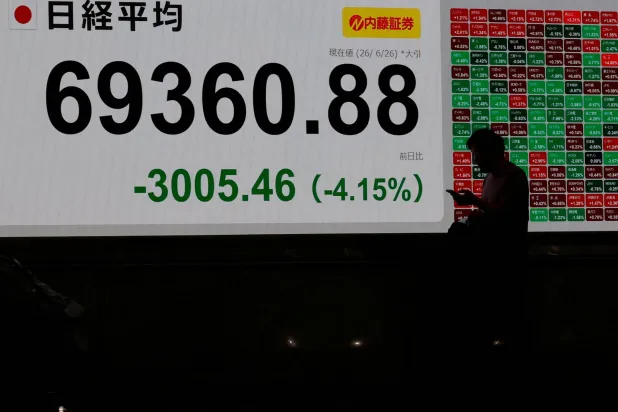
Japan's Nikkei index closed lower on Monday as investors assessed corporate outlooks after renewed conflict in the Middle East pushed up oil prices.
Japan's Nikkei index closed lower on Monday as investors assessed corporate outlooks after renewed conflict in the Middle East pushed up oil prices. The Nikkei fell 1.92% to 67,242.73 points, while the broader Topix index lost 0.71% to 4,007.49 points.
Daisuke Hashizume, senior analyst at Daiwa Securities, said: 'The market was concerned about rising costs due to higher oil prices, coinciding with the start of Japanese corporate earnings season.'
Oil prices jumped more than 4% on Monday as energy shipments through the Strait of Hormuz remained threatened, with the U.S. and Iran announcing renewed military strikes.
Chipmaker shares dragged down the Nikkei, with Advantest falling 3.39% and Tokyo Electron dropping 2.25%. Memory maker Kioxia shares plunged 12.86%.
Hashizume said: 'With the market watching memory prices, the Nikkei is influenced by South Korea's benchmark index, which is heavily weighted toward memory makers like SK Hynix.'
Nikkei losses widened later in the session as South Korea's Kospi benchmark fell, triggering temporary trading halts. SK Hynix shares dropped over 15% on Monday as investors took profits after its prominent listing on Nasdaq saw a 12.8% jump on its debut on Friday.
In Japan, Yaskawa Electric shares fell 14.34% to a session low of 5,972 yen after the robot maker's first-quarter net profit dropped 21.7%. Bank stock gains, as investors shifted focus from AI stocks to value stocks, helped limit the Topix decline.
Mitsubishi UFJ Financial Group shares rose 2.31%, and Sumitomo Mitsui Financial Group shares gained 1.63%. Among over 1,500 stocks traded on the Tokyo Stock Exchange's main board, 36% rose, 60% fell, and 2% were unchanged.
Yields Rise
The yield on the 10-year Japanese government bond reversed course and rose on Monday as the market assessed the potential shift in the investment strategy of the Government Pension Investment Fund (GPIF). The benchmark 10-year JGB yield rose 3 basis points to 2.79%, after falling to a session low of 2.735% earlier.
Yields move inversely to bond prices. The 10-year yield had fallen 17 basis points on Friday, supported by improved bond investor sentiment after Finance Minister Satsuki Katayama said the government would consider measures to encourage the GPIF to increase its investments in domestic financial assets.
Rento Maruyama, chief foreign exchange and interest rate strategist at SMBC Nikko Securities, said: 'The market overreacted to Katayama's comments.' He added: 'Traders rushed to buy bonds on Friday, looking for a signal to repurchase Japanese government bonds that had fallen sharply over the week.' JGBs had been sold off after the government unveiled an economic plan last month amid rising spending concerns and doubts about the Bank of Japan's ability to tighten policy. Maruyama explained that 'the market on Monday assessed the potential shift in GPIF allocations. Under the current framework, the fund can increase its domestic bond investments by up to 12.26 trillion yen ($75.70 billion). If 70% of that is allocated to 10-year JGBs and invested over three years, it would reduce the yield by up to 7 basis points.' He added that if other investors follow the GPIF's lead, the 10-year yield could fall up to 20 basis points. But since no final decision has been made, Maruyama considered Friday's reaction overdone. The GPIF currently maintains roughly equal allocations between domestic and foreign stocks and bonds.
Original source: Asharq Al-Awsat



Comments (0)
Be the first to comment.