Oil rises with escalating supply risks .. and buying supports gold

Oil rose on escalating supply risks from US-Iran tensions and Ukraine, while gold surpassed $4,100 supported by dip-buying.
Oil continued its gains after the US downplayed the possibility of holding talks with Iran soon, and threatened to launch broader strikes, as risks threatening global supplies extended beyond the Middle East to the Black Sea.
Brent crude rose to trade near $92 a barrel, rising for the fourth day, while WTI crude exceeded $85.
Washington carried out attacks on Tehran for the 11th consecutive day, in an attempt to weaken its ability to threaten commercial shipping in the Strait of Hormuz, and added that it remains open despite the attacks. Oil futures have risen this month as fighting escalates, while three tankers have been attacked in the waterway in recent days.
Mon, 20 2026
Ukraine crisis worsens pressure
Outside the region, the market is also dealing with a series of attacks on the Caspian Pipeline Consortium terminal on the Russian Black Sea coast, which ships most of Kazakhstan's crude oil. Meanwhile, the US said yesterday, Tuesday, that Iran desperately wants to meet, but we are not interested. Tehran denied claims that it seeks talks with Washington. Crude prices have swung repeatedly depending on prospects for escalation and de-escalation.
Jay Hatfield, CEO of Infrastructure, said, 'Our view is that we will remain somewhat within a price range of $80 to $90, depending on news flow,' adding, 'If the Red Sea actually closes, that would pose a threat we have not seen yet, and could push us above $100.'
Brent could exceed $100 a barrel before the end of the year if the conflict drags on and commercial inventories in OECD countries decline, according to Bernstein. Goldman Sachs also pointed to the possibility of prices returning to three-digit levels, although that is not the bank's base case.
Gold exceeds $4,100
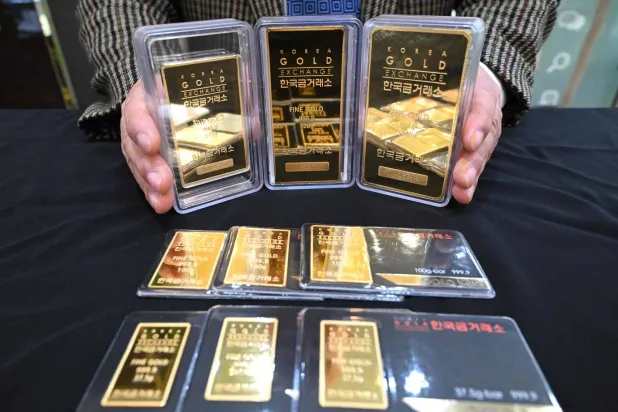
Gold continued its gains supported by buying on price dips, although escalating tensions in the Middle East kept the market under pressure.
The precious metal rose by up to 1% to trade above $4,100 an ounce, extending gains of nearly 2% in the previous session. Silver also rose to near $60 an ounce.
The two waves of gains came while bond yields remained high, and the renewed hostilities between the US and Iran have so far shown no sign of a resolution.
The momentum has already attracted new inflows into exchange-traded funds (ETFs), as total holdings rose by 7.4 tons yesterday, Tuesday, according to a Bloomberg tally, the highest daily inflow in more than a month.
Justin Lin, an analyst at Global X ETFs, referring to the sharp drop in volatility to levels last seen in early June, said: 'This is likely a price breakout following the collapse in volatility over the past few days.' He added: 'It appears buyers have successfully defended the $4,000 level, and selling pressure has eased.'
Tue, 30 2026
War and interest rates weigh
The conflict between the US and Iran helped end a multi-year rally in gold, as the metal fell about a quarter from its January peak near $5,600 an ounce. Traders are balancing higher energy prices and weak US economic data, while looking for clues on the Fed's interest rate path. High borrowing costs are a negative factor for non-yielding gold.
Morgan Stanley analysts wrote that gold is struggling to find direction, with central bank purchases supporting prices, while ETFs sold holdings due to rate hike fears. However, they see room for these funds to return to the market, given expectations that the Fed will eventually keep rates unchanged this year and resume cutting them next year. Analysts forecast gold to reach $4,450 and silver to $65.40 by the fourth quarter.
Original source: Aleqtisadiah





Comments (0)
Be the first to comment.