Report: US-Europe Alliance Reaches 'Critical Point' Over Iran War
Transatlantic relations between the United States and Europe are rapidly deteriorating amid escalating disputes over the Iran war, reinforcing the impression that the world's most important geopolitical partnership is sliding toward 'divorce,' according to The Wall Street Journal.
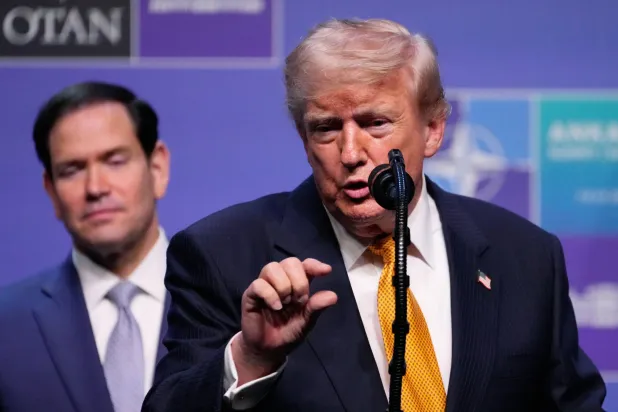
The newspaper said in a report published Saturday evening that US President Donald Trump expressed 'disgust' with his European allies for not joining the US-Israeli war against Iran, noting that he raised with aides and journalists the possibility of withdrawing from NATO, the 77-year-old alliance that until recently was a cornerstone of the West.
In contrast, the report added that European leaders have declared strong opposition to a war they were not consulted about, seeing it as illegal and unwise.
The newspaper continued that after a year in which Trump imposed tariffs on European products, cut most US aid to Ukraine, repeatedly mocked European leaders, and threatened to take over Denmark's Greenland, European leaders and their voters are not in a mood to offer help.
According to the newspaper, the escalating dispute puts the future of NATO 'on the line,' the alliance that for decades has maintained Europe's security and enabled its prosperity.
Until recently, Trump's main criticism of the alliance revolved around burden-sharing, arguing that European countries do not bear their fair share of common defense.
But as NATO member states refrained from participating in the Tehran war, Trump began questioning whether defending Europe serves US interests if European countries do not support US military interventions in the Middle East or other regions.
The newspaper noted that this stance carries a clear implication that the US role in NATO is a 'service' to Europe, and must be matched by equivalent compensation to be worthwhile for Washington.
It quoted Trump as telling the British Telegraph newspaper last week: 'We would always stand by them, but they did not stand by us,' adding that European support in the Strait of Hormuz should have been 'automatic,' just as the US automatically supported Ukraine 'even though it was not its problem.'
The newspaper stated that the current White House stance toward the old continent represents a departure from US strategy since World War II, which had long considered Europe's stability and security a vital US interest.
It added that the long-term commitment to Europe came after Washington repeatedly realized it could not ignore major conflicts in the continent or remain outside them.
Despite the decline in US military presence in Europe after the Cold War, former US presidents continued to see Europe's stability as an important goal and NATO leadership as a means to achieve it.
The newspaper pointed out that the European Union, comprising 27 countries, is the largest trading and investment partner of the United States, and about two-thirds of Americans believe their country benefits from NATO membership.
The newspaper quoted François Heisbourg, special advisor at the Foundation for Strategic Research in Paris and a former French official, as saying Trump was never a supporter of the alliance, but last week marked a 'notable shift.' He explained: 'Americans are now talking directly and explicitly about leaving NATO. The idea that it can be dispensed with is completely new.'
Polish Foreign Minister Radosław Sikorski, on platform X, called on allies to take the divorce scenario seriously, saying they want to be good and loyal allies of the United States, but the US president's statements cannot be ignored.
The newspaper added that even traditional allies have lost confidence in US assessments and decisions over the past year, especially after Trump's efforts to annex Greenland and his approach to the Russia-Ukraine war, seen as biased toward Moscow.
UK Prime Minister Keir Starmer, who has faced repeated criticism from Trump, said last week that his country is turning toward Europe in its economic and security policies, signaling that the United States cannot be relied upon.
The newspaper noted that until last February, when Washington withdrew from some leadership roles in NATO, the message was that the US remained committed to the alliance but that Europe must take on more responsibility. This stance was considered logical in Europe, according to Fabrice Pothier, CEO of Rasmussen Global geopolitical consultancy.
Regarding Iran, Pothier said Trump 'is protesting and showing displeasure because he took a unilateral step with Israel alone, and is now beginning to realize the magnitude of the heavy burdens it entails.' He added: 'The United States will become a more isolated superpower, at a higher cost to itself.'
The newspaper explained that anger within the US administration has grown, partly because European countries, including France, Britain, Italy, and especially Spain, imposed restrictions on how the US could use their air bases and airspace in the war. European allies also rejected Trump's demands to send naval forces to help reopen the Strait of Hormuz while the war continues.
Nevertheless, the newspaper noted that Europe has covertly assisted the military campaign against Tehran, with US aircraft and warships using bases in Britain, Germany, France, Italy, Portugal, and Greece for logistical support, as well as for launching strikes against Iran.
Some European countries also sent air defense systems to help protect friendly Gulf states from Iranian missile and drone attacks.
European officials told the newspaper that NATO has always been an alliance with clear limits, as its charter states it is a mutual defense pact covering Europe and North America, and does not obligate members to support wars the US chooses in other regions like the Gulf.
The Wall Street Journal stated that Trump's insistence that NATO did not intervene when the US needed it is an unfair stance, noting that the only time the alliance's mutual defense clause was invoked was after the September 11, 2001 attacks, when allies joined the US and participated in the war it led in Afghanistan, suffering thousands of casualties in the fight against the Taliban. The US president downplayed the allies' role last January, incorrectly claiming they stayed behind the front lines.
The newspaper quoted former British diplomat Philip Dickinson as saying: 'The resentment over these remarks in Europe was clear and deep, in a way that many in the United States did not realize.'
It noted that European leaders still hope to placate Trump by highlighting increased military spending. Finnish President Alexander Stub told his US counterpart during a phone call on Wednesday that NATO is undergoing changes and that Europe is taking on more responsibility.
Original source: Asharq News
Comments (0)
Be the first to comment.