Republicans Cling to Trump for November Elections: Winning Card or Losing Bet?
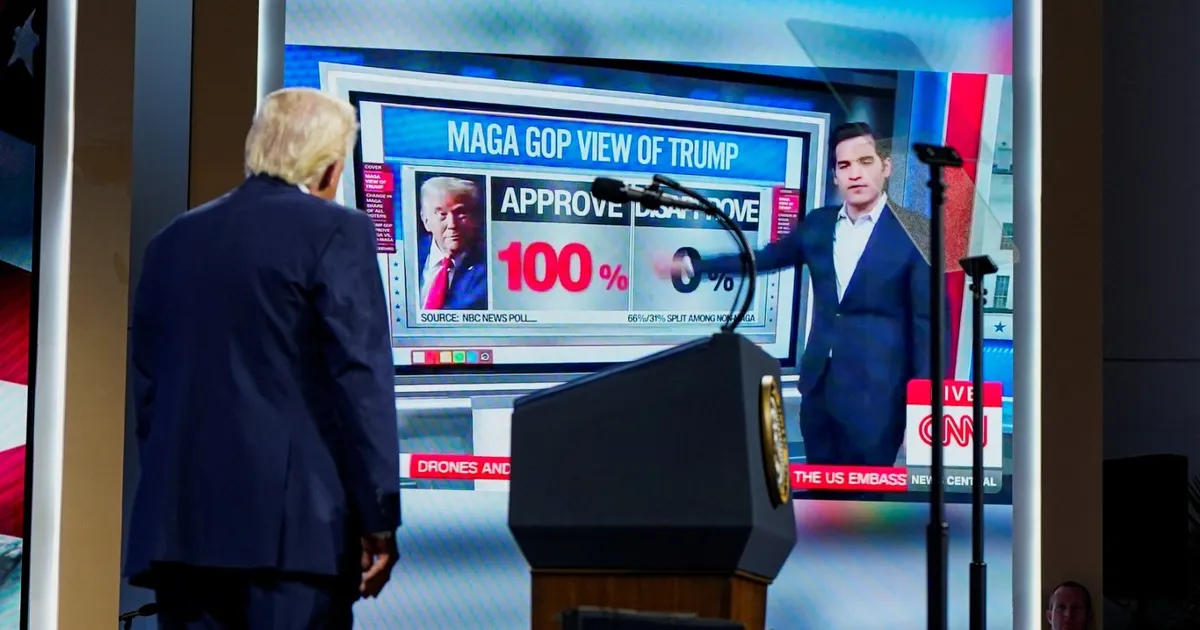
Republican lawmakers facing tough re-election battles are betting on President Donald Trump's presence in their districts to rally party supporters for the midterm elections scheduled for this November, brushing aside concerns that his declining popularity could alienate swing voters and cost them their slim House majority.
The Hill newspaper reported that this strategy seems unusual for lawmakers in tough races, who were expected to distance themselves from Trump to avoid losing swing voters, as the president's approval rating stands at 40%, according to the Real Clear Politics average of polls.
However, Republican campaign experts believe his popularity within his base could help boost turnout and overcome the historical trend in midterm elections, where the president's party typically loses seats in Congress.
Republicans hold a slim majority in the House, meaning that losing even a limited number of seats could hand control to Democrats.
Republican Representative Ryan Mackenzie of Pennsylvania, who won a previously Democratic-held seat in 2024, said 'Republicans want as many voters as possible to turn out,' adding, 'In 2024, we showed that when everyone votes in a presidential election, we succeed in Pennsylvania.'
He pointed to his own House victory, Dave McCormick's Senate win, and Trump's win in the state, adding, 'We know from previous elections that Trump motivates Republican voters to turn out, so we want everyone to vote.'
At a campaign rally Trump held in Mackenzie's district in June, the president pointed to several Republican lawmakers in attendance who are not facing strong challenges in their own districts, before saying he came to support Mackenzie and inviting him to deliver brief remarks at the podium.
Trump kicked off his 2026 midterm campaign efforts with a rally in Iowa last January, attended by Republican Representatives Zach Nunn and Mariannette Miller-Meeks, who represent districts expected to be highly competitive.
Republican Representative Juan Ciscomani of Arizona, who represents a competitive district, described Trump as 'firmly at the wheel and putting America first' during an event in April hosted by the conservative organization Turning Point USA, which mobilizes young people and students to support Republican policies.
'MAGA Majority'
Trump's growing influence within the party is reflected in the National Republican Congressional Committee, the House GOP's campaign arm, which rebranded its program for supporting promising candidates against Democrats as 'MAGA Majority' instead of 'Young Guns,' referencing Trump's 'Make America Great Again' slogan.
Committee spokesman Mike Marinella said Trump is 'the most motivating figure for Republican voters' enthusiasm and turnout,' adding that the party's candidates look forward to campaigning alongside him in competitive districts.
The committee is betting that Trump's presence can mobilize Republican voters who do not vote regularly, even as this group has historically been more likely to sit out non-presidential elections.
But this strategy carries risks for Republican lawmakers in competitive districts, as their association with an unpopular president could drive opponents to vote in numbers that surpass any potential increase in supporter turnout.
Democratic Congressional Campaign Committee spokesman Viet Shelton said 'Congressional Republicans are prioritizing their loyalty to Trump over the interests of working families,' citing tariffs, healthcare policies, tax cuts for the wealthy, and the administration's ongoing war.
He added that 'the appearance of vulnerable Republican lawmakers alongside Trump sends, from the Democrats' perspective, a message to voters that they are working for the president's interests, not their constituents'.
Trump repeatedly says that Republican candidates perform better when they campaign alongside him rather than distancing themselves. After the party's major losses in the 2018 elections, he cited the victories of lawmakers in swing districts whom he supported, and criticized candidates who distanced themselves and then lost.
Races Different from 2018
Republican officials say the competitive map in 2026 is more difficult for Democrats than in 2018, when the party took control of the House.
The National Republican Congressional Committee, in a memo issued last June, said that for Democrats to retake the House, they would need to win Republican-held seats in districts where Trump averaged 53.2% of the vote in 2024.
It continued: 'When Democrats flipped seats in 2018, it was in districts where Trump averaged no more than 46.6% in 2016,' arguing that this gap makes the current playing field more difficult for them.
This strategy is also tied to Trump's broad influence within the Republican Party, as he backed primary challengers against Republican incumbents who opposed his stances, contributing to their losses. This included lawmakers in Indiana who refused to redraw district lines in a way that benefited the party, along with former Kentucky Representative Thomas Massie and former Louisiana Senator Bill Cassidy.
Trump's early endorsements also helped his preferred candidates avoid tough primary fights and lock down open-seat races, allowing Republicans to save money and resources for general election battles.
In contrast, some Republican lawmakers have shown that distancing themselves from Trump can be electorally beneficial, including Pennsylvania Representative Brian Fitzpatrick, who stressed that members of Congress represent their local communities and that voters decide based on a lawmaker's record and connection to their district.
Fitzpatrick was among the few Republicans who held onto their seats in swing districts in 2018. However, Trump recently criticized him for repeatedly voting against the president's positions, warning that 'that doesn't end well.'
Other Republican lawmakers are more cautious in their relationship with Trump, even as they host him in their districts. New York Representative Mike Lawler, who represents a swing district, attended a Trump rally in May but later refrained from fully committing to campaigning alongside the president.
Original source: Asharq News


Comments (0)
Be the first to comment.