Saudi Arabia's non-oil private sector grows at fastest pace in four months
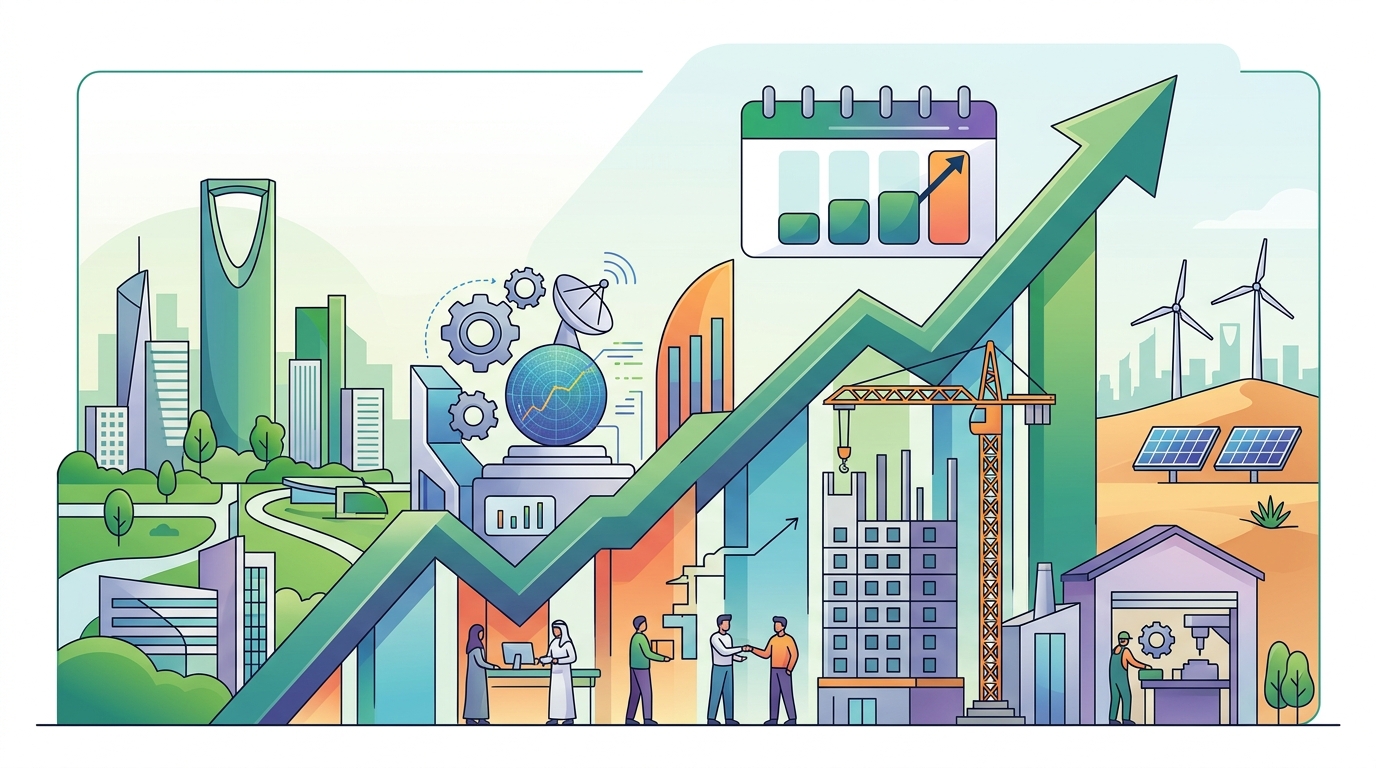
Participants in the survey attributed this to the approval of new projects, increased customer demand, and the return of orders that had previously been delayed due to the conflict in the region.
A survey published on Sunday showed that Saudi Arabia's non-oil private sector accelerated its growth in June, supported by the strongest rebound in new business volumes in four months, despite companies continuing to suffer from severe cost pressures and weak external demand.
The seasonally adjusted Saudi Arabia Purchasing Managers' Index (PMI) issued by Riyad Bank rose to 53.3 in June from 52.8 in May, recording its highest reading in four months and indicating a strong improvement in operating conditions at the end of the second quarter.
Rising Activity
Output growth remained broadly stable, with about 18 percent of surveyed companies reporting an increase in activity compared to only two percent reporting declines.
Participants in the survey attributed this to the approval of new projects, increased customer demand, and the return of orders that had previously been delayed due to the conflict in the region.
New business volumes grew at the fastest pace since February, as declining geopolitical concerns boosted investor confidence and increased domestic spending.
Naif Al-Ghaith, Chief Economist at Riyad Bank, said: 'The rise in output and the faster increase in new orders in four months indicate that business activity has regained momentum as the second quarter draws to a close.'
However, not all indicators were positive; export orders shrank sharply for the fourth consecutive month amid logistical obstacles and intense foreign competition, while employment stagnated.
Higher Input Costs
Meanwhile, input costs recorded the highest quarterly increase in 15 years, prompting companies to raise their product prices at the second-fastest rate in nearly six years.
According to its 2025 budget, Saudi Arabia's Ministry of Finance expects the economy to grow by 4.6 percent in 2026, before reaching 3.7 percent in 2027.
At the end of May, credit rating agency Moody's affirmed Saudi Arabia's credit rating at 'Aa3' with a stable outlook, noting that the Riyadh economy remains resilient to the repercussions of the Iran war and navigation disruption through the Strait of Hormuz.
In January, Fitch affirmed Saudi Arabia's credit rating at 'A+' with a stable outlook, according to its recently issued report, indicating that the rating reflects the strength of the country's financial position.
Read more
"S&P: Saudi Economy Capable of Overcoming Regional Conflict"
"How Did the Saudi Economic Budget Double Amid Transformations?"
"Non-Oil Activities Drive Saudi Economy Growth of 1.3 Percent"
The International Monetary Fund estimates that the Saudi economy will grow by 3.1 percent in 2026, accelerating to 4.5 percent in 2027, reflecting continued economic recovery and expansion of non-oil activities.
The World Bank also expects the Saudi economy to grow by 4.3 percent in 2026 and 4.4 percent in 2027, driven by increased investment and improved business environment.
Rising Oil Prices
The Organization for Economic Co-operation and Development expects growth of 4 percent in 2026, before a relative decline to 3.6 percent in 2027, amid more conservative estimates regarding the pace of global growth.
Global credit rating agency Standard & Poor's expects real GDP growth of 4.4 percent in 2026, reflecting in part its assumption that oil production will increase to an average of 10.1 million barrels per day from 9.5 million barrels per day in 2025, and that oil prices will rise in 2026, as the risk premium in the market has pushed global oil prices higher.
Fitch expects GDP growth to reach 4.8 percent in 2026, while the deficit is expected to shrink to 3.6 percent of GDP by the end of 2027, with non-oil revenues continuing to benefit from booming economic activity and improved revenue efficiency.
Original source: Independent Arabia





Comments (0)
Be the first to comment.