Selling forces dominate TASI and erase its morning gains

Saudi stocks declined at the end of today's trading after TASI reversed its early gains and closed near its session lows, alongside a surge in liquidity and pressure on a number of leading stocks.
The TASI index closed at 10,802 points, losing 0.2%, and the decline came despite a higher number of advancing companies than declining ones, indicating that pressure was more concentrated in heavyweight stocks rather than being the result of a broad selling wave in the market.
Market movements today show sellers in control, keeping their selling pressure on the index in a sideways path during this month, coinciding with anticipation of financial results, reflecting low risk appetite moving upward ahead of the results.
Trading opened at 10,826 points and continued to rise, with gains reaching 51 points, but the index later lost its gains and fell to a low before reducing losses by 6 points at the close. The range between the session's high and low was 0.7%, with the fluctuation range increasing by about 80%.
Mon, 13 2026
Liquidity rises without supporting prices
Trading value jumped to 4 billion riyals, a daily increase of 82%. The average transaction value reached about 9.77 thousand riyals, compared to 8.16 thousand riyals in the previous session, indicating that the increase in activity was not limited to a rise in the number of executed transactions, but also included growth in their average sizes.
Despite this, the additional liquidity did not translate into price support for the index. The top 10 most traded companies accounted for about a third of market liquidity, with Al Rajhi leading trading values at about 304 million riyals, followed by Resan at 182 million riyals, and then Aramco at 174.59 million riyals.
TASI
Positive breadth for the market while leaders pressure
Shares of 125 companies rose, compared to 116 companies declining, while the rest were unchanged, keeping market breadth slightly tilted to the upside despite the index closing in the red.
This divergence shows that TASI's losses came largely from a decline in a number of companies with high market weights.
The MT30 index also fell by 0.3%, about twice the decline of TASI, confirming that large-cap stocks performed relatively weaker than the rest of the market.
Sun, 12 2026
Banks limit the decline of energy and basic materials
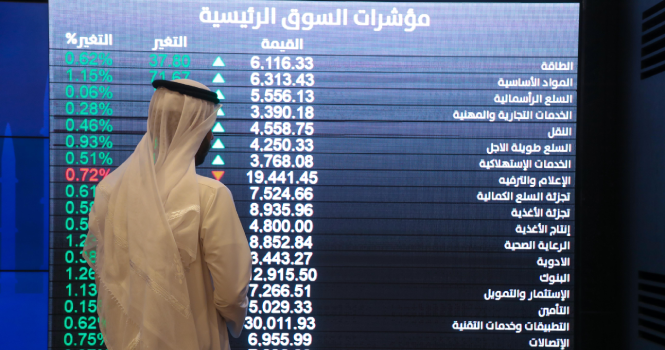
At the sector level, 13 sectors declined versus 9 advancing, showing that weakness was broader sectorally than the picture reflected by the number of advancing and declining companies.
The capital goods sector led the declines with 1.8%, while the commercial and professional services sector rose 2%, and the highest traded sector was banks with a value of 705 million riyals, equivalent to 18% of market liquidity, forming the most prominent balancing factor against the decline in the energy and basic materials sectors.
Original source: Aleqtisadiah

Comments (0)
Be the first to comment.