Shipping costs: A dilemma shrinking hopes of lowering inflation as the dollar declines in Egypt
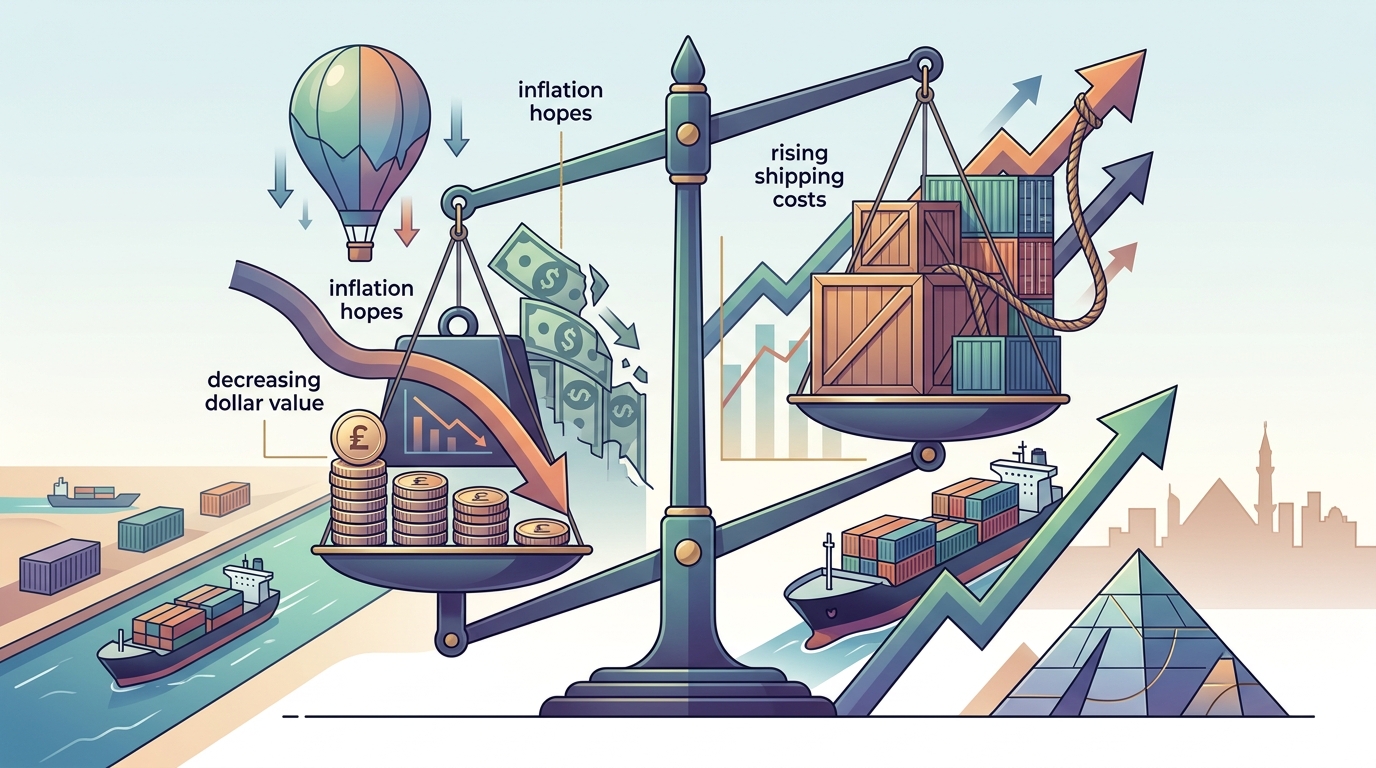
Despite the decline in the dollar exchange rate in Egypt over recent weeks, driven by an easing of geopolitical tensions in the region, this drop has not been reflected in commodity prices at the pace consumers expect—a factor that hinders chances of a notable decline in inflation in the coming period.
Representatives of business organizations in Egypt who spoke with Al Arabiya Business attributed the difficulty for Egyptian companies to reduce prices to pre-US-Iranian war levels—despite the green currency falling below 49 pounds at the close of Sunday's trading—to the continued rise in shipping and insurance costs for imported goods, which limits companies' ability to lower prices.
Macroeconomic analysts also agreed that the dollar's decline alone is insufficient to reduce prices, given the continued high shipping and insurance costs on imports, in addition to companies relying on stock imported when import costs and the exchange rate were at elevated levels.
Rising shipping and insurance costs
Ali Eissa, head of the Egyptian Businessmen's Association, said that the high shipping and insurance costs for goods and imported production inputs over the past period continue to pressure commodity prices and limit the markets' benefit from the dollar's decline.
Eissa added to Al Arabiya Business that the Iranian war and the accompanying sharp increase in shipping and insurance fees raised the cost of Egyptian imports, as the dollar's drop should have had a greater impact on product prices, but the continued high logistical costs absorbed a large part of this effect.
"Any increase in the cost of logistical services—whether maritime shipping or domestic transport—directly reflects on commodity prices, as it is a major component of the cost structure," according to Eissa.
Maritime shipping costs have seen significant increases since the start of the Iranian war at the end of last February, with container shipping prices from East Asia rising by about 200%, while shipping costs from European countries increased by 60%, according to estimates from the General Division of Importers at the Federation of Egyptian Chambers of Commerce.
Old shipments delay price cuts
Montaser Zaitoun, a member of the Automobile Division at the Cairo Chamber of Commerce, agreed, saying that the decline in the dollar and the drop in shipping and insurance costs will reflect positively on inflation rates and commodity prices gradually, not immediately as consumers expected.
Zaitoun explained to Al Arabiya Business that importers are still dealing with shipments imported during the past period, when shipping and insurance costs and the dollar exchange rate were at high levels, so they are currently relying on calculating an average cost between old and new shipments to reduce losses and avoid selling below import cost.
He added that insurance costs have not yet returned to normal levels despite the easing of geopolitical tensions, noting that price declines will remain linked to a decline in all elements of import costs, foremost among them shipping, insurance, and the exchange rate.
He expected markets to gradually absorb these changes, with their impact appearing more clearly during the third quarter of this year.
For his part, Mohamed Anis, a member of the Egyptian Society for Economics and Legislation, said that the impact of high shipping and insurance costs on Egypt differs from some other countries, especially since a large part of its imports come from China via the Red Sea and the Bab el-Mandeb Strait.
Anis added to Al Arabiya Business that the Iranian war did not disrupt navigation on this route, and thus there was no significant average increase in shipping or insurance costs, nor did supply chains experience disruptive disruptions.
He explained that imports from Europe arrive via the Mediterranean to Egyptian ports, which were also unaffected by the recent war developments, noting that "the overall picture does not indicate a significant increase in shipping or insurance costs, nor widespread supply disruptions during the past period, although some shipments experienced limited delays at the start of the tensions."
How does shipping cost affect inflation?
Eissa expected Egypt's inflation rate to stabilize in the upcoming reading, explaining that the dollar's decline was offset by higher shipping and insurance costs, creating a balance that limited price declines.
Eissa pointed out that a tangible decline in prices requires a continued fall in the dollar exchange rate and a decrease in insurance fees associated with war risks.
The head of the Egyptian Businessmen's Association explained that the goods currently being traded still bear the high shipping and insurance costs contracted previously, while the positive impact of lower these costs will appear with the arrival of new shipments to markets.
Eissa sees fuel prices as one of the most important factors affecting inflation, stressing that any reduction in fuel prices, especially those related to transporting goods, will have a direct and noticeable impact on calming inflation rates.
In contrast, capital market expert Haitham Fahmy downplayed the impact of high shipping and insurance costs on inflation rates in the coming months, expecting these costs to gradually decline as geopolitical tensions in the region end.
He pointed out that inflation data did not reflect a significant impact from this increase, as the annual urban inflation rate fell to 14.6% in May, compared to 14.9% in April, indicating the limited impact of shipping disruptions on prices.
Fahmy ruled out that markets would experience a new inflationary wave due to high shipping costs, especially with improved supply chain conditions and stability in global trade.
Anis said the Iranian war raised inflation rates in Egypt by about 3%, before they began to slow again in April and May.
He expected inflation to continue its downward trajectory in the coming months, if geopolitical conditions remain stable and no new disruptions occur in global trade, predicting the inflation rate to approach 11% during the fourth quarter of 2026.
Ad material
Ad material
Original source: Al Arabiya




Comments (0)
Be the first to comment.