US Official: Lebanon and Israel Move to Implementation Phase of Framework Agreement

A US official said Thursday that Lebanon and Israel have moved to implement a framework agreement for a permanent settlement, involving pilot zones for Israeli withdrawal and Lebanese army deployment, while tensions persist over Hezbollah disarmament and the scheduling of talks in Rome.
A US official said Thursday that Lebanon and Israel have moved to the 'implementation phase of the framework agreement,' referring to the tripartite agreement sponsored by the United States that lays out a roadmap toward reaching a permanent settlement between the two countries.
Commenting on the upcoming talks between the two countries in Rome, the official added that the meeting is a closed session allowing the two governments to refer the file to technical teams, which will work on all issues stipulated in the framework agreement.
He explained that work in the first pilot zone will begin within days, while additional pilot zones are currently being identified and necessary plans are being drawn up, noting that the US Central Command (CENTCOM) is coordinating with Lebanon and Israel to move the implementation forward.
The official continued: 'We will soon begin communicating with international partners to help the Lebanese government effectively restore its sovereignty in these areas, and across the country.'
On June 26, Lebanon, Israel, and the United States signed a tripartite framework agreement, which includes the start of a limited Israeli withdrawal from two areas in southern Lebanon, in exchange for the deployment of the Lebanese army in them, under US supervision of the implementation of security arrangements.
'Pilot Zones'
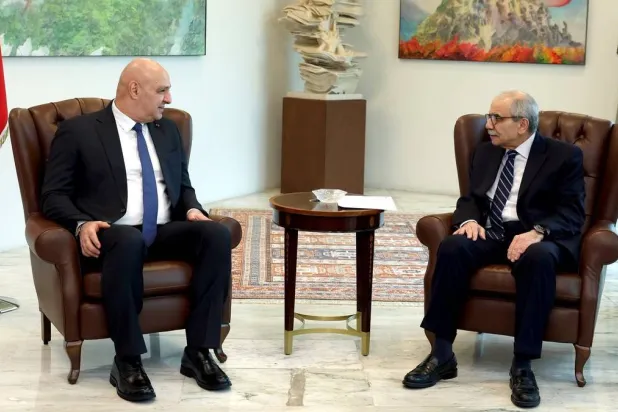
Earlier Thursday, US Ambassador to Lebanon Michel Issa said that preparations are underway to implement what was agreed upon regarding the 'pilot zones,' during his meeting with Lebanese President Joseph Aoun in Beirut.
The Lebanese presidency said that Aoun stressed during the meeting the need to consolidate the ceasefire in the south and pressure Israel to halt military operations and abide by the framework formula announced at the end of the Lebanese-American-Israeli negotiations in Washington.
He emphasized the need to stop the shelling, demolition, and bulldozing carried out by Israeli forces in a number of towns and villages they occupy.
The US ambassador indicated that a US military delegation will arrive in Beirut within days to coordinate and determine the implementation mechanism on the ground, stressing that 'it is necessary to avoid any vacuum when Israeli forces withdraw from the specified area, and based on the results of coordination meetings, the date for the start of implementation on the ground will be set.'
The tripartite framework agreement stipulates the implementation of two pilot zones involving an Israeli withdrawal and deployment of the Lebanese army, along with the disarmament of non-state armed groups, to represent the first phase in a path leading to a full Israeli withdrawal from all Lebanese territory, according to security arrangements and a phased implementation mechanism.
Military sources told Al-Sharq on Thursday that the arrival date of the head of the Military Coordination Commission, US General Joseph Clervild, tasked with coordinating and determining the mechanism for Israel's withdrawal from the 'pilot zones,' has not yet been set.
In contrast, Israeli Defense Minister Israel Katz said Thursday that the Israeli army will continue to remain in what he described as the 'security zone' in southern Lebanon 'until Hezbollah is disarmed.'
Katz added: 'We did not ask anyone for permission to enter Lebanon, and we do not need permission to stay there,' according to what was reported by Haaretz.
Rome Meetings
Regarding the path of negotiations between Lebanon and Israel, sources told Al-Sharq on Wednesday that the meeting scheduled for July 14 and 15 in the Italian capital Rome is still not confirmed.
The sources said that the reason for not finalizing the date of the sixth round of talks is that Lebanon stipulates the start of implementing the pilot zones before holding meetings with the Israeli side.
The US ambassador in Beirut explained that the transfer of meetings from Washington to the Italian capital is due only to 'technical reasons' related to facilitating the movement of ambassadors and members of delegations.
He added that the Rome meeting has an 'organizational and executive nature regarding what was stated in the framework formula, especially concerning the formation of specialized working groups to implement the arrangements agreed upon in Washington that may need legal or technical specialists depending on the topics under discussion.'
Issa affirmed that what will happen in Rome is 'a continuation of what was agreed upon in Washington,' pointing to several meetings to be held in the Italian capital or elsewhere to follow up on implementation according to the phases to be agreed upon.
Lebanon entered an unprecedented official negotiating path with Israel through rounds of talks in Washington, culminating in the signing of a tripartite framework agreement under US sponsorship that stipulated security arrangements aimed at consolidating the ceasefire and extending the Lebanese army's control, with negotiations to be completed to reach a final agreement.
Since Israel began attacking Lebanon in early March last year, following rocket attacks by Hezbollah in response to the assassination of Iranian Supreme Leader Ali Khamenei, the government of Benjamin Netanyahu announced that it wants to extend its control over southern Lebanon up to the Litani River, which flows into the Mediterranean Sea about 30 kilometers from the Israeli border.
Original source: Asharq News



Comments (0)
Be the first to comment.