World Gold Council to Arqaam: Jewelry demand falls 23%
World Gold Council to Arqaam: Jewelry demand falls 23% in Q1 2026
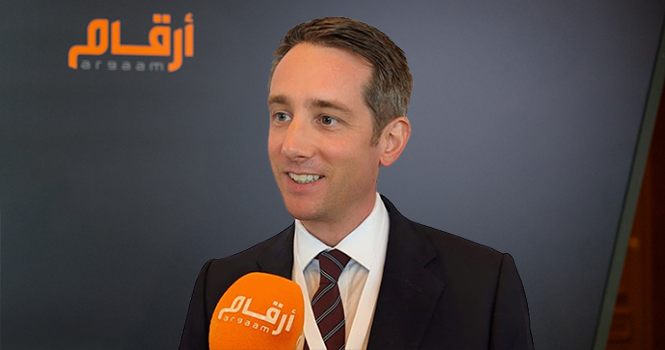
Andrew Naylor, Head of Middle East and Public Policy at the World Gold Council
Andrew Naylor, Head of Middle East and Public Policy at the World Gold Council, said that the impact of high gold prices on jewelry sales volumes was clear, with global jewelry demand falling 23% to 300 tons in the first quarter of 2026.
Naylor added, in an interview with Arqaam, that the decline included several major markets, with demand down 32% in China, 19% in India, and 23% in the Middle East, indicating that these figures reflect the sensitivity of consumption to the sharp rise in gold prices.
He noted that the value of spending on jewelry nevertheless rose to a record $47 billion in the first quarter, the highest ever, explaining that this means consumers have not abandoned gold, but have become more selective in purchasing.
He pointed out that part of the demand in markets such as China and India has shifted towards bars and coins, as gold plays a dual role as both adornment and an investment tool.
Regarding price movements, Naylor said that the recent decline in gold prices after reaching a historic record of $5,405 per ounce in January 2026 is closer to a natural correction after a strong rally, and not an indication of a structural reversal in market direction.
He added that the previous rises were driven by large investment inflows, escalating geopolitical tensions, persistent inflationary pressures, and strong demand from central banks, indicating that these factors remain strongly in place.
He noted that high levels of volatility were expected amid global uncertainty, explaining that the recent price movement appears to be a limited correction within a market supported by strong factors, not the start of a new downtrend.
Regarding central bank demand for gold, Naylor said that the annual survey of central bank gold reserves conducted by the World Gold Council indicates continued strong momentum in official demand for gold, with 89% of reserve managers reporting that they expect global central bank gold holdings to increase over the next twelve months.
He added that 45% of reserve managers, the highest level recorded, reported that their institutions plan to increase their gold holdings over the next year, while 84% of participants believe that gold will account for a larger share of total reserves in five years, compared to 76% last year.
He explained that gold has recently surpassed U.S. government bonds to become the most important reserve asset for many central banks, a shift reflecting growing confidence in its role as a long-term asset.
He stated that these indicators reflect continued strong demand from central banks during the second half of the year.
Naylor stressed that the World Gold Council does not provide guidance or forecasts regarding future demand or price trends for the remainder of the year.
He noted that first-quarter data confirms that the cultural and financial importance of gold remains entrenched, and that high prices typically affect sales volumes, not gold's standing among consumers.
According to the World Gold Council's Mid-Year 2026 Gold Outlook report, gold enters a pivotal phase in the second half of the year amid continued uncertainty related to geopolitical developments, global interest rate paths, and investor sentiment.
The report indicated that rising geopolitical risks, particularly tensions between the United States and Iran, were the most influential factor in gold's performance during the first half of the year, along with investor trends and profit-taking, while the opportunity cost was affected by markets reassessing interest rate expectations and the U.S. dollar.
It added that the majority of gold price movements occurred during Asian and American trading sessions, reflecting the growing role of Asian investors in setting global prices for the precious metal.
The report suggested that, if current conditions persist, gold will trade within a range of 5% up or down around $4,100 per ounce until the end of the year, noting that gold regaining its upward trajectory could be linked to deteriorating geopolitical or economic conditions, or changes in interest rate expectations.
It stated that gold surpassing $4,500 per ounce would likely require strong indications of a global economic slowdown, while a stronger dollar, higher-than-expected rate hikes, and improved risk appetite represent the main potential pressures on gold prices.
To Arqaam
Various Interviews
{{displayname}}
{{profession}}
{{followercount}}
{{aboutme}}
Original source: Argaam


Comments (0)
Be the first to comment.