Zellij: Decorative Element Carried by Moroccans and Algerians to World Stadiums
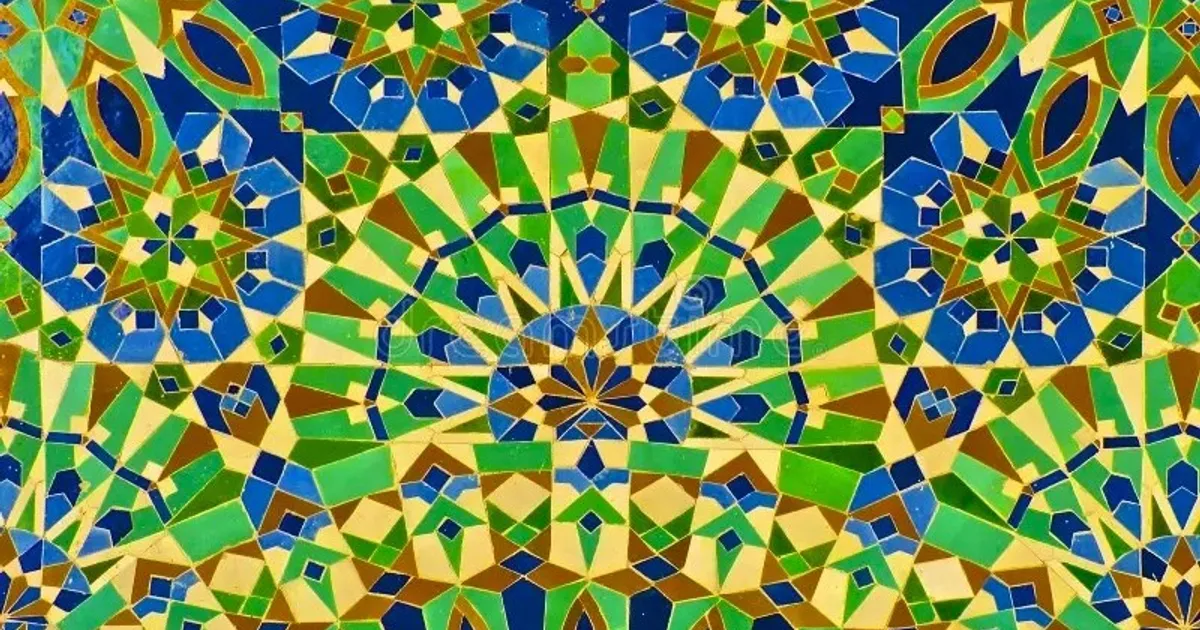
تجدد الخلاف بين المغرب والجزائر حول فن الزليج التقليدي مع مباراة المغرب وفرنسا في ربع نهائي كأس العالم، وسط مساعٍ مغربية لإدراجه ضمن التراث الثقافي غير المادي لليونسكو.
Zellij, a traditional mosaic, has become a point of contention between Morocco and Algeria once again, coinciding with the start of the Moroccan national team's quarter-final match against France on Thursday, and following a request by the Moroccan Ministry of Youth and Culture to UNESCO to include it on the list of intangible cultural heritage.
Zellij is part of the cultural identity of Moroccans, one of the most distinctive and enduring traditional crafts, deeply rooted in the country's architectural and artistic heritage, and officially recognized as intellectual property. The artisans who create it preserve this heritage by passing their expertise from generation to generation.
Zellij and the Moroccan National Team
Today's quarter-final match between the Moroccan national team and France has brought zellij back into the spotlight, reviving the controversy that erupted in 2022 when the Algerian Football Federation and the German sportswear company Adidas unveiled the Algerian national team jersey inspired by Moroccan zellij tiles.
This sparked reactions from the Moroccan government, which demanded the withdrawal of the jersey and threatened Adidas with legal action, forcing the company to backtrack and acknowledge that the design was inspired by the traditional Moroccan craft of zellij, affirming its respect for the Moroccan people and their artisans.
The French newspaper Le Figaro published a report on Wednesday discussing Morocco's efforts to "restore the place of zellij in the art of mosaic decoration, which goes back centuries, and its ancient craft community. In contrast, Algeria is taking the same path."
Zellij in a traditional hammam in Morocco - Al-Sharq
The newspaper explained that "the official shirts of the Moroccan national team players in the World Cup matches, which will take place on Thursday, July 8, are decorated on the collar and sleeves with lines inspired by Moroccan motifs and embroidery."
Renewed Dispute
In 2025, the unveiling of the Algerian national team jersey for the 2026 World Cup, held in Canada, Mexico, and the United States, renewed the dispute between Moroccans and Algerians, as the design features a central vertical line with a pattern similar to that of Moroccan zellij tiles.
As part of this campaign, a delegation from the Moroccan Ministry of Youth, Culture, and Communication met with the acting Director-General for Culture at UNESCO, Lazare Assomo, and the Secretary of the 2003 Convention, Fumiko Ohinata.
The ministry organized this meeting in coordination with the Secretariat General of Crafts and the Social and Solidarity Economy, under the supervision of Morocco's permanent delegation to UNESCO.
According to a statement from the ministry, the meeting focused on the official request submitted by Morocco during the current session "to include the art of zellij on the list of intangible cultural heritage, in order to defend zellij as an authentic Moroccan national heritage."
The participants also sought to "enhance the promotion of this heritage based on documented historical facts and the enduring nature of this inherited craft, which remains alive and passed down through generations."
Fez and Tetouan
Zellij is a decorative element consisting of geometric mosaics made from small pieces of tiles, widely used to adorn mosques, schools, palaces, fountains, and historic buildings, particularly in cities such as Fez and Tetouan. According to experts, it goes beyond mere decoration; it is a sophisticated visual language passed down through generations of artisans.
At the same time, Algeria is seeking to present it as part of its cultural heritage, prompting the Moroccan government to take steps to secure international recognition.
It is worth noting that the dispute between Algeria and Morocco over the caftan was resolved in Morocco's favor last December, when UNESCO recognized the Moroccan caftan on its list of intangible cultural heritage, following a positive vote at a meeting of its intergovernmental committee in New Delhi, India.
Morocco is currently seeking to include the art of zellij on UNESCO's list of intangible cultural heritage.
Original source: Asharq News





Comments (0)
Be the first to comment.