4 Animated Films from France's Annecy Festival
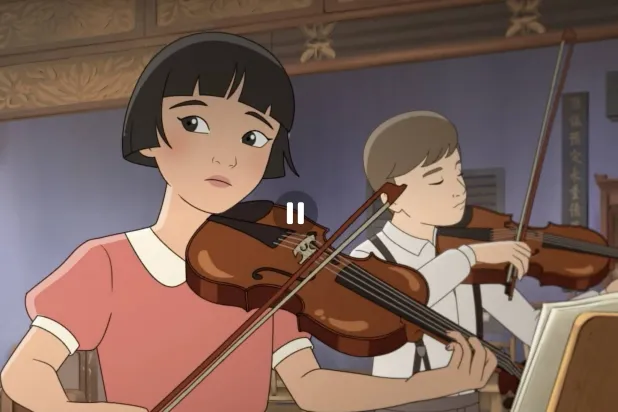
THE VIOLINIST
• Director: Raul Garcia and Erwin Han
(Good)
• Spain, Singapore (2026) | Best Animated Feature Film Award at the Annecy Festival
Unlike the animated films shown in cinemas, which almost all fall between acceptable and mediocre, the films of the Annecy Festival, dedicated to animation cinema, are abundant with works that feature a striking interaction between drawing and recording, and between drawing and drama. They are not entertainment films; therefore they are free from the urge to amuse.
"The Violinist" is one of the best of these films. It is a drama about a woman named Fay and a boy named Kai, and follows their intertwined history with the period of Japanese invasion of Singapore. Music and occupation are the two faces of this story: the former represents hope and the accompanying sorrow, the latter reveals the impact of the invasion on society in general and on Fay's life in particular.
But the film is not at the same level throughout its duration. On one hand, it offers a good visual treatment of the historical period, and on the other, its level drops when it tries to expand on secondary characters, treating them with less care and precision.
A NEW DAWN
• Director: Yoshitoshi Shinomiya
• Japan (2026)
Drama about a young man facing progress
(Average) This film had its world premiere at the recent Berlin Film Festival. It is a drama interspersed with many musical segments, as well as events centered around its protagonist Kitaro, who is surprised by a government decision to demolish a fireworks factory that his family has inherited generation after generation. The purpose is to build a road connecting this small town to other cities. Kitaro decides to resist the decision.
Soon director Yoshitoshi Shinomiya, in his first feature-length film, raises the relationship between the young man's attachment to his historical heritage and the idea of moving into the future. The viewer must be a fan of Japanese singing to engage with this aspect of the film; for singing constitutes a major element that, along with the desire to provide aesthetic atmospheres, almost turns the story itself into a secondary element.
"A New Dawn" (Annecy Festival file)
THE OBSESSED
• Director: Wataru Takahashi
• Japan (2026)
Fantasy that delivers less than it aspires to
(Average)
Some of the problems that marred "A New Dawn" (above) recur in this film, although it has a more interesting story. "The Obsessed" revolves around a Japanese young man named Giuseppe, obsessed with diverse habits and interests: he is a private detective when he wants, a butterfly collector when he wishes, and a singer at all times. Had the director balanced these well and drawn a clear dramatic thread linking these interests and justifying them psychologically or dramatically, the film would have reached a level higher than merely creating mystery around its protagonist.
And as in "A New Dawn", the desire to highlight visual aesthetics and execute ideas overshadows the story, which becomes a secondary element compared to building atmospheres. As for the drawing, it fails, in itself, to present a complete artistic achievement.
"58th" (Annecy Festival file)
58th
• Director: Karl Joseph E. Papa
• Philippines (2026)
Political history returns as drawing
(Good)
On November 22, due to a dispute between politicians in Maguindanao province in the Philippines, a horrific massacre occurred, claiming 58 victims, most of them journalists covering local elections. The film returns to that incident to focus on the daughter of one of the victims, as she recalls her father's memory, and through it, those events.
She is Renavi Mumay, daughter of photojournalist Reynaldo Mumay, the only one among the 58 victims whose body is still missing. The film uses Renavi, along with the character of a director who appears within the events, as a gateway to return to the past. It does not delve into details or analyze the circumstances of the incident, but does not deviate from its goal of evoking it and shedding light on it.
This film has been given great care in terms of drawing characters and the surrounding environment. The director used live-action filming, then transformed the footage into animation, similar to American director Richard Linklater's films "Waking Life" (2001) and "A Scanner Darkly" (2006).
This style gives the work a connection to reality, but it remains artistically unjustified and does not fully belong to the art of animation. Moreover, the film is executed with extreme realism, and its story is suitable for a live-action feature film. Nevertheless, the director's choice to present it in an animation format is a bold step, matching in boldness the importance of the subject it addresses.
Original source: Asharq Al-Awsat





Comments (0)
Be the first to comment.