Watch | Jeddah Summer Starts from 'Al-Balad'... Museums and Old Markets Offer Diverse Experiences
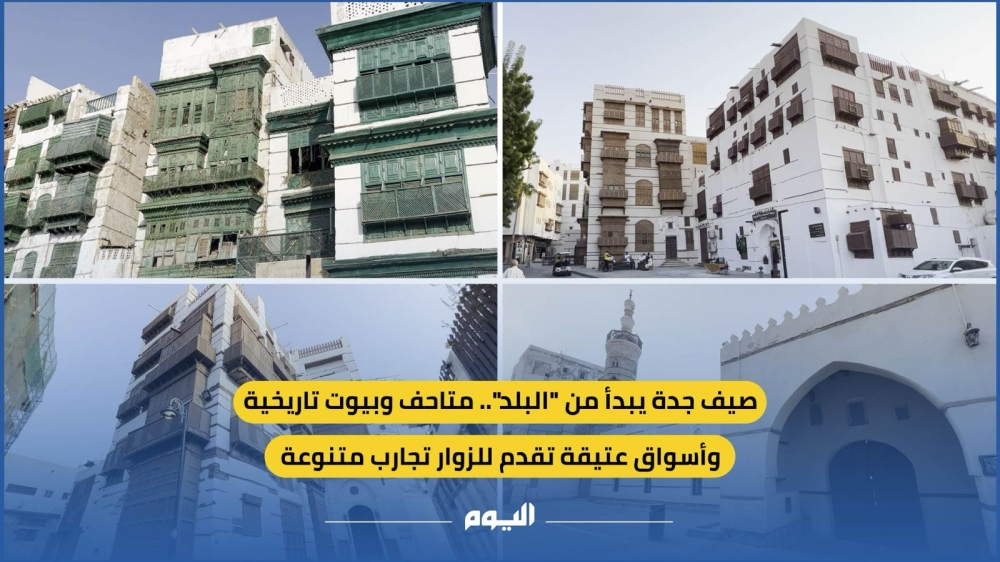
During a tour by "Al-Youm" in historic Jeddah, the lens captured how it transforms during the summer vacation into one of the most prominent cultural and tourist destinations in the Kingdom. It combines heritage architecture, museums, historic houses, historic mosques, and traditional markets, offering visitors a comprehensive experience that evokes the history of a city that, for centuries, served as a gateway for pilgrims and traders arriving via the Red Sea.
Related News
Historic Jeddah, listed as a UNESCO World Heritage site, is one of the most prominent heritage sites in the Kingdom. It spans an area of 2.5 square kilometers and includes more than 650 historic buildings with unique architecture, along with five historic markets and over 36 historic mosques, making it an open museum reflecting the city's history and cultural development.
The visitor's experience typically begins with wandering through narrow alleys and old neighborhoods adorned with famous wooden lattice windows (rawashin). Here, one can see historic houses, many of which have been rehabilitated to become museums, cultural centers, art galleries, and heritage cafes, as part of the Historic Jeddah Program's efforts to revitalize the area and turn it into a global cultural and tourist destination.
Historic Houses in Jeddah
Among the key stops visited by tourists are Beit Nassif, one of the most famous historic houses in Jeddah, associated with important national milestones; Beit Ba'ishan and Beit al-Mutabbili, which reflect traditional Hijazi architecture; as well as Beit al-Sharif and a number of other houses that have been converted into galleries and cultural centers showcasing details of the city's social and economic life in the past.
The area also includes several museums that enrich the visitor's experience, foremost among them the Red Sea Museum, opened in the historic Bab al-Bunt area, which showcases the history of maritime navigation and trade across the Red Sea. Another is the Tariq Abdulhakim Museum, documenting the career of one of the most prominent pioneers of Saudi music, in addition to art galleries and cultural spaces spread throughout the area.
Historic mosques receive special attention from visitors. The Mosque of Othman bin Affan (may Allah be pleased with him) stands as a witness to the beginnings of Islamic history in Jeddah, with archaeological studies showing it is over 1,400 years old. Meanwhile, Al-Shafei Mosque is one of the most prominent Islamic landmarks in the area, with its minaret, built in the 7th century AH, being one of the oldest standing minarets in the city. Al-Mimar Mosque also stands out as a historic site linked to the ancient pilgrimage route.
Interactive Experience for Families and Children
A visit to historic Jeddah is incomplete without passing through its ancient markets, which have preserved their commercial character for hundreds of years. Foremost among them is Souk Al-Alawi, the largest market in the historic area, featuring diverse shops for traditional crafts, clothing, perfumes, and gifts. Souk Al-Nada retains its historical status linked to maritime trade, while Qabil Street is one of the most famous historic streets and was the first location in Jeddah to receive electricity. Also notable are Souk Bab Makkah markets, which still maintain their popular atmosphere and heritage products.
Historic Jeddah also offers an interactive experience for families and children through guided tours that narrate the history of buildings and markets, handicraft workshops, walking and photography trails, as well as cultural and artistic events that strengthen visitors' connection to the city's architectural and cultural heritage, offering an experience that combines entertainment and knowledge.
With the increasing demand for domestic tourism during the summer vacation, historic Jeddah continues to consolidate its position as one of the most prominent heritage destinations in the Kingdom. It gives visitors the opportunity to travel through the pages of history within an area of just a few kilometers, yet it holds more than fourteen centuries of civilization, embodying the cultural legacy of a city that has historically been the gateway to the Two Holy Mosques and a meeting point of civilizations and cultures.
Original source: Al-Yaum




Comments (0)
Be the first to comment.