Assilah Murals: Between Reinforcing City Identity and Countering Randomness
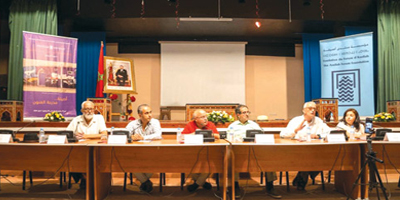
Participants in a symposium on Assilah's murals praised the experience as a leading public art project in the Arab world, emphasizing its role in shaping the city's visual identity and calling for preserving its quality and standards.
A view of participants at the symposium
Friday/Saturday July 10, 2026
Asilah - Al Jazeera:
Participants in the symposium 'Assilah Murals: Towards a Visual Identity for the City,' recently held as part of the summer session of the 47th edition of the Assilah International Cultural Season, under the high patronage of King Mohammed VI, said that the Assilah mural experience represents one of the most prominent public art experiments in the Arab world, due to its continuity and renewal over nearly half a century, while maintaining its founding spirit and openness to new generations and a diversity of artistic visions and styles.
The speakers affirmed that this experience succeeded in making art part of the city's daily life and establishing a distinctive visual identity for Asilah, thanks to its balance between fidelity to the founding philosophy and keeping pace with artistic transformations, which allowed it to maintain its radiance and remain a source of inspiration for cultural initiatives in Morocco and abroad.
The participants called for preserving this cultural and artistic heritage by adhering to the standards upon which the mural experience was founded, ensuring its quality and preventing it from turning into a random practice that loses its aesthetic and cultural value.
Deep-rooted Visual Identity
Hatim al-Batwi, Secretary General of the Asilah Forum Foundation, considered that talking about the city has become automatically associated with its murals, which have transformed, since the launch of the cultural season in 1978, from an artistic experiment in public space into one of the most prominent symbols that establish Asilah's identity and its cultural and civilizational project.
He explained that the murals are not limited to decorating walls, but constitute a cultural practice that reshapes the relationship between art and society by moving creativity from closed halls to the public space, making it accessible to all residents and visitors, and becoming part of the daily landscape and a shared visual language.
He added that the specificity of the Asilah experience lies in making the city itself a subject of creativity and a partner in it, where each mural contributed to enriching the place and adding a new page to a visual memory accumulated over decades, until the city's walls became an open record for dialogue between generations, artistic schools, and different cultures.
Al-Batwi pointed out that this accumulation created a distinctive visual character for Asilah and cemented its image as a city of arts, within a cultural project that succeeded in making creativity part of daily life and culture a lever for urban development.
Education in Beauty and Citizenship
Al-Batwi affirmed that the experience was not limited to instilling aesthetic taste, but also contributed to building a civic awareness based on respect and preservation of public space, as turning walls into artworks enhanced the sense of collective responsibility towards the city and instilled in children and youth a culture of respecting the environment and shared space.
He added that the Asilah murals simultaneously represent a cultural, developmental, and environmental project that contributed to enhancing the city's attractiveness and its cultural and touristic radiance, providing a model that confirms the ability of investment in culture to improve quality of life and promote sustainable development.
Unique Experience
For his part, visual artist Abdelkarim al-Wazzani reviewed his relationship with the Asilah season and the mural experience since the mid-1980s, considering that the city presented a model different from mural experiences worldwide, both in its philosophy and its connection to artistic and aesthetic education.
He noted that the murals in Asilah have become a 'catalogue' of Moroccan visual art, allowing visitors to learn about various national artistic experiments and schools.
Artist Bouzid Bouabid, meanwhile, affirmed that Asilah was instrumental in his artistic career, considering that the artist does not come to give beauty to the city but to draw inspiration from its beauty and enrich himself from its experience, recalling in this context the pioneering role of the late Mohamed Benaissa and Mohamed Melhi in founding and sustaining this cultural project.
Accumulation That Forged Taste
Syrian artist Khalid al-Saai, in turn, spoke about his long relationship with Asilah, noting that over time the experience accumulated visual awareness and plastic taste among the city's residents, and contributed to forming a special relationship between the public and art.
He affirmed that what distinguishes the Asilah murals is their respect for each artist's individuality while maintaining the general framework that characterizes the experience.
Artist Mohamed al-Mourabiti saw Asilah as a school in its own right, considering that the city's cleanliness and the beauty of its urban space were among the elements that prepared the success of the mural project, which in turn contributed to developing artistic taste among residents and visitors.
Integrated Cultural Project
For her part, aesthetics researcher Chorouk al-Melhi considered that the Asilah murals transcend being a plastic art experience to form an integrated cultural and human project that succeeded in building a collective memory and visual identity for the city, making art part of the daily life of its residents.
Al-Melhi recalled her personal experience with the season since childhood, affirming that the children of Asilah received, through direct contact with artists, a deep aesthetic and cultural formation through which they learned to respect difference and openness to diverse artistic experiences.
She added that the murals were not mere decorative works but documented human and national issues, including the Palestinian cause, the environment, migration, and the dialogue of cultures, transforming into a living visual archive that reflects the transformations of the city and the world.
In conclusion, al-Melhi stressed that preserving this heritage is not limited to the continued creation of murals, but also requires safeguarding the founding idea of the experience, respecting the standards for selecting artists, and coordinating works with the city's architectural space, to ensure Asilah remains a model of refined art, far from randomness, and to preserve the trust left by the founders and artists who contributed to building this pioneering cultural project.
Read also
Original source: Al-Jazirah



Comments (0)
Be the first to comment.