“Between Fog and Path”… How Arab Memory Transformed into Paintings?
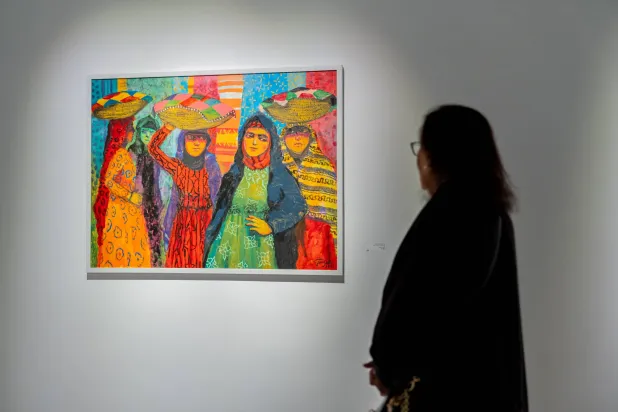
It is not easy for a Yemeni artist, a Saudi artist, and a Kuwaiti artist to come together in one exhibition, and then the visitor discovers that what unites them is not the artistic school or the plastic style, but memory itself. A memory that each one carried from his homeland, keeping it for many years, before redrawing it on the walls of the exhibition “Between Fog and Path” in Jeddah.
Decades ago, Hakim Al-Aqel, Abdul Sattar Al-Mousa, and Thuraya Al-Baqsami sat in the halls of the Surikov Academy of Fine Arts in Moscow, learning the rules of drawing, the construction of light, the anatomy of the body, and the philosophy of color. But the distant Russian city did not make them identical copies; rather, it returned each one to his country carrying a different visual language, yet the question of identity and memory remained the thread that never broke between them.
Painting “The Man’s Wash” by artist Abdul Sattar Al-Mousa (Hafez Gallery)
For the Yemeni artist Hakim Al-Aqel, the painting does not begin from the mountain, nor from the woman, nor even from the fog that recurs in his works, but from memory. He told Asharq Al-Awsat: “Memory is not a reservoir of the past, but the solid nucleus that shapes the future,” asserting that art does not only perform the function of documentation, but rather turns into the “alternative guardian” of identity when places change and the features of societies transform. Thus, he does not see in women and mountains mere plastic elements but rather pillars of Yemeni existence; for him, woman represents continuity and fertility, the mountain symbolizes pride and steadfastness, while fog turns into a space between reality and imagination, hiding the past as much as it reveals it.
Painting “Mountain Nymphs” by artist Abdul Hakim Al-Aqel (Hafez Gallery)
Al-Aqel recalls his years of study in Moscow as a moment of artistic formation, but he confirms that he returned to Yemen to search for a different light. He summarizes that journey by saying, “In Moscow I learned how to see light, and in Yemen I learned how to breathe color.”
He adds that the Russian school gave him discipline in building the painting, but he did not carry it as is; rather, he made it a framework that embraces the Yemeni spirit, until the mountains, faces, and villages in his works became closer to myth than to realistic scenery.
When asked about Yemen after many years of transformations, he does not speak about destruction, but about survival, saying that if he were to redraw his country’s memory today, he would draw it as “an eternal survivor wearing its mountains as a cloak, waiting for the morning.”
At the other end of the exhibition, Thuraya Al-Baqsami appears as if she is completing the same sentence, but from a different angle. The woman that Al-Aqel paints as an extension of the land, Thuraya Al-Baqsami sees as a pivot for social change, not just a symbol of beauty.
Painting “The Good Earth” by artist Thuraya Al-Baqsami (Hafez Gallery)
She told Asharq Al-Awsat that women in Arab art have moved beyond their traditional role within the painting, no longer just a presence that decorates the scene, but have come to represent ambition, the ability to change, and the making of the future.
She believes that this transformation came as a result of the development of the Gulf art movement and the openness of artists to global experiences, including her personal experience in the Soviet Union, where the human being was the focus of academic study at a time when many Gulf experiences still tended to paint landscapes and folkloric elements.
She affirms that these transformations were directly reflected in her works, which dealt with women’s issues and rights, before reaching their peak with her famous painting “No to Occupation,” which she painted a few days after the Iraqi invasion of Kuwait.
She recalls that moment as one of the most impactful stations in her life, explaining that the painting was designed to be secretly distributed to members of the resistance, before later becoming a work acquired by museums and art collections, and it remained for her the truest expression of the Kuwaiti people’s rejection of the occupation.
Although she combines painting and writing, she sees that each has its own language, and she says that the painting is not born with the same alphabet as the word; what unites them is imagination, while the tools of expression remain completely different. Perhaps what strikes Thuraya Al-Baqsami most in the Jeddah exhibition is that the selection of works was done independently, yet the woman appeared as the common denominator among the three artists, despite the difference in their homelands and experiences.
Here, the title of the exhibition, “Between Fog and Path,” acquires another meaning. The fog surrounds not only the mountains in Hakim Al-Aqel’s paintings, but also surrounds Arab memory itself; that memory that each artist tries to rescue in his own way. Al-Aqel searches for the memory of place, Thuraya clings to the memory of the human, while Abdul Sattar Al-Mousa documents the memory of society through its faces and daily life, so the three experiences meet at one question: How can art preserve what time cannot keep? Perhaps that is why the exhibition does not appear as just a gathering of three artists who studied in Moscow, but as a dialogue between three Arab homelands that chose to tell their stories with colors instead of words, and to make the painting a place where memory resides, even when everything outside its frame changes.
Original source: Asharq Al-Awsat

Comments (0)
Be the first to comment.