Bonnie Tyler... The raspy voice that changed the power ballad
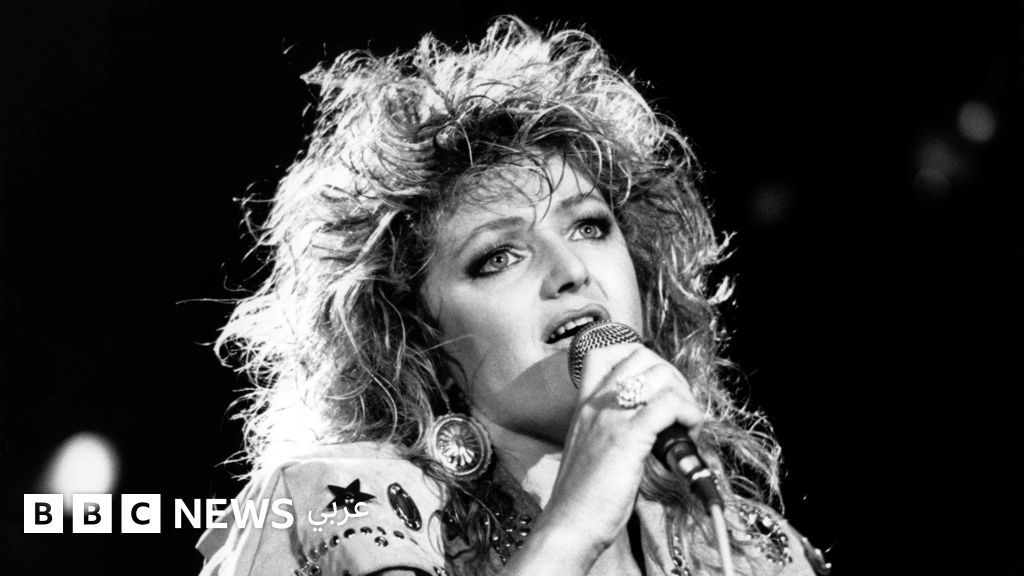
From the daughter of a Welsh miner to the owner of one of the most famous songs of the 1980s, Bonnie Tyler built her fame with a raspy voice and dramatic performance that transformed emotional heartbreak into timeless songs. This is the story of her career, the rise of 'Total Eclipse of the Heart', and her presence that extended from European stages to the memory of Arab audiences.
Bonnie Tyler... The raspy voice that changed the power ballad
Image caption, Bonnie Tyler, whose real name was Gaynor Hopkins, died at age 75.
Published 4 hours ago
Reading time: 5 minutes
It was enough for Bonnie Tyler to utter the first words of a song for the recognition of the voice's owner to be almost certain.
That raspy voice, saturated with unusual roughness and a feeling that every word is extracted from a painful personal experience, carried the Welsh singer from small clubs in South Wales to the top of the charts in Britain and the United States, and made her songs part of the global memory of pop and rock music.
Tyler, whose real name was Gaynor Hopkins, died at age 75 in a hospital in the Portuguese city of Faro on July 8, 2026, after complications following emergency intestinal surgery.
She had been receiving treatment in Portugal, where she spent long periods of her life, and was placed in a medically induced coma before her condition briefly improved, according to statements from her family and team.
Lisa Marie, Elvis Presley's only daughter, dies at 54
Congolese singer Papa Wemba dies during a concert
With her passing, 1980s music loses one of its most distinctive voices, an artist who built a lasting presence with a limited number of songs that stood the test of time and found their way to new generations through films, advertisements, talent shows, and streaming platforms.
Difficult beginnings
Image caption, Bonnie Tyler in the 1970s
Gaynor Hopkins was born on June 8, 1951 in the village of Skewen, near Neath in South Wales, and grew up in a family with six children. Her father worked in coal mines, and the family lived far from the world of fame she would later enter.
She sang in front of an audience for the first time in a church, then left school at sixteen and worked in a shop. After participating in a local talent competition, she began seriously considering a professional singing career.
She placed second, and saw the result as the start of her career. She worked as a backing vocalist, then formed a band called Imagination, and spent years singing in pubs and nightclubs in South Wales.
Skip most read and continue reading
Trump agrees to continue talks with Iran, Tehran threatens to strike Israel in response to any attack on infrastructure
The volcanic eruption that produced the loudest sound in recorded history
The Iran-US ceasefire collapsed even before Trump announced its end... Why?
Syrian authorities announce dismantling of Islamic State cells and arrest of a prominent leader in the south
During one of her performances, her voice caught the attention of a talent scout, and she signed a contract with RCA in the mid-1970s. She was asked to choose a stage name, and settled on Bonnie Tyler, which soon overshadowed her original name.
Her first success came in 1976 with the song 'Lost in France', then the following year she achieved her broader breakthrough with 'It's a Heartache'.
The song spread widely in Europe and the United States, and became one of the highlights of her career.
As for her famous raspy voice, it came after surgery to remove nodules from her vocal cords. Tyler said she did not adhere to the period of silence recommended by doctors, so the operation left a permanent effect on her voice.
At first she feared her career was over, but then that roughness became the most prominent feature of her voice and artistic identity.
The song that made her famous
Image caption, Bonnie Tyler in the music video for 'Holding Out for a Hero' in 1984, which became one of the standout songs of her career.
Skip podcast and continue reading
Worthy of attention
In-depth explanation of key events and topics, to help you understand the most important changes around you and their impact on your life
Episodes
End of podcast
At the start of the 1980s, Tyler was seeking to transcend her image as a pop singer influenced by country music and move into broader, more dramatic works. This direction led her to American songwriter and producer Jim Steinman, known for his theatrical works with singer Meat Loaf.
Their collaboration resulted in the song 'Total Eclipse of the Heart', released in 1983 as part of the album 'Faster Than the Speed of Night'.
The song topped the sales charts in Britain, remained at number one for four weeks in the United States, and also reached number one in several other countries. Its global sales exceeded six million copies, and Tyler was nominated for a Grammy Award for Best Female Pop Vocal Performance.
The album made history as the first album by a British female artist to top the UK album chart, and Tyler also received a Grammy nomination for Best Female Rock Vocal Performance.
The music video for the song helped cement its fame, coinciding with the early rise of MTV.
A year later, she released the song 'Holding Out for a Hero', which was used in the film 'Footloose'.
Thus, Tyler became one of the leading voices of the power ballad, a type of emotional song that combines romantic melody with loud, rock-influenced production.
Why did her songs reach Arab listeners?
Image caption, Welsh singer Bonnie Tyler in a photo from 1992.
Bonnie Tyler did not build her presence in the Arab world through regular tours or collaborations with Arab musicians, and there are no unified records available to measure historical sales of her work in Arab countries.
But her songs found their way to Arab audiences through the media that shaped the region's relationship with Western music since the 1980s and 1990s: English and French-language radio stations, cassette tapes, satellite music channels, foreign films, and later talent shows and video and streaming platforms.
The nature of her music helped it cross cultures, even among listeners who do not fully understand the lyrics.
Her works are based on clear and direct emotions, such as a broken heart, an absent lover, waiting for salvation, and searching for a hero. These themes are also strongly present in Arabic emotional songs.
Her dramatic performance, in giving voice and emotion wide space, also approaches some traditions of Arab tarab, though the musical style differs. She performed her songs as if an entire destiny depended on the final sentence.
Thus, the presence of 'Total Eclipse of the Heart' has surpassed its release time in 1983. The song remained present in karaoke parties, internet clips, singing shows, advertisements, and films, and reached an Arab audience that sometimes encountered it many years after its release.
The phrase 'Turn Around', which is repeated in the song, helped cement it in memory even among those who did not memorize the rest of the lyrics.
With the spread of the internet, the song resurfaced whenever a solar eclipse occurred, in a repeated play between its title and the astronomical phenomenon. It surpassed one billion streams on Spotify before Tyler's death, an indication of its transition from the memory of the 1980s generation to a younger digital audience.
Success not repeated on the same scale
Image caption, Bonnie Tyler maintained her public presence and continued singing until her final years.
Original source: BBC Arabic




Comments (0)
Be the first to comment.