Critic's Screen: Three Anti-War Films on Three Fronts
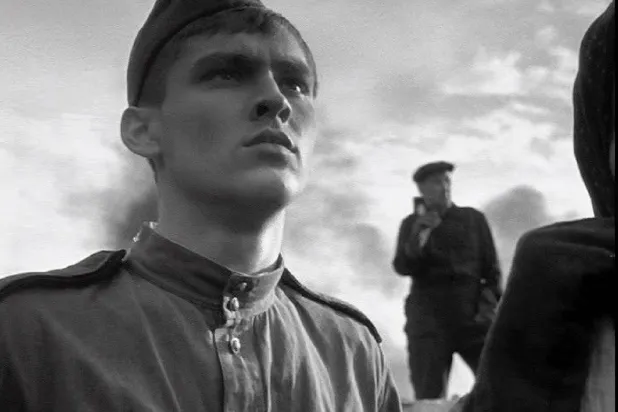
At the end of the film, we hear the following commentary: 'This young soldier could have become a good father and a wonderful citizen.'
BALLAD OF A SOLDIER
★★★★
Director: Grigory Chukhrai
Russia (1959) | The Russian Front
At the end of the film, we hear the following commentary: «This young soldier could have become a good father and a wonderful citizen. He could have become a worker, an engineer, or a professor. He could have sown wheat and beautified the earth with gardens. But he had just enough time to become a soldier.»
In a notebook where director Grigory Chukhrai recorded his memories as a soldier defending Stalingrad, he wrote: «We must tell what happened here.» Chukhrai, born in Ukraine in 1921 and raised in Moscow, went to World War II and experienced it practically. Later, he captured its beats in more than one film, including «The Forty-First», which won an award at the Cannes Film Festival in 1957. This did not save him when Soviet state censorship banned «Ballad of a Soldier» for years. Most likely, its humanitarian message left a bitter taste; it is about a young soldier (Vladimir Ivashov) who is granted leave in appreciation of his heroism on the front to visit his mother after a two-year absence. However, time will pass, and we discover with him the other side of the war. We encounter with him another life representing human heroics unrelated to fighting on the front. These circumstances lead the soldier to return to the front after his allotted leave expires, and the mother remains standing on that hill waiting. A wonderful film bearing an eloquent message about the other side of wars.
CROSS OF IRON ★★★★
Director: Sam Peckinpah
Britain/Germany (1977)
The German Front
In an interview, director Sam Peckinpah («Pat Garrett and Billy the Kid», «Straw Dogs», etc.) considered this film his best and closest to his heart. It is adapted from a 1955 novel by Willi Heinrich, revolving around the Allied conflict. German conscript Steiner (James Coburn) confronts Captain Stransky (Maximilian Schell), who aspires to win the «Iron Cross» medal, claiming he led the battle. To achieve his goal, the captain names Steiner as a witness to that, but the latter refuses to be dragged into this deception, making the captain harbor a grudge against him. Steiner conceals from Stransky a military order to retreat in the face of a potential Russian attack. The soldiers withdraw, and the two remain alone in the confrontation.
James Coburn in the film «Cross of Iron» (EMI)
A drama without heroics, and a confrontation between two soldiers; one of them, Steiner, is more aware of the tragedy of wars, while the other tries to use it for advancement. There are other characters reflecting contrasting directions, and some highlight Steiner's humanity when he saves a Russian boy from being killed, but he is not about to save his direct superior, Stransky, from failure, rather leading him to oblivion.
The film's tone is painfully sarcastic, and the ending provides Steiner's booming laughter, which parallels the final laughter in Peckinpah's previous film «The Wild Bunch», unleashed by Edmond O'Brien at the end of that film.
THE THIN RED LINE
★★★★︎
Director: Terrence Malick
USA (1998)
South Atlantic Front
Novelist James Jones derived some of his works, such as the novel «From Here to Eternity» (Fred Zinnemann, 1953) and his fourth novel «The Thin Red Line» (published in 1962), from his autobiography, as he was a soldier in the World War II battle that took place on Guadalcanal Island (northwest of Australia) and emerged with the «Purple Heart» medal.
Nick Nolte in the film «The Thin Red Line» (20th Century Fox)
The film begins by introducing us to its characters, who appear closer to separate islands in a single furnace that does not erase each's specific features. The day after the platoon arrives at its new position, a fierce battle breaks out between it and the well-entrenched Japanese forces in carefully studied positions. The execution of the battles is good, but the depth exercised to reveal each character's background and hopes is equally important.
The battle scenes, in their long minutes, combine the realism of combat and death, rising above what war cinema has achieved in most of its productions, yet the film comes across as if it were a philosophical inquiry into life and its troubles. Battles were inevitable, and they protect the film from changing its core, but that voiceover narration that dominates the work gives it an auditory reading over its visual one, and both elevate it artistically to the utmost limit of an artist's ambition.
★ Poor | ★★: Mediocre | ★★★: Good | ★★★★ Very Good | ★★★★★: Excellent
Original source: Asharq Al-Awsat



Comments (0)
Be the first to comment.