Digital Restoration Brings Youssef Chahine Back to World Screens
); googletag.cmd.push(function() { onDvtagReady(function () { googletag.display('div-gpt-ad-3341368-3'); }); }); }
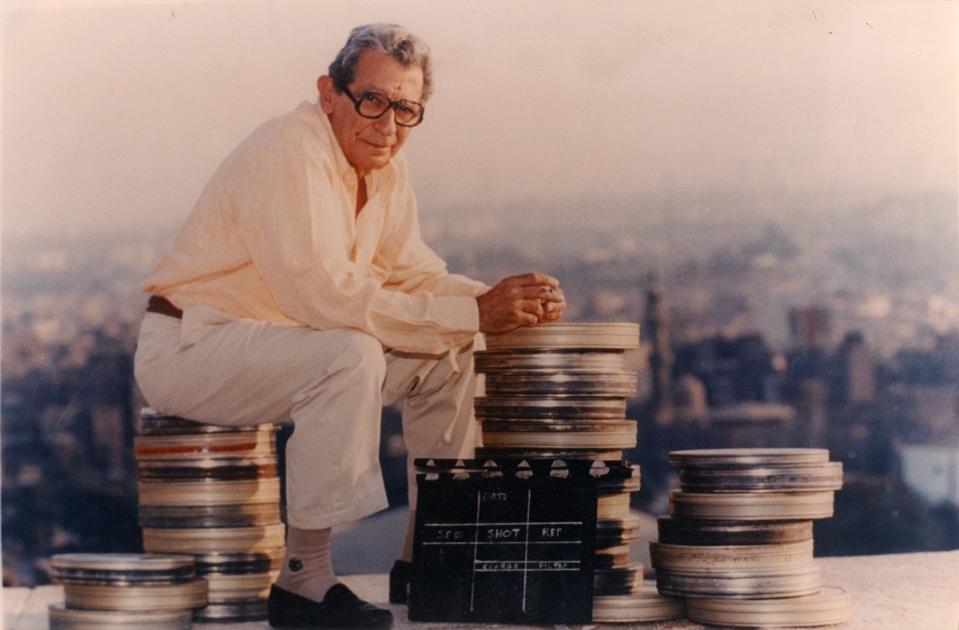
More than a decade after his passing, Youssef Chahine returns to screens as if he never left. At times, Chahine was a resident of the French Cinematheque in Paris—the country he loved, whose language he spoke, and with which he maintained peer-to-peer relationships. At other times, he was a guest in the Czech Republic, which screened a collection of his films as part of its famous Karlovy Vary festival. Between these two stops, his spirit toured many European countries (Germany, Switzerland, and Italy), speaking through his cinema and sparking a hidden dialogue between yesterday and today. In all these screenings, Chahine was the absent presence; perhaps his absence made him more present in hearts, finally achieving what every artist aspires to: that his art speaks for him.
Throughout his life, Chahine was keen for the audience to view his works under the best conditions, both in sound and picture. Now, modern digital technology has allowed the restoration of a number of his works, which has enabled this reunion to take place. However, this does not happen without arrangements and great effort. There are people who protect the great legacy of the director of "Bab el-Hadid" from fading away in a world that evolves at a fast pace and tends to neglect everything old. Chahine's niece, director and producer Marianne Khoury, is among those who have dedicated most of their time to preserving the master's legacy. She spent the last months of her life trying to bring his cinema into the light of modern requirements, by seeking to restore a number of his works.
Cinematic Worlds
At the end of last year, the French Cinematheque organized a tribute to Chahine titled "A Journey into the Worlds of Youssef Chahine," marking ten years since the passing of the man they call in Egypt 'the international director.' The accompanying exhibition included a number of Chahine's belongings, manuscripts, film decoupages, and musical instruments, all taken from his private archive, which he opened to the public. Opening the doors of the artist's secret garden to the general public and displaying his belongings before the eyes of curious onlookers is a long-standing Western tradition that has become institutionalized despite its fetishistic nature. Countless exhibitions and retrospectives are held annually in major Western capitals to introduce a director or celebrate an actor's work. Re-releasing old films in theaters so that generations unfamiliar with them can watch them, or for those who want to rediscover them in light of the maturity they have achieved, is also a function of cultural institutions that carry an enlightenment and pedagogical mindset. Unfortunately, this tradition is almost absent in the Arab world.
"Zawya" Cairo
With the restoration of Chahine's films and their screening to the public from late last year to the present, some Arabs have realized the importance of cinematic memory. Some young Arabs have grasped what it means for their generation to overcome the barrier of time and watch on the big screen works they had heard about but never seen. Apart from the stops in Paris and Karlovy Vary, the screenings of Chahine's restored films in Cairo at the end of last year were crucial in drawing attention to the importance of this topic. For days, long queues formed in front of Zawya Cinema in downtown Cairo. The Cairene audience of all ages was able to return to Chahine's time and the eras he depicted, through 21 restored films, in the rightful place for cinematic viewing: the theater.
With the recent technological development worldwide, the digital restoration of films has become easier. This encouraged the company "Misr International" to restore the films whose rights it owns, noting that Chahine produced films in partnership with other European companies, so the task of restoring them falls to those companies. However, Marianne Khoury is seeking to restore all of his films, a difficult and costly process; the first phase alone has taken about ten years so far.
Some of Chahine's films that flopped at the box office at the time, such as "Al-Nasser Salah Ad-Din," achieved unprecedented glory when screened after restoration. Although the film was shown several times on Egyptian channels, those screenings did not do justice to the ambitious work. It is likely that Chahine never witnessed such turnout for his films during his lifetime.
Arab-Western Dialogue
At Karlovy Vary, a festival that saw a reasonable turnout for Arab cinema after the Arab Spring (the festival had little interest in the Arab region before the popular uprisings), Chahine's films helped spark dialogue between Arabs and foreigners. A journalist from a European country sitting next to me during one of the screenings seemed amazed by "Alexandria... Why?" He admired its modern language and cinematic anxiety, and kept peppering me with questions about Chahine after we left the theater. As for the festival's artistic director, Karel Och, he admitted that Eastern Europe in general and the Czech Republic in particular had long been remiss in introducing Chahine to local audiences, and that the tribute to him was a form of compensation. Consequently, 11 restored films by Chahine made their way to the screens of the Czech festival.
Marianne Khoury recounts that Chahine himself had started a project to restore his films, but his death prevented him from achieving what he had in mind. She says: 'He was very conscious about the preservation of films. He even began buying films he had not produced. He also started organizing his archive. After his death, we wanted to continue what he started. So far, we have restored 21 films, with help from the French, especially regarding films co-produced with French entities. The Bologna laboratory in Italy undertook the restoration of "Al-Nasser Salah Ad-Din." Our family, the Chahine family, restored the rest. Restoration methods differ: the Italians do not restore like the French, etc. We learned a lot about restoration during this process, both legally and technically. In Cairo, we did not expect this interaction with his films. The turnout was tremendous. Some viewers sang during the screenings, especially during "The Return of the Prodigal Son." The film rekindled the emotions of the 1970s generation. The film "Dawn of a New Day" — even I didn't know it well, so I discovered it after restoration. And every time the audience discovered a film, they would return the next day to discover another. The lesser-known films saw great turnout: Chahine's early works, like "Baba Amin" or "Struggle in the Valley." This was a surprise to us.'
Marianne Khoury seems optimistic when I talk to her about the lack of a culture of retrospectives of old works in the Arab region, whether with restoration or without. She says things are starting to change, and there will be two retrospectives of Chahine in the coming months, in Britain and the United States (MoMA), although it is clear that interest is more foreign than Arab. If a conclusion can be drawn, it is that there should be a call to generalize this experience to include the entire Arab cinema archive. This seems more urgent today in a time dominated by forgetfulness. Cinema, like literature and painting, is part of the lives of people who passed through here and left indelible marks, and the trust requires passing their stories from generation to generation. And because Chahine was pioneering and visionary in most of his works, we must ask: Will he pave the way for others?
Photo captions:
More about: Youssef Chahine, Egyptian cinema, International festivals, Cairo
Original source: Independent Arabia


Comments (0)
Be the first to comment.