Naguib Mahfouz's Readings Only Lead to Open Beginnings
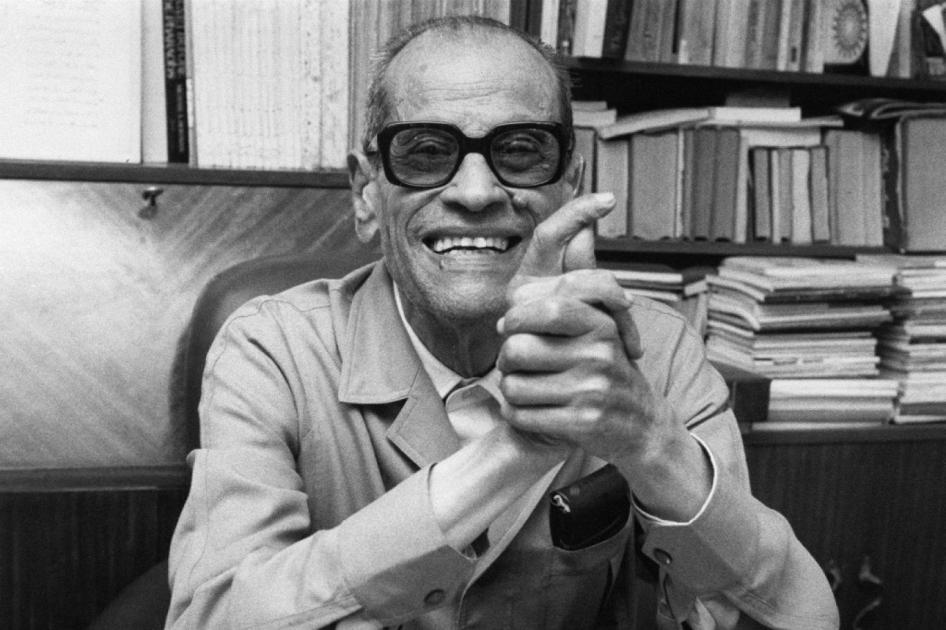
Critical approaches to Naguib Mahfouz's novels will always yield something new, even if it pertains to a specific critic, who will find in a particular work something different from what he had previously found in the same work.
); googletag.cmd.push(function() { onDvtagReady(function () { googletag.display('div-gpt-ad-3341368-3'); }); }); }
Summary
Critical approaches to Naguib Mahfouz's novels will always yield something new, even if it pertains to a specific critic, who will find in a particular work something different from what he had previously found in the same work.
Critical approaches to Naguib Mahfouz's novels will always yield something new, even if it pertains to a specific critic, who will find in a particular work by the author of 'Children of Gebelawi' something different from what he had previously found in the same work, according to various methodologies known in literary criticism. This is precisely what Hussein Hamouda relies on in his book 'In the Absence of the Garden... On the Continuum of Time/Space in Naguib Mahfouz's Novels' (Critical Writings series – General Authority for Cultural Palaces / Cairo), as he begins and ends it by saying: 'How much has been written and said about Naguib Mahfouz's works, and how much more can be written and said about them.' Thus Hussein Hamouda began his book, and thus he concluded it. Between the opening and the conclusion lies a journey whose driving motive has not ended, hence its author says: 'We do not claim to have reached some conclusion, but rather we have merely arrived at another beginning.' For Naguib Mahfouz's world, before and after that journey, remains replete with its secrets that drive continued attempts to approach it, making them connect and follow one after another.
The writings that have approached Naguib Mahfouz's literature, in the view of many, including Mahfouz himself, begin with an article by Sayyid Qutb about the novel 'Kifah Tiba' (The Struggle of Thebes) published in 1944. The book 'Al-Muntami: A Study in Naguib Mahfouz's Literature' by critic Ghali Shukri, published in 1964, remains one of the most important of those writings, noting that it focused on Mahfouz's short story collections from 'Hams al-Junun' (Whisper of Madness) published in 1948, to 'Khamarat al-Qitt al-Aswad' (The Black Cat Tavern) published in 1971. There is also Ibrahim Fathi's 'The Novelistic World of Naguib Mahfouz' (1978), George Tarabishi's 'Naguib Mahfouz as a Philosopher by Proxy' (1988), Rashid al-Anani's 'Naguib Mahfouz through His Novels', Richard Jacquemond's 'Naguib Mahfouz through His Novels', Mahmoud al-Dabaa's 'The Crisis of Criticism and the Openness of the Text... Naguib Mahfouz and the Seven Arts' (2020), and Faisal Darraj's 'Evil and Existence: The Fictional Philosophy of Naguib Mahfouz' (2022). Many of these writings are included in the bibliography that Hussein Hamouda relied on to complete his book 'In the Absence of the Garden'.
Between One Edition and Another
This leads us to a question whose essence is related to the specific context from which Hussein Hamouda set out, namely why was the book 'In the Absence of the Garden' republished about 15 years after its first edition was issued by 'Madbouly Library' in Cairo? The question is pertinent in light of the fact that the 'new' edition does not include anything new that distinguishes it from its predecessor, in addition to lacking any reference to the Madbouly Library edition, noting that the author – may God grant him health – could have modified the book itself by deletion or addition, or could have made room for another study, whether by himself or by other critics, presenting a different text, in the context of critically approaching Naguib Mahfouz's novels, especially since he heads a periodical concerned with this matter, affiliated with the Supreme Council of Culture in Egypt. Naguib Mahfouz's works and the writings about them have always been of interest to him as one of the most prominent academics in the field of literary criticism in the Arab world.
We can rely with full confidence on what Hamouda himself presented in his work, in the context of his and our emphasis on the importance of presenting something new, which has not been achieved by republishing this book as is, through an entity affiliated with the Ministry of Culture, with the highest level of supervision over its publication overseen by the poet Jirjis Shukri, who seems fond of republishing classics, but Hamouda's book is not a classic. Even if we assume it has sold out at its original publisher, that does not justify reprinting it without the new edition containing something that distinguishes it from its predecessor, in terms of approach and vision, especially since 'Naguib Mahfouz's novels, with their richness and ability to constantly renew, will continue to hold that enticing allure that provokes many attempts at understanding and interpretation, one attempt completing another,' in Hamouda's own words.
Presence of the Garden
The title, as Hamouda emphasizes, does not exactly match the book, but rather approximates it, or merely challenges it. Perhaps this distance arises, in the author's view, from an attempt to avoid using a term that might seem heavy in a book title, but there is no harm, and it might be fine to use it, then repeat its use within the book's chapters. The intended term is 'time-space' or the 'chronotope' coined by Bakhtin among concepts he distilled from penetrating and insightful analyses (in Hamouda's words) that still prove their vitality and ability to continue analyzing diverse fictional – and generally literary and artistic – works belonging to experiences stretching in various directions outside the cultural field from which these concepts emerged and were shaped.
Consequently, the word 'garden' in the title is one of the terms with spatial and temporal connotations as well. Hamouda devoted the seventh and final chapter of his book to tracing its recurrence in Naguib Mahfouz's novels across the diversity of their worlds, the span of their creative period, and the different dates of their publication, 'as if they are constant themes – representing – part of a stable language in Mahfouz's fictional world, even if their embodiment differs – to this or that degree of difference – from one novel to another' (p. 212). The garden in Naguib Mahfouz's novels is embodied 'as a home for a beautiful first paradise, outside the dust of the world and outside its hell, remaining in it – when we are inside it – seems like a dream, and its world is recalled – when we are outside it – time and again, but it remains there as a mark on a world, in a time and place, of beautiful features, elusive presence' (p. 265).
A Beginning Without End
Hamouda's book thus seeks to approach Naguib Mahfouz's novels from a perspective that starts from a specific point, namely the concept of the time/space continuum, whose formulation is attributed to Mikhail Bakhtin, and this is what distinguishes it from what has been written before and after about the literature of the author of 'Children of Gebelawi'. Yet the book itself ends without ending, both the motive and the ambition from which its journey started, so to speak, thus that end is in reality only another beginning, since Naguib Mahfouz's world before and after the start of that journey remains replete with its secrets that drive further attempts to explore it, crowded with its artistic values and dimensions that encourage trying again and again, ad infinitum.
Read More
This section contains related articles, placed in the (Related Nodes field)
In any case, Hussein Hamouda's book sought to investigate some of the 'chronotopes' that recur in Naguib Mahfouz's novels, with the exception of his first three historical novels. That is, the study here covers 32 novels, aiming to explore a single idea related to the concept of the chronotope, in terms of showing some aspects of its basic presence in these novels, on the one hand, and identifying models of the levels and modalities of this presence, on the other hand, and then sensing the extent of its engagement with specific chronotopic themes from which Hamouda proceeds, on a third hand.
Renewal and Continuity
Original source: Independent Arabia





Comments (0)
Be the first to comment.