Publishers Race to Reprint Homer’s Epic... with Dazzling Embellishments
The market for Homer’s epic is experiencing intense congestion — reminiscent of a famous palace on the island of Ithaca — prompting publishers to devise clever methods to attract readers to their editions.
It is the climax of the 'Odyssey'; Odysseus finally returns home to Ithaca to find his house swarming with suitors competing to marry his wife Penelope and seize his throne. He must now overthrow these intruders and reclaim his rightful place, but the question remains: how?
In their own way, book publishers are waging a similar battle.
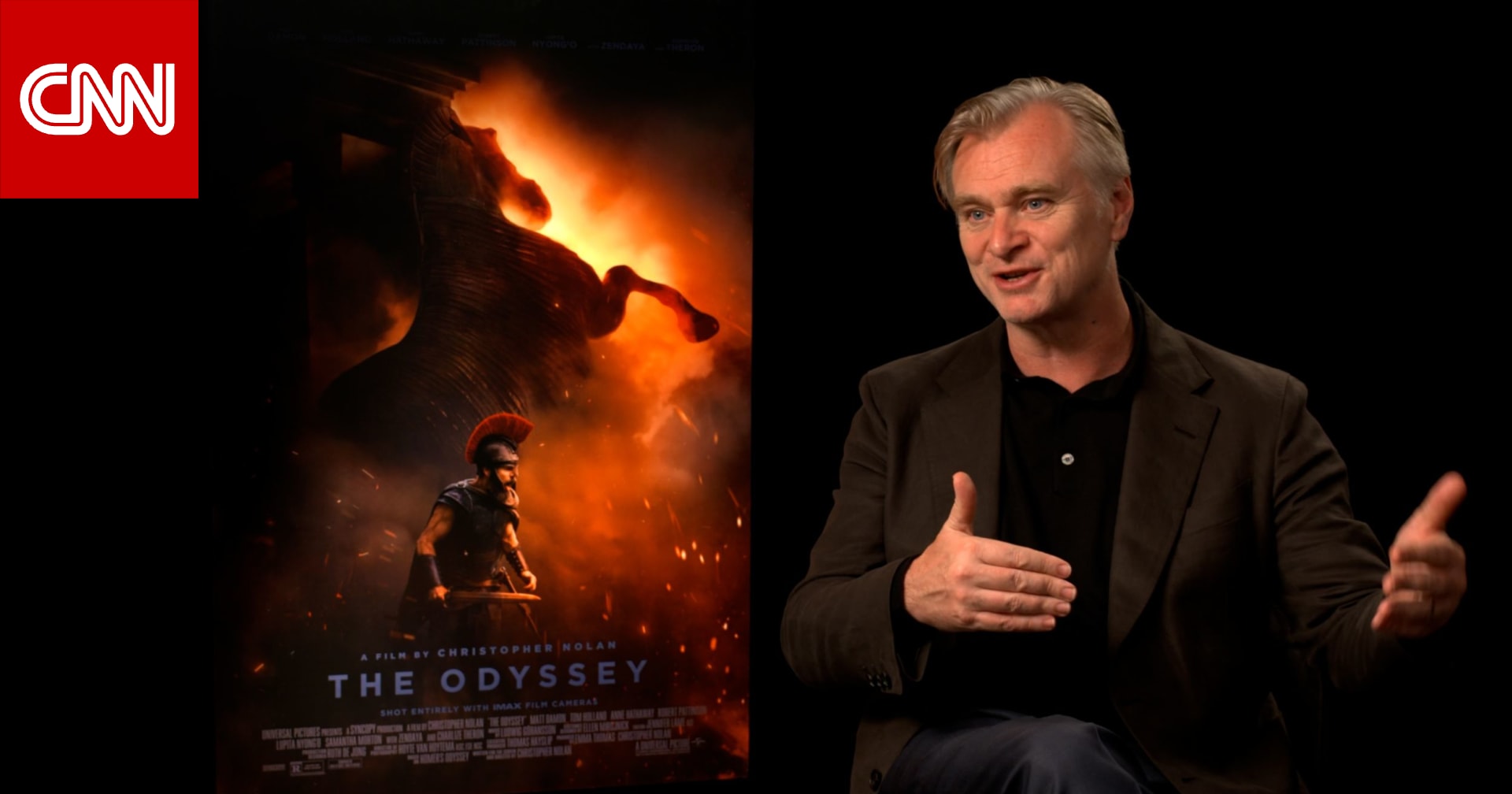
Public interest in the 'Odyssey' has increased in the period leading up to the release of the film adaptation of Homer’s epic — starring a star-studded cast — directed by Christopher Nolan last week. So far this year, sales of the 'Odyssey' have risen by 76 percent compared to last year, according to data from Circana BookScan, a specialist in tracking book sales.
For publishers who are reprinting dozens of currently available translations of the 'Odyssey', this situation represents both a challenge and an opportunity. Here is how some of them are handling the moment.
The straightforward method publishers are using to elevate their translations of the 'Odyssey' is to reissue them in a new and dazzling guise.
One such publisher is Picador; in May, the publisher — which operates in the United States as an imprint of Farrar, Straus & Giroux — launched a new edition of Robert Fitzgerald’s translation of the 'Odyssey', first published in 1961. Nolan’s film directly influenced this reissue strategy.
Sheila O'Shea, director of publicity and marketing at Farrar, Straus & Giroux and Picador, said in an email: 'We originally planned to release a new luxury edition of the Odyssey in fall 2025, but we postponed it to spring 2026 to capitalize on the excitement surrounding Christopher Nolan’s film adaptation of the epic.' Along with the timing adjustment, Picador gave the new edition a fresh, appealing look, featuring a vibrant green cover, foil-stamped embellishments, flaps, and deckled edges.
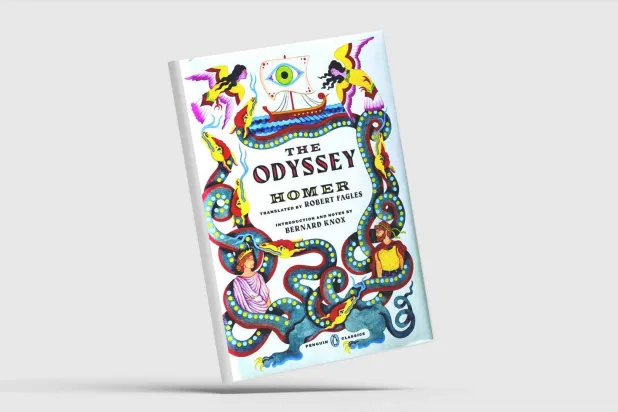
Picador is not the only one giving the epic a makeover; in June, Penguin Classics reissued Robert Fagles’ translation, first published in 1996, in a hardcover volume with a colorful dust jacket adorned with characters from the poem.
The release date of Nolan’s film came at a perfect time, coinciding with Penguin Classics’ plans to celebrate the 30th anniversary of Fagles’ translation and the 80th anniversary of the imprint itself; the series launched in 1946 with E.V. Rieu’s translation of the 'Odyssey'.
Elda Rotor, publisher of Penguin Classics, said in a statement: 'It was actually great timing; while film fans were looking forward to seeing the cinematic adaptation of Homer’s epic, we were at the same time preparing to celebrate Fagles’ translation.'
Celebrity Appeal
Rather than relying solely on reissues, some publishers are turning to another tool: recruiting celebrities.
Although many of the most popular translations of the 'Odyssey' date back decades, two recent translations have gained notable cultural prominence: in 2017, W.W. Norton & Co. published a translation by Emily Wilson, a professor at the University of Pennsylvania. Last year, the University of Chicago Press released a translation by Daniel Mendelsohn, a professor at Bard College.
There is often a stereotypical perception of classics scholars as reclusive monks in the 'ivory tower' of academia, but both Wilson and Mendelsohn are notable exceptions, enjoying strong and engaging media presence. Mendelsohn’s cultural criticism is as respected as his scholarly work; he has written for prominent publications such as the New York Times, the New Yorker, and the New York Review of Books.
Wilson — the first woman to translate the 'Odyssey' into English — has become a focus of attention and controversy for two reasons: first, her translation, which was notably frank and provocative, sparked intense debate about the best way to translate Homer’s works. And second, her work found itself in the midst of the 'culture wars,' a phrase she herself used in a recent interview with New York magazine.
Wilson told the magazine last month: 'After I published my translation of the Odyssey, the work was met with praise — albeit somewhat simplistic — as an embodiment of girl power, but it also faced backlash and criticism.'
The notable fame that both translators have gained has been a significant advantage in the current climate of widespread interest — or 'Odyssey fever' — currently sweeping the scene.
In this context, Louise Brockett, director of communications at Norton, said in an email: 'It may not be surprising that we are promoting Emily Wilson’s translation, but what is more surprising is the amount of interest that is spontaneously escalating; group reading sessions of Wilson’s translation have been organized, and reading clubs have been established dedicated to discussing the Odyssey.'
Similarly to Wilson, Mendelsohn has become 'a go-to voice for journalists covering news of this work, and those wanting to learn more about the epic and Homer’s world,' according to Levi Stahl, marketing director at the University of Chicago Press, in an email.
* Editor in the Book Review section
The New York Times Service
Original source: Asharq Al-Awsat


Comments (0)
Be the first to comment.