What Makes the Trojan Horse Scene in 'The Odyssey' So Stunning?
When Christopher Nolan's film 'The Odyssey' premiered in New York on July 14, a horse statue nearly 40 feet (about 12 meters) tall stood above the red carpet in Manhattan.
Credit: Melinda Sue Gordon/Universal Pictures
(CNN)-- When Christopher Nolan's film 'The Odyssey' premiered in New York on July 14, a horse statue nearly 40 feet (about 12 meters) tall stood above the red carpet in Manhattan.
Other giant horse statues have toured the country (and the UK) to promote the film, which also uses the famous Trojan Horse image in some of its posters. Although the original ancient Greek poem does not recount precise details of that legendary trick, it remains a powerful symbol for Nolan's new film, a reason well understood by fans who have already seen it.
In a moving and lengthy scene that deeply touches emotions, Nolan transports the audience inside the wooden horse, depicting the terrifying conditions experienced by the hidden soldiers in a cramped space, highlighting their frantic longing for victory in battle.
This minutes-long scene is unique and unmatched in the many previous artworks that have addressed this legendary moment. Max Nelson, associate professor of Greek and Roman studies at the University of Windsor in Canada, who has taught courses on the portrayal of the ancient world in film, said he cannot recall another work that trapped the audience with the Greeks inside the horse in such a 'grim' manner. He added: 'The harsh conditions the Greeks faced while waiting for days inside the Trojan Horse have never been shown on screen before.'
What seems particularly new and innovative in Nolan's film is that it flips the perspective audiences are used to, as Nelson explained: 'This event is usually shown from the Trojans' point of view, who have to decide what to do with this horse.'
It is clear that the idea for this scene has been on Nolan's mind for a long time. The British director was briefly attached to direct the 2004 film 'Troy' starring Brad Pitt, before the task was given to Wolfgang Petersen.
Nolan told Empire magazine last year: 'The idea has been in my mind for a very long time; specifically certain images, like how I wanted to approach the Trojan Horse scene, and things like that.'
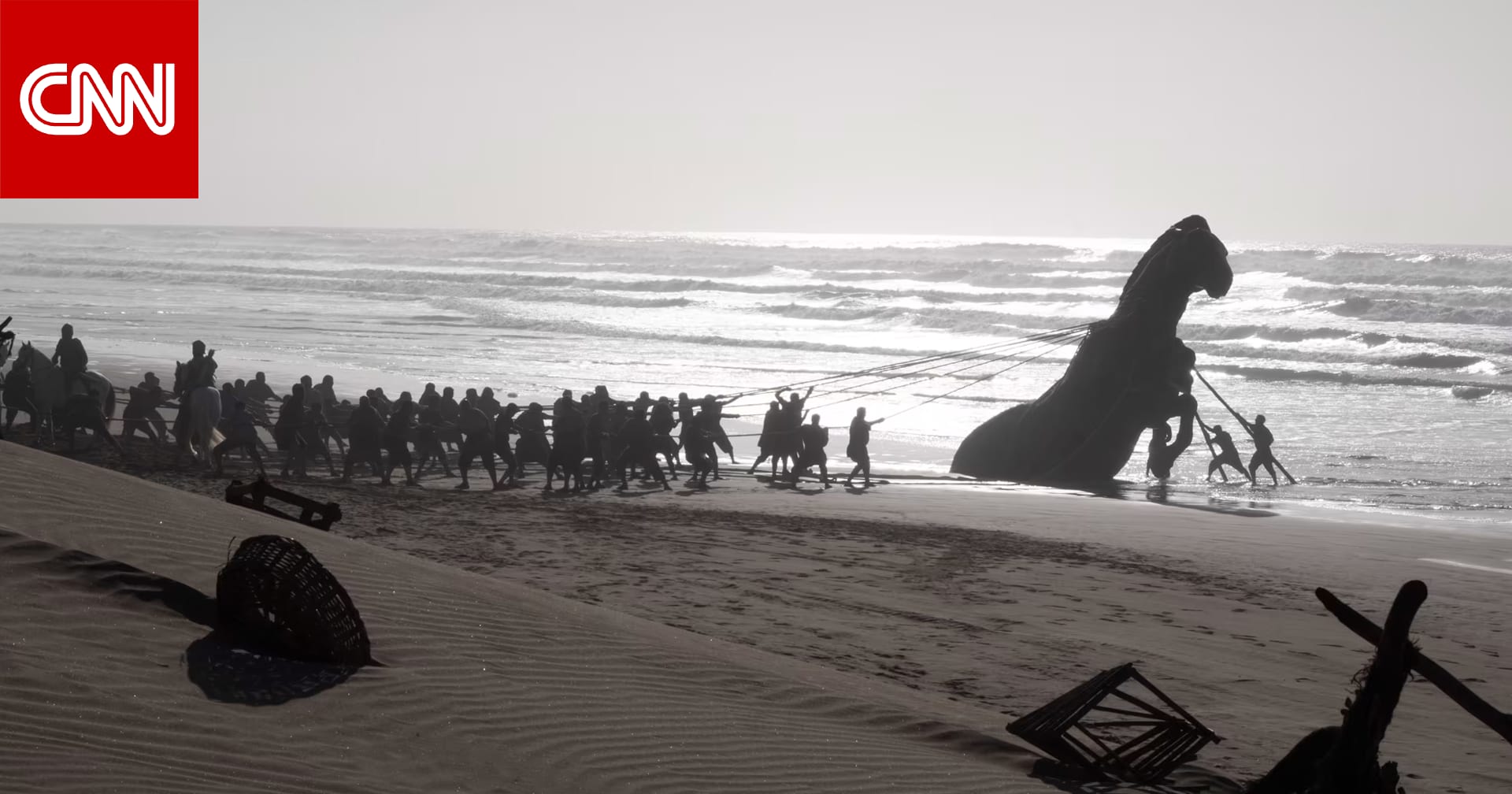
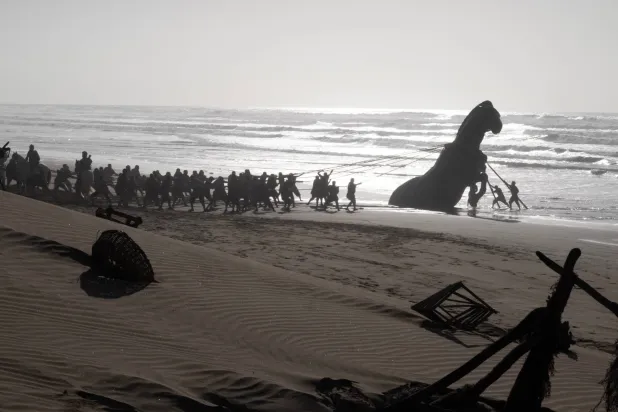
He also said in a recent statement to The Independent that he spent a long time thinking about how to depict the Trojan Horse and make it look 'realistic' and convincing to the audience. He added: 'The image of that horse sinking into the sand has been stuck in my mind for 20 years.'
Indeed, 'The Odyssey,' starring Matt Damon, begins with a short scene showing the Trojans discovering the horse statue, which looks like it was abandoned on the sea shore waves, just as Nolan imagined. Here, Sinon, the only Greek soldier left behind, explains to the Trojan soldiers that the horse is a farewell gift to the gods from his army, which seems to have abandoned its years-long siege of the city.
Then, just when we think we are about to follow that deadly gift as it enters the gates of Troy, Nolan cuts to another shot. We don't see the horse again until about 45 minutes later, when Menelaus tells Telemachus the details of hiding inside the statue with the latter's father, Odysseus, and other soldiers.
The account we witness on screen is horrifying: men drowning inside the horse during the first two tidal waves, while others struggle to breathe through straws amid rising water. Menelaus describes how the men, piled on top of each other in suffocating heat, were forced to urinate and defecate on each other.
When the Trojans discover the horse, the Greeks must be extremely careful not to make a sound as they hear Sinon being killed. They then have to remain completely silent while a soldier tests the horse by stabbing it repeatedly with a sword, injuring one of those hiding inside.
The statue is pulled by ropes by Trojan soldiers groaning under the weight, before being suddenly hoisted upright next to a sacred temple, causing a violent jolt that destabilizes those inside once more. To the beat of drums that quicken and rise gradually, we finally see the Greeks stealthily descending a rope in the dead of night, eliminating a few Trojan guards, then struggling to open the city's massive gates amidst growing enemy crowds. In a film full of many quiet moments, this scene is one of the most thrilling.
Depictions of the Trojan Horse in previous works varied greatly. The horse's events are extensively detailed in Virgil's epic 'The Aeneid,' and in the 1956 film 'Helen of Troy' and the 1961 film 'La guerra di Troia' (The Trojan Horse); the horse was often shown being transported on wheels in an already upright position. Those old films lack any shots showing what happens inside the horse, and their battle scenes may seem to modern audiences to lack violence and be suitable for all ages, as 'it was common at the time to depict battles in a theatrical style, without bloodshed,' Nelson said.
In two short TV series that covered the ancient Greek myth—'The Odyssey' (1997) and 'Helen of Troy' (2003)—quick shots show soldiers hiding inside the horse, but neither shows any real suffering inside; rather, the horse seems a spacious and somewhat comfortable place to wait for the siege to begin.
According to Kim Shelton, professor of ancient Greek and Roman studies at the University of California, Berkeley, there have been many ways to depict the Trojan Horse myth, from early Roman frescoes dating to the 7th century BC to medieval manuscripts. She said: 'Because it's an element of myth and imagination, there was never a definitive, standardized version.' However, she noted that it has often been depicted mounted on wheels since ancient times.
Yet Shelton prefers the version from the 2004 film 'Troy' because its dilapidated design, made of weathered wood and ropes, suggests it was assembled from abandoned ship remnants, the only material available at the time. The film also shows the horse being moved into Troy by rolling it over logs, rather than being mounted on wheels.
'Troy' did not show any scenes from inside the horse, but Shelton believes that the shots showing the soldiers' lurking eyes inside successfully conveyed 'the sense of danger from being cramped inside and trying not to be discovered.' Compared to the 2004 version, Nolan's horse design and structure seem more streamlined and refined, but that does not mean the experience was not grueling or suffocating for those inside, including the cast and crew.
Damon told GamesRadar+ that when he asked the director the day before shooting the scene how they would execute it, the director replied that they would have to improvise. He said: 'It was a real lesson... Nolan said: We'll cram ourselves inside and see how we handle it.'
Original source: CNN Arabic



Comments (0)
Be the first to comment.