Cyclospora parasite... How does it penetrate the stomach to colonize the small intestine?
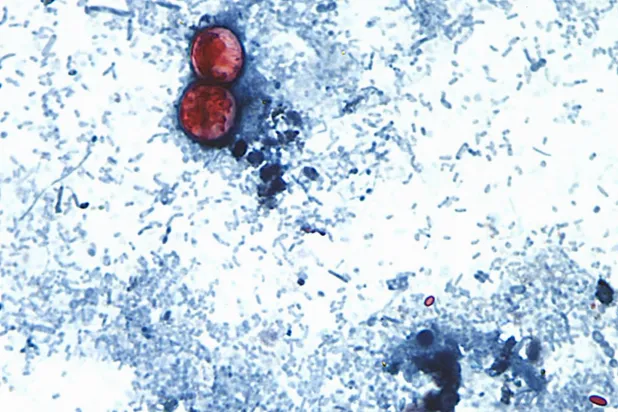
A microscopic parasite that crosses the stomach to colonize the small intestine, causing severe intestinal symptoms with outbreaks spreading via lettuce and fresh vegetables in the United States.
A healthy vegetable salad often transforms from an ideal food choice into a source of cross-border health concerns when it becomes a carrier for microscopic organisms invisible to the naked eye.
In this context, the name of the Cyclospora parasite has returned to the forefront of global and US health agency reports, after being linked to multiple outbreaks primarily associated with consumption of fresh vegetables, especially imported and domestic lettuce and leafy greens, reopening the file on food supply chain safety and the challenges of combating parasitic diseases in the era of food globalization.
Many wonder what Cyclospora disease is and how it affects the digestive system. The journey of this parasitic infection begins when contaminated food is ingested, where the microscopic parasite passes through the stomach, taking advantage of its thick cell wall that resists acidic juices, to find its final abode inside the small intestine.
Once it colonizes the cells lining the intestine, it causes severe intestinal disturbances leading to acute watery diarrhea and weight loss, requiring accurate laboratory diagnosis to determine the appropriate treatment protocol to eliminate the parasite and restore vital digestive system functions.
Microscope of the silent threat and the nature of the pathogen
Cyclospora cayetanensis is scientifically known as a microscopic single-celled parasite belonging to the spore-forming protozoa.
This microorganism is transmitted to humans primarily through consumption of water or food contaminated with human feces containing the intestinal parasite.
The life cycle of this organism is characterized by the fact that the oocysts excreted in feces are not immediately infectious; they need several weeks in a warm, humid environment to become infectious, making crop contamination in farms or via irrigation water the main cause of infection spread, not direct person-to-person transmission through daily contact.
Microscopic image from the Centers for Disease Control and Prevention (CDC) showing Cyclospora parasites in a stool sample stained with safranin (Associated Press)
Lettuce crisis in America and summer outbreak concerns
Summer months in the United States are associated with repeated waves of Cyclospora infection, with the Centers for Disease Control and Prevention (CDC) observing a close link between these cases and consumption of leafy vegetables, especially various types of lettuce and pre-packaged crops in bags.
These crises recur due to the complexity of distribution and irrigation paths in large farms, as a single contamination incident in water networks or sewage channels near fields can transfer the microscopic parasite to thousands of food shipments that are quickly distributed to markets and restaurants, making it difficult to trace the source and contain the outbreak in a timely manner.
Packages of leafy vegetables from Taylor Farms displayed in a US store in California amid federal investigations looking into the possible link between the company's shredded lettuce and the recent Cyclospora outbreak (AFP)
This crisis is no longer just theoretical warnings in laboratory corridors; it has turned into a worrying health reality casting a heavy shadow over American tables after the CDC announced the spread of the intestinal outbreak to include 34 US states.
The health system recorded an unprecedented record jump of about 7,000 confirmed and suspected cases, putting food safety and supply chain tracking in the United States to its toughest test in years.
Michigan topped the list of the most affected states, becoming the main epicenter of this outbreak after cases there exceeded the thousand mark suddenly and rapidly.
Bags of ready-made vegetable salad supplied by Taylor Farms displayed in a US store in California, coinciding with ongoing federal investigations to verify the link between the company's shredded lettuce and the wave of Cyclospora intestinal outbreak. (AFP)
This explosion in the infection curve in Michigan alerted local health authorities, who rushed to try to contain the outbreak and dry up its sources in markets.
Preliminary medical reports suggested that pre-packaged lettuce or leafy greens for ready-made salads are the prime suspect behind this mass infection, especially after observing clusters of patients indicating a common distribution point feeding restaurant chains and major commercial markets in the area.
Bags of ready-made vegetable salad supplied by Taylor Farms displayed in a US store in California, coinciding with ongoing federal investigations to verify the link between the company's shredded lettuce and the wave of Cyclospora intestinal outbreak. (AFP)
Vegetables and fruits accused on the contamination list
Cucumber is characterized by its very high water content (Pixels)
The risk of this microscopic parasite is not limited to lettuce leaves alone, but extends to include a diverse list of fresh agricultural products that are usually eaten without cooking. This list includes green coriander, basil, cabbage, cucumber, in addition to some types of imported fruits such as various berries and strawberries, as well as other crops historically associated with outbreaks such as snow peas, broccoli, cauliflower, and green onions.
Various types of berries are among the best dietary options in the summer season (Pixels)
These crops are an ideal environment for parasitic oocysts to adhere to their folded and winding external surfaces, or even to their peels that come into contact with contaminated soil and irrigation water such as cucumber, where traditional washing with water alone fails to completely remove them due to the strong adhesion of the parasitic cysts, requiring strict sterilization measures at the source, or peeling some vegetables to ensure the safety of the end consumer and protect them from intestinal parasitic infections.
Symptoms of the disease and suffering of the digestive system
When the parasite settles in the human small intestine, it causes a disease medically known as cyclosporiasis.
Symptoms of this disease appear after an incubation period usually about a week from consuming contaminated food, and include acute watery diarrhea that may last for days or weeks if not medically treated.
This diarrhea is accompanied by severe loss of appetite, marked weight loss, painful abdominal cramps, nausea, and general physical fatigue, leading to exhaustion of the patient and significant impact on their daily quality of life.
Is the infection deadly? Assessment of death rates
Cyclospora infection is generally classified as non-fatal for the vast majority of healthy individuals, as symptoms resolve on their own or with appropriate antibiotics.
Although deaths directly resulting from this parasite are very rare, almost negligible in official medical reports,
the real danger lies in complications of severe dehydration resulting from persistent diarrhea.
This threat becomes particularly serious when it affects vulnerable groups such as the elderly, infants, and people with severely weakened immune systems.
Drug response and approved treatment protocol
Original source: Asharq Al-Awsat





Comments (0)
Be the first to comment.