Healthy Cities in the Northern Borders: A Story of Transforming Development into Life - Abdulkarim bin Daham Al-Daham
The article discusses the Healthy Cities Program in Saudi Arabia's Northern Borders Region, highlighting its humanitarian approach, the support from regional governor Prince Faisal bin Khalid, and efforts to accredit cities like Arar, Tarif, Rafha, and Al-Uwaqilah. It emphasizes that true development is measured by human well-being and quality of life.
Healthy cities are not just a banner hung at city entrances, nor a certificate added to the record of achievements; they are a promise of a safer, healthier, and more reassuring future. They are a humanitarian project before being a development project, and a message affirming that humans are the true wealth, and that quality of life begins with an environment that embraces people, preserves their health, and provides them with the means for a dignified life.
With this in mind, the wise leadership—may God support them—has given exceptional attention to the health sector and quality of life programs, believing that true development is measured not only by buildings and facilities, but by the health and well-being built in people, and by providing them with a safe and sustainable environment. Thus, the targets of Saudi Vision 2030 came to draw a roadmap that makes quality of life one of the most important foundations of development, and elevates health services to global levels, so that citizens and residents live in an environment that promotes health, supports prevention, and instills a culture of community responsibility.
Geographical References
In this context, the Healthy Cities Program stands out as one of the most successful national initiatives that have transcended the concept of treatment to the making of health itself. The Kingdom's efforts have resulted in the accreditation of 17 healthy cities according to precise scientific standards concerned with improving quality of life, enhancing community participation, and building more sustainable cities where humans are the focus of every project and health is the hallmark of every achievement.
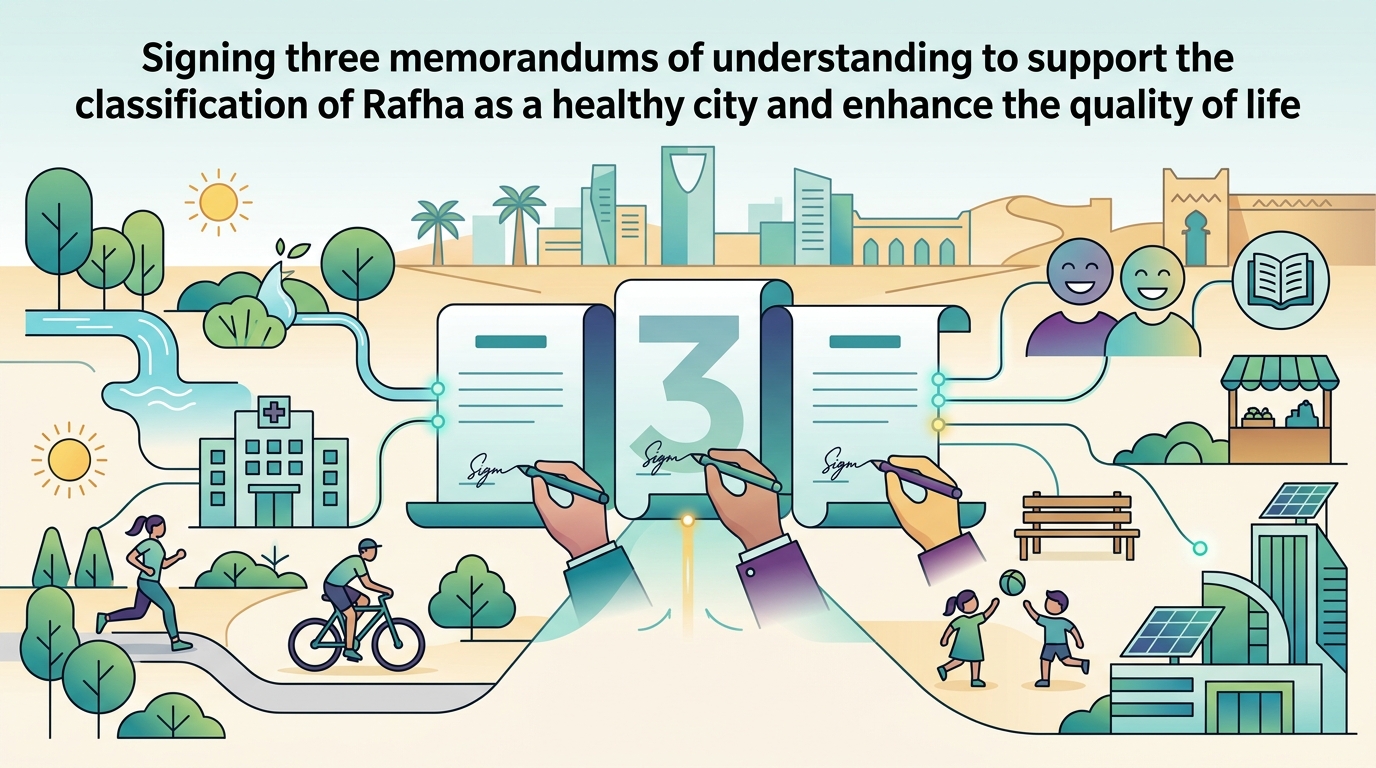
Today, the Northern Borders Region stands on the threshold of a new qualitative phase, as strenuous efforts continue to qualify the city of Arar and the governorates of Tarif, Rafha, and Al-Uwaqilah to join the Healthy Cities Program. This project aims not only to achieve accreditation but also to build a civilized model that embodies the concept of a city pulsating with life, where the elements of health, awareness, community partnership, and environmental sustainability are available.
Perhaps what gives this project its real momentum is the great support it receives from His Royal Highness Prince Faisal bin Khalid bin Sultan bin Abdulaziz, Governor of the Northern Borders Region, who believes that investment in humans is the most lasting investment. His Highness has chaired numerous meetings, continuously reviewed the national indicators of the Healthy Cities Program, and followed the work step by step, directing the removal of obstacles, mobilizing resources, and accelerating the completion of accreditation requirements. This reflects leadership that believes community health is a shared responsibility and that development is not complete unless it is reflected in people's lives and quality of living.
Healthy cities are not the responsibility of one specific entity; rather, they are a national culture and a collective effort in which the roles of all government agencies, the private sector, the non-profit sector, and community members are integrated. True success will only be achieved by continuing work according to approved executive plans, enhancing coordination between relevant authorities, and meeting all required standards, leading to a healthy environment that contributes to improving quality of life and makes the Northern Borders Region a model to be emulated in sustainable health development.
Amidst these efforts, names worthy of praise and appreciation emerge, foremost among them the National Coordinator of the Healthy Cities Program in the Kingdom, Dr. Falah bin Fahad Al-Mazrou, who leads this national program with the guidance and support of the Minister of Health, Fahad Al-Jalajel, dedicating his expertise and capabilities to serve its noble goals. Also notable is the distinguished role of the Director General of Health Affairs in the Northern Borders Region, Dr. Mohammed bin Ali Al-Habdan, who worked with a team spirit and mobilized the capabilities of the health sector to support this project, along with the sincere efforts of the region's Healthy Cities Coordinator, Fahd bin Tuwaish Al-Anzi, who follows daily details and works persistently to complete accreditation requirements and achieve the program's targets.
What is happening today in the Northern Borders Region is not just preparation for obtaining official accreditation; it is building a brighter future, where health is cultivated before illness, prevention culture is instilled before treatment, and cities are built to be more merciful to their inhabitants.
And when Arar, Tarif, Rafha, and Al-Uwaqilah are crowned with healthy city accreditation, the achievement will not just be a number added to the national record of accomplishments; it will be a new success story about a homeland that put people first, about leadership that believed the greatest investment is investment in human health, and about a region that decided to make quality of life a way of living, and health a path to a future befitting the sons and daughters of this great nation.
Original source: Al-Jazirah
Comments (0)
Be the first to comment.