How Do Populist Doctors Exploit Religion to Win Patients?
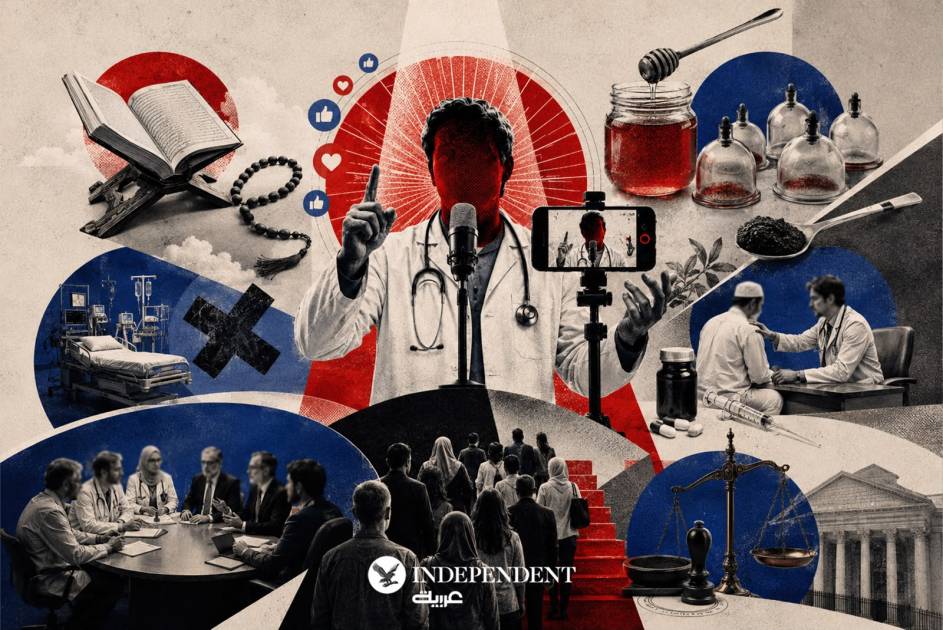
Doctors and Islamic scholars distinguish between believing in the value of prayer, Ruqya, and Prophetic medicine, and turning them into marketing tools or comprehensive alternatives to medical treatment. Islam did not make treatment contradictory to trust in God, but rather established combining faith and taking the necessary means.
The man wasn’t wearing a white coat, nor standing inside a hospital or lab. He sat in front of the camera holding a jar of honey, quoting a prophetic hadith, then confidently announced that modern medicine had failed to treat what he could cure. In minutes, comments turned into a flood of praise and prayers, and questions about diagnosis, clinical studies, success rates, and side effects disappeared.
This scene is no longer an exception in the Arab world; it has become a model for a growing phenomenon that can be described as 'populist medicine': a discourse that borrows the prestige of religion and the symbolism of the sacred to build trust surpassing people’s trust in medical institutions, and presents itself as an alternative to evidence-based medicine. Here, the doctor becomes not a healer, but a moral and spiritual authority, and objecting to him, in the eyes of his followers, becomes an objection to religion itself.
0 seconds of 4 minutes, 27 secondsVolume 90%
Press shift question mark to access a list of keyboard shortcuts
00:00
04:27
04:27
The problem is not religion... but its exploitation
Doctors and scholars differentiate between belief in the value of prayer, Ruqya, and Prophetic medicine, and turning them into marketing tools or comprehensive substitutes for medical treatment. Islam did not set treatment as the opposite of trust in God, but rather decreed the combination of faith and taking the means.
Perhaps the irony is that the most famous book relied upon by many promoters of herbs, 'Prophetic Medicine' by Ibn al-Qayyim, presents a much more balanced picture than what these promoters spread. Ibn al-Qayyim says: 'In authentic hadiths, there is an order to seek treatment, and it does not contradict trust in God... Rather, true monotheism is not perfected except by directly undertaking the means that God has established as requirements for their effects, both in decree and law... So the servant should not make his inability a trust, nor his trust an inability.'
In this sense, Ibn al-Qayyim sees no conflict between faith and medicine, but considers taking the means as part of faith—a message often lost when texts are taken out of context to market a recipe, product, or therapy session.
Many of those who raise the slogan of 'Prophetic medicine' today ignore the most explicit chapters of Ibn al-Qayyim warning against the ignorant practitioner. The man whose name they quote to defend unverified remedies is the same one who affirmed that treatment does not contradict trust, and that a doctor who deludes people with knowledge he does not possess bears responsibility for what he inflicts on patients, and that the complete doctor is one who combines medical expertise with care for the psychological and spiritual aspects, not one who substitutes one for the other.
The doctor warned about by Ibn al-Qayyim: He does not suffice with calling for treatment, but devotes a full chapter to warning against the 'ignorant practitioner.' He says: 'The ignorant practitioner... if he deceives the patient and makes him think he is a doctor when he is not... the doctor guarantees what his hand has done.' Elsewhere he states that the complete doctor is one who encompasses both physical and psychological ailments, but also affirms that 'the skillful doctor uses every aid against the disease,' and that the basis of treatment rests on preserving health, restoring it if lost, minimizing harm, and preferring the greatest benefits with the least harms.
These texts reveal that the reference which some raise as their slogan does not justify their claims, but rather places strict restrictions on those who undertake treatment without knowledge.
Saudi medical and cancer research scientist Fahd Al-Khodairy, in an interview with 'Independent Arabia,' revealed that the biggest problem comes from populist practitioners casting suspicion on modern medicine and demonizing it, in order to promote treatments that, according to cases handled by several health institutions, are characterized by 'fraud and deception.'
This statement is incorrect and unscientific and does not cause cancer. The one who said it does not differentiate between carcinogens and natural and environmental contaminants that the body accepts and deals with naturally and with divine instinct. pic.twitter.com/lD7TGGveRL — Prof. Fahd Al-Khodairy (@DrAlkhodairy) July 2, 2026
He points out that they cite examples of some incurable diseases that modern medicine is still studying to understand their basics and physiology and then discover the appropriate treatment, to show that it is a failed medicine. But according to Professor Al-Khodairy, 'they forget that modern medicine, drugs, and vaccines have, by God’s grace, contributed to preventing millions of infections and saving millions of lives compared to past deaths from those diseases. In fact, some vaccines against viruses and bacteria have ended decades of epidemics and viruses that killed millions of people a century ago.'
He noted the success of modern medical research in stopping the deterioration of many disease conditions even if they haven't found a definitive cure for them, such as cancer, and that they 'have increased the average lifespan of modern humans compared to what it was a century ago,' considering that 'if we track the statistics and numbers, we would find a huge difference between the number of infections and deaths then and now, with no room for comparison.'
How does the populist doctor build his authority?
The populist doctor usually does not start from the lab, but from the pulpit. He knows that trust precedes evidence, and that people may believe someone who quotes a hadith or uses religious discourse more than they believe a chart or a scientific study.
Hence, the pattern repeats: quoting religious texts, then presenting moving healing stories, followed by casting doubt on modern medicine, and finally offering a product or therapy session as the path that doctors missed. This discourse relies on personal testimonies more than studies, and on emotion more than proof.
In the Arab region, among the most famous for this type of propaganda, which later turned out to be baseless in medical reality, was the late Yemeni Sheikh Abdul Majeed al-Zindani, who claimed years ago to have obtained recipes capable of treating HIV/AIDS.
Regarding this kind of claim, consultant Al-Khodairy, speaking from his experience as a specialist doctor who devoted part of his time to confronting such propaganda, asserts that some of them use tricks that fool patients, choosing ignorant people, those with little knowledge and little religious culture.
He added, 'He may also target the smart person who has knowledge but has suspicions about others and lacks trust in health systems and medications. He has a hidden belief in a conspiracy by pharmaceutical companies and the health system to profit from human health. This practitioner only needs these groups, which constitute more than 20 to 30% of people.'
He believes that this segment has become fuel for rumors, spreading and glorifying such figures even if they are not patients and do not deal with him (the populist doctor) and have not tried his medicines, 'but they sympathize with him out of hatred for pharmaceutical companies and the health care system, and may contribute to spreading and promoting fictional stories he has published through his followers about the healing miracles that happened at his hands and his extraordinary ability to cure patients. When you follow up and verify, you find no actual patient, no real personalities, only myths transmitted from his followers.'
Original source: Independent Arabia



Comments (0)
Be the first to comment.