Greenland shark lives for centuries... What did scientists discover about the secrets of its resistance to aging?
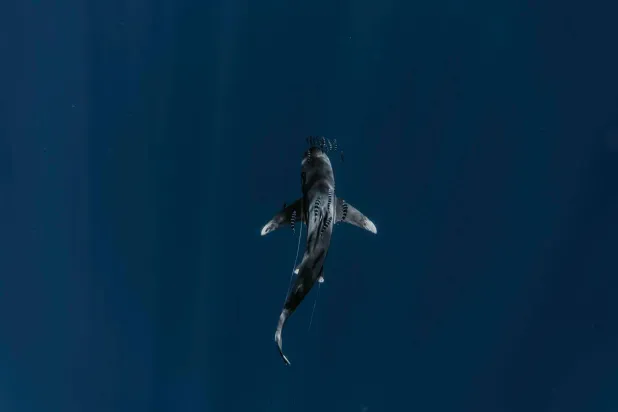
The Greenland shark is one of the most mysterious marine creatures; not only because of its ability to live in the depths of polar oceans, but also for its exceptional lifespan that may extend for centuries. This mysterious marine creature possesses exceptional abilities; it maintains a heart that beats for centuries, and eyes that do not easily lose their efficiency, defying the signs of aging-related decline.
In April 2026, researchers and volunteers on the west coast of Ireland found the first Greenland shark observed stranded on the country's shores. The dead animal, which was about 3 meters long, was estimated to be over 150 years old, meaning it was born during the reign of Queen Victoria and U.S. President Abraham Lincoln.
Although this age seems exceptional for humans, it is relatively young for a Greenland shark, which is believed to be the longest-living vertebrate on the planet; it can live for about 400 years, with scientific estimates ranging between 300 and 500 years.
Emily De Los, a marine biologist at the Irish Whale and Dolphin Group, said according to a BBC report: 'It's amazing to think about how long this animal lived, and what it might have witnessed during its life.'
Greenland shark dissection reveals new secrets
The shark's death provided a rare opportunity for scientists to study a species about which much remains unknown. The shark, which weighed more than 200 kilograms, was transferred to a veterinary laboratory for an autopsy involving researchers from several institutions.
Jasmin Stafino Germalm, a researcher in marine ecology at University College Cork in Ireland, said: 'Dead animals can provide important information about their living counterparts.'
During the autopsy, researchers examined the shark's organs, measured their sizes, and took samples; they also preserved its skin, covered with small sharp teeth known as 'dermal denticles,' for use in future scientific studies.
Eyes that do not deteriorate despite more than a century passing
Scientists have long believed that the Greenland shark suffers from severe vision impairment, possibly blindness, due to its long lifespan and the small parasites that live on the surface of its eyes.
However, recent research has presented a different picture; it found that its eyes and retina are healthy and specialized for living in the dark depths of the ocean.
Lily Fogg, a researcher in evolutionary biology at the University of Basel in Switzerland, said that the visual system of this shark resembles 'a low-light camera,' explaining that the cells and molecular mechanisms responsible for vision remain intact even in sharks that have lived for over a century.
She added that this is striking, because it indicates that this creature has developed mechanisms to resist age-related decline, unlike humans whose vision typically deteriorates with age.
Genes for repairing damage and a heart that resists aging
Researchers believe that one reason for the Greenland shark's longevity may be related to its ability to repair DNA damage; studies have found that some genes responsible for repairing genetic damage are more active in it compared to other shorter-lived shark species.
Scientists also studied the heart of this creature, which weighed about 34 kilograms, and despite the appearance of age-related signs such as scarring, they noted that it had continued to function efficiently.
These results indicate that the Greenland shark has developed an exceptional ability to withstand changes usually associated with deteriorating heart health in humans. Scientists believe that this resilience may be one of the keys that helps this animal survive for centuries.
But researchers emphasize that these discoveries do not mean they have found a way to slow human aging or extend lifespan, but rather they provide a deeper understanding of the biological mechanisms that help some creatures resist the effects of aging.
A slow creature reveals survival secrets
The Greenland shark lives in the North Atlantic waters and polar regions around Greenland, Canada, and Iceland, and has developed characteristics that help it survive in extremely cold waters.
This shark is characterized by its slow movement and solitude; it often feeds on carrion, but can sometimes hunt live prey, such as seals, using its suction power to swallow them.
Its slow metabolism may also be one of the factors that helped it adapt to a resource-scarce environment, where prey is available seasonally.
Many secrets still unknown
Despite its large size and wide distribution, the Greenland shark remains one of the most mysterious marine creatures. Brian Devine, a marine biologist at the environmental organization Oceans North, says that scientists do not yet know its mating or birthing locations, nor the number of pups it produces, or its reproduction rate.
This lack of information makes it difficult to estimate the global population of these sharks or assess the risks they face, such as accidental entanglement in fishing nets.
The National Museum of Ireland hopes to display this shark in the future, giving visitors the opportunity to learn about one of the most mysterious shark species and the scientific efforts to understand the secrets of its long life.
"); googletag.cmd.push(function() { onDvtagReady(function () { googletag.display('div-gpt-ad-3341368-4'); }); }); }
Original source: Asharq Al-Awsat






Comments (0)
Be the first to comment.