Libya Faces Risk of Foot-and-Mouth Disease Outbreak with Precautionary Measures
Libyan authorities have expanded precautionary measures to address fears of a foot-and-mouth disease outbreak among cattle and sheep, after infections and suspected cases were detected in several cities, alongside the closure of livestock markets and increased veterinary oversight in areas in the east and west.
The actions of the two governments in Tripoli and Benghazi reflect growing concern over the spread of the disease and its potential economic losses, amid warnings that years of political division have weakened the animal health system and reduced the effectiveness of vaccination programs.
Technicians from a veterinary team during the examination of an animal suspected of having foot-and-mouth disease in the Libyan city of Zliten (Agricultural Police).
Dr. Abdul Hamid al-Sharif, director of the Epidemics and Zoonotic Disease Control Department at the National Center for Animal Health in western Libya, believes that current concerns are not only related to the emergence of new hotspots but also to the accumulation of crises that the veterinary sector has suffered for years. He told Asharq Al-Awsat that veterinary authorities are continuing containment efforts through epidemiological verification teams deployed in municipalities, which collect samples and test them locally, or send them to external laboratories when local testing is not possible.
Fears increased in western Libya after the Agricultural Police announced on Saturday the confirmation of an infection in a sheep flock in the Al-Amamra area of the Municipality of Msallata, resulting in the death of 4 heads and infection of 86 others, following a report from a breeder and a field inspection by veterinarians.
Minister of Agriculture and Animal Resources in western Libya, Abdul Latif al-Taher, during his inspection of the headquarters of the National Center for Plant Protection and Quarantine last week (Ministry page).
This coincided with an escalation of precautionary measures, as the municipalities of Qasr Bin Ghashir, Al-Ajailat, and Bani Walid closed livestock markets and imposed restrictions on the entry of animals and meat from areas suspected of infection, to limit transmission.
Agricultural officials also intensified inspection campaigns in livestock markets in the towns of Souk al-Khamis Amsayhel, Al-Asaba'a, and Gharyan late last week, while veterinary teams in Zliten dealt with suspected cases by taking samples from several livestock, while a joint committee in Bir al-Ghanam concluded that no infections were recorded.
In the east of the country, veterinary authorities in Al-Bayda announced suspected infections in sheep flocks in the Qandula and Marawa areas, after symptoms including lameness, mouth and tongue ulcers, and deaths appeared. Animal health teams collected samples for laboratory tests to determine the nature of the virus and take necessary containment measures.
The head of the Veterinary Medical Professions Syndicate in the city of Al-Marj, Dr. Marwan al-Asbali, issued a warning about the danger of foot-and-mouth disease, noting that it is characterized by rapid spread and ability to travel through the air over long distances, in addition to transmission via equipment, vehicles, and people moving between barns. He clarified in previous statements to the Libyan News Agency (LANA) that 'the disease, despite low mortality rates among adult animals, causes significant economic losses due to decreased milk production, abortions, and emaciation, while mortality rates among newborn lambs and calves rise to between 50 and 70 percent due to heart muscle infection.'
Foot-and-mouth disease has been recurring in Libya for years, and each time it is met with measures by authorities in the east and west of the country. However, Al-Sharif attributes the recurrence of outbreak waves to the potential impact of political division. He explains that 'lack of resources, irregular arrival of vaccines on time, and flaws in implementing vaccination programs are all factors that have contributed to the spread of the disease,' highlighting that 'the conflicts the country has witnessed in recent years have also led to an expansion in the import of livestock and meat, amid the weakness of some state institutions, which may have contributed to the entry of new disease hotspots and made foot-and-mouth disease appear almost annually.'
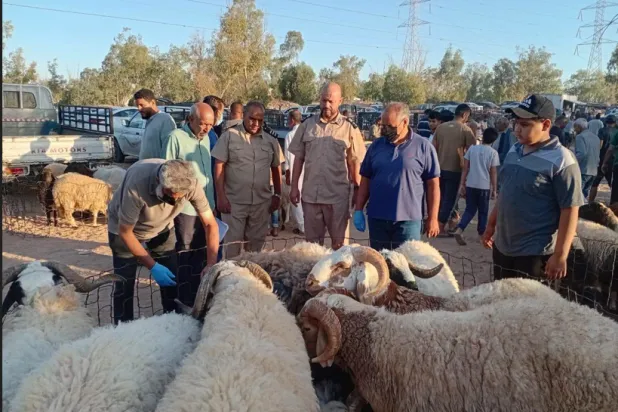
From inspection operations of sheep on a farm in western Libya (Agricultural Police).
However, the recurrence of the disease is not only due to the years of division, according to Al-Sharif. He explained in this context that Libya has witnessed sporadic disease hotspots in the east and west since the 1980s, with infections appearing about every 5 years, before being contained through 'ring vaccination,' which relies on culling infected animals and vaccinating livestock within the hotspot area. He pointed out that the last comprehensive vaccination campaign nationwide was carried out in 2013, before the infection rate increased between 2015 and 2019, transforming from spaced-out waves to almost annual outbreaks.
Foot-and-mouth disease is one of the most contagious viral diseases among cloven-hoofed animals, such as cattle, sheep, and goats. It causes fever, mouth and hoof ulcers leading to lameness and decreased milk production, and is transmitted through direct contact, air, and contaminated tools, while human infection remains rare.
Specialists recommend adhering to periodic vaccination programs, applying biosecurity measures inside barns, imposing quarantine on new animals, and safe disposal of dead animals. Al-Asbali also emphasized that early reporting of suspected cases is one of the most important factors in containing the disease.
However, the director of the Epidemics and Zoonotic Disease Control Department stressed that permanently eradicating foot-and-mouth disease 'is not only related to veterinary measures; it requires addressing the root causes of the crisis by restoring the capabilities of state institutions, ensuring regularity of vaccination programs, and tightening control over livestock import movements.'
Original source: Asharq Al-Awsat



Comments (0)
Be the first to comment.