The 'Star Doctor'... Has Cosmetic Medicine Lost Its Battle to Fame?
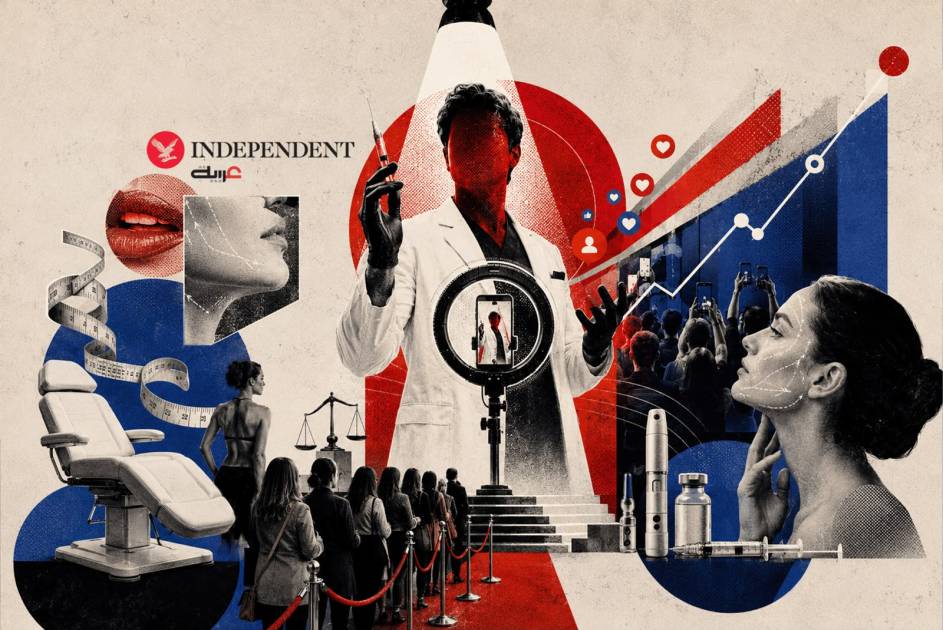
Summary: Algorithms have become partners in medical decision-making, and cosmetic clinics no longer only sell operations and procedures; they now sell a visual dream created by digital platforms. From the phone screen to the operating room, the rules of the game have changed: the number of followers now competes with experience, and quick procedures have turned into a multi-billion dollar trade.
How many followers does he have? How many Reels (short videos) does he post per week? And how many virtual influencers does he market for?
These may be the most common questions today among cosmetic doctors and their patients, instead of asking about experience and number of successful operations. In an era where success is measured by views, many clinics have transformed from silent operating rooms into filming studios adorned with ring lights, where the doctor has become a star who knows his role, reads a pre-written script, and appears to the audience as if he is a performer on a TV show, and the patient has become a customer waiting his turn on a booking list for the sake of marketing and sales.
With this reality, many doctors have turned from guardians of knowledge into content creators and sellers, seeking audiences before seeking diagnoses, and using criteria and trends on digital platforms as a means of influence and profit, until health became a content industry closer to corruption than science. Cosmetic clinics, with their quick promises and 'before and after' photos polished with filters, are the most shining facade of this model, and perhaps the most profitable as well.
From surgery to trend: You only have to search or talk to your friends about cosmetic procedures in front of your smartphone, and pages of cosmetic doctors and other specialists who found their main income in cosmetics will inundate you, accounts with the word 'Sponsored' at their side, making you imagine the amounts paid so that the ad reaches the folds of your brain. Only numbers are capable of dispelling the illusion that cosmetics is still a limited personal decision. According to the global survey issued by the International Society of Aesthetic Plastic Surgery at its 2023 conference in Singapore, more than 37.9 million cosmetic operations and procedures were performed worldwide in one year, including about 17.4 million surgical operations and 20.5 million non-surgical procedures, an increase of more than 42 percent in just four years.
Botox alone accounted for 7.8 million injections, followed by hyaluronic acid filler injections at about 6.3 million injections, while rhinoplasty procedures declined by 10 percent in favor of faster and less expensive procedures such as blepharoplasty (eyelid surgery), which topped the list of surgical procedures worldwide for the first time, surpassing breast augmentation and rhinoplasty.
Many clinics have turned from silent operating rooms into filming studios (Independent Arabia)
Accelerated growth and marketing offers: This accelerated growth does not necessarily reflect an improvement in medical need, but rather an explosion in marketing offers. Estimates indicate that the global cosmetics market, including devices, injections, and procedures, is heading to exceed $108 billion by the next decade, driven by the influence of social media, as Instagram has become a real demand engine, turning a photo into a prescription and a like into a surgical appointment.
This acceleration has a documented human cost. In the United States, a person who impersonated a doctor named Andrew John Hardy, without any medical degree, was convicted of second-degree murder after the death of actress Karelya Parada following injection of industrial silicone in a 'Brazilian butt lift' procedure.
In detail, this 'non-doctor star' injected the actress in unequipped hotel rooms, leading to her death from a silicone embolism in the lung and heart wall. The case then revealed secret networks carrying out these dangerous procedures away from official medical oversight in America.
It is the second crime for the same convict, after a previous manslaughter conviction for two other victims, revealing the fragility of oversight even in markets that are supposed to be the most regulated in the world. In an investigative report published by KFF Health News in partnership with NBC News, it was revealed that a certified surgeon in California named Heidi Regines was linked to the deaths of three women during liposuction and buttock lift procedures, without her license being immediately suspended, amid calls from national plastic surgery associations to tighten safety standards and urge potential patients to verify thoroughly before signing any surgical contract, an implicit acknowledgment that the current oversight mechanism is unable to keep pace with the speed of the market.
The Arab reality: Market indicators indicate that Gulf countries have become among the fastest growing regions in cosmetic surgeries and procedures, driven by high healthcare spending and expanding medical tourism.
A report titled 'Size and Forecast of the Cosmetic Surgery and Procedures Market in the United Arab Emirates' in 2026 stated that the value of the cosmetic surgery and procedures market reached about $189.1 million in 2024, with expectations to rise to $880.9 million by 2033 at a compound annual growth rate of 8.7 percent. In Saudi Arabia, a report titled 'Cosmetic Surgery Market Flourishes in Saudi Arabia' indicated that the Kingdom accounts for about seven percent of cosmetic surgeries globally, with a market value exceeding $5 billion, ranking second in the Arab world after the UAE and 29th globally.
Egypt also leads Arab countries in the number of cosmetic surgeons, benefiting from being one of the oldest countries where this type of surgery was known in history, as indicated by ancient manuscripts, in addition to its relatively low prices compared to Europe and America.
Lebanon and the series of suspicious clinics: As for Lebanon, which was historically described as the cradle of cosmetic surgery in the region before the specialty moved from it to Egypt and then to the rest of the Arab countries, it still holds an advanced global rank, classified second after Brazil in number of procedures per capita, according to local data such as that issued by the Lebanese Order of Plastic Surgeons.
Lebanon has long boasted the title 'Hospital of the Middle East,' based on the historical competence of its doctors and its position as a regional destination for medical tourism, of which cosmetic surgery represents more than 70 percent. However, the economic crisis that has hit the country since 2019 revealed the other side of this industry, manifested in the migration of many senior doctors and the explosion of 'popular' clinics offering tempting prices and instant results.
In May 2025, the General Directorate of State Security arrested the owner of an unlicensed cosmetic clinic after it was found that he was practicing cosmetics impersonating a specialist doctor. Seized in his clinic were quantities of expired medications and others that were unlicensed altogether, after his procedures led to physical deformities and serious health complications for a number of his clients. In January 2026, the Bekaa Investigation Squad raided a clinic in Zahle belonging to an impersonator of a cosmetic and dermatology doctor without any license, and sealed it with red wax. Between the two incidents, and dozens of others that did not reach the media, the same story repeats: a training certificate hanging on the wall instead of a specialization certificate that took six years of study, as real cosmetic surgery requires, since this precise specialty is not a profession that can be learned in a course or workshop.
With cosmetics, but...
Original source: Independent Arabia



Comments (0)
Be the first to comment.