Al-Tamimi to Okaz: Saudi Arabia supported security and development in Hadhramaut
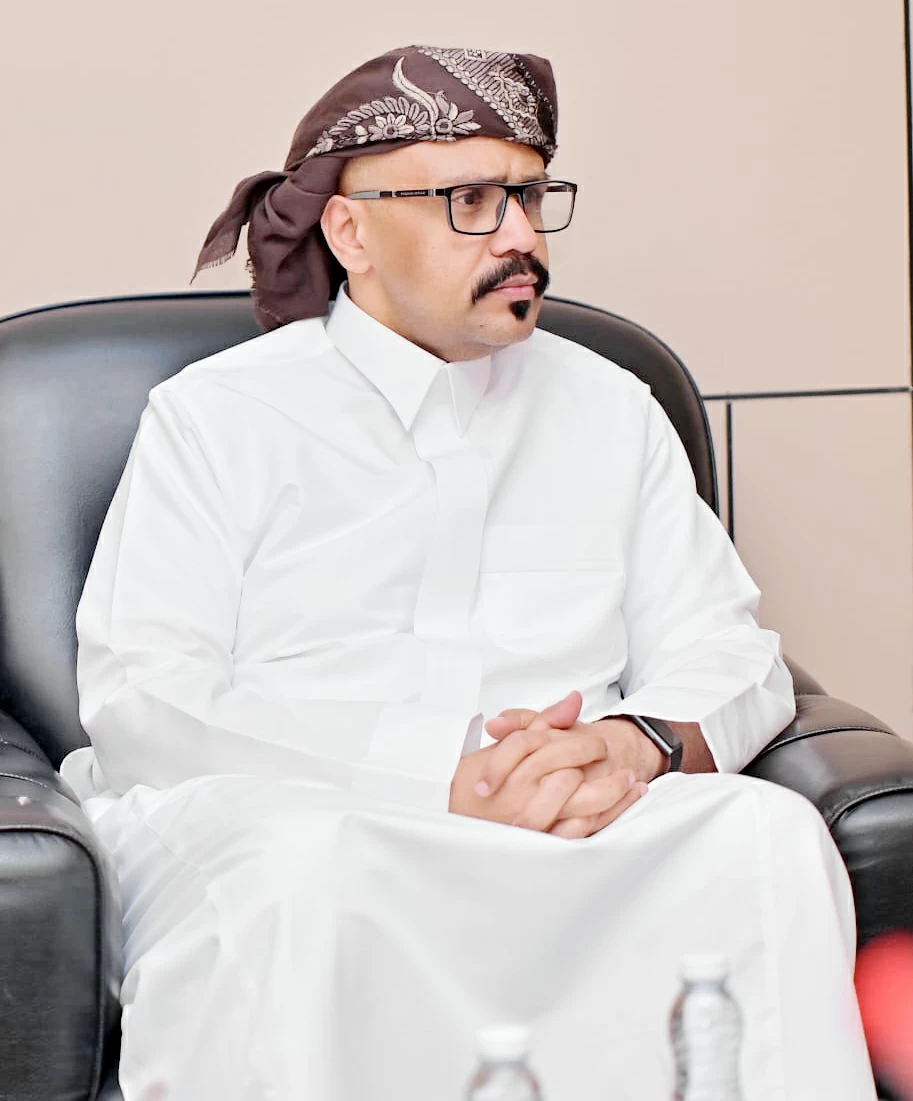
He affirmed that the Southern dialogue under the Kingdom's auspices is a historic opportunity.. and the tribe is not a substitute for the state
Follow Okaz channel on WhatsApp
Amid the political and security transformations in Yemen, Hadhramaut stands out as one of the most distinctive governorates due to its geographical location, tribal and economic weight, and its role as a key pillar in any future political settlement. Amid the complexities of the scene, the tribe remains present as a factor in maintaining stability and community peace alongside state institutions.
In this interview, Director General of the Tribal Affairs Department in Hadhramaut's Wadi and Desert region and Advisor to the Minister of Interior, Sultan Zayed Al-Tamimi, discusses the reality of Hadhramaut today, the 'General Reconciliation' project, and the future of the relationship between the state and the tribe, his vision for the Southern dialogue, and highlights the Saudi role in supporting security and development in various fields.
Here is the text of the interview:
"• Hadhramaut today stands between political complexities, tribal sensitivity, and security concerns.. How do you describe the real scene in Hadhramaut's Wadi and Desert now?
"" The scene in Hadhramaut's Wadi and Desert cannot be reduced to a political or security headline alone; these files are interconnected and overlapping. Hadhramaut's geographical nature and tribal composition have made the tribe part of the stability system, not an antithesis to the state or a substitute for it.
When state institutions weaken, the tribe becomes a social reference that preserves security, contains conflicts, and prevents a slide into chaos, as demonstrated by the experiences Hadhramaut has gone through in recent years. What is required today is building a real partnership between the state and the tribe, not putting them in opposition to each other, because the stability of Hadhramaut is a shared responsibility.
"• You announced the 'General Reconciliation' project.. What has been achieved so far, and what are the most prominent files you are working to close?
"" The General Reconciliation project is not just a media announcement; it is field work that has already begun. We conducted extensive visits to various tribes and contributed to resolving a number of blood feuds, disputes, and tribal conflicts. We are working to bring viewpoints closer and bridge gaps between social components.
True, the vast area of Hadhramaut makes the task large, but we believe that preparing society for comprehensive reconciliation begins with closing small files before large ones, so that we reach a general reconciliation that enhances community peace and establishes lasting stability.
"• How can the role of the tribe in Hadhramaut be transformed from a reactive role during crises into a permanent partner of the state in security and development?
"" This is the core of our vision in the Tribal Affairs Department. The tribe should move from individual effort and reactions to organized institutional work that serves the state and society.
We have received great support and attention from the member of the Presidential Leadership Council, Governor of Hadhramaut, Salem Ahmed Al-Khanbashi, which helped activate this approach, so that the efforts of the tribes become a tributary for security, stability, and development, and a partner of the state in addressing societal issues.
"• You called for a Southern dialogue under Saudi auspices, but you indicated that the tribes are far from its mechanisms.. What do you mean?
"" In Hadhramaut, society is tribal in nature, whether those who carry weapons or those who have engaged in civil life, and all represent a pillar of stability.
The tribes proved their national role when Mukalla fell to Al-Qaeda in 2015; they took the initiative to protect state institutions and oil companies, prevented the organization from expanding into the rest of Hadhramaut, then handed over those sites to the state after liberation without any cases of looting or sabotage.
The tribes also assumed political roles amid the weakness of parties, and contributed to representing Hadhramaut in various consultations. Therefore, any dialogue that bypasses this component will lose an important part of its chances for success, while involving it enhances opportunities to reach sustainable solutions that gain community acceptance.
"• Where do you stand between Hadhramaut's historical distinctiveness and attempts to draw it into political projects that do not represent its interests?
"" Hadhramaut possesses a historical, geographical, and political distinctiveness that no one denies. It is a land on which a state was established throughout history, and it possesses great economic and human resources. It suffices that the Hadhrami person contributed to building states and spreading Islam around the world with his morals and trade.
Therefore, the people of Hadhramaut see that their issue should be present as an independent issue in any political settlement, away from attempts at annexation or partisan or regional polarization, because the interest of Hadhramaut is the compass on which everyone should agree.
"• How do you view the Kingdom's role in Hadhramaut politically, security-wise, and developmentally?
"" The relationship between Hadhramaut and the Kingdom of Saudi Arabia is a historical relationship that goes beyond politics; it is a relationship of neighborliness, kinship, shared interests, and social extension.
The Kingdom has always been a refuge for the people of Hadhramaut in various stages, hosting them and opening doors for work, education, and a decent life.
Today, this support is embodied in the political, security, and developmental aspects, through sponsoring dialogue efforts, supporting security and stability, and implementing projects through the Saudi Program for the Development and Reconstruction of Yemen and the King Salman Humanitarian Aid and Relief Center in the fields of electricity, education, health, infrastructure, and others—projects whose impact citizens have directly felt.
We also appreciate the Saudi positions that contributed to containing tensions and preventing Hadhramaut from sliding into wider conflicts, a role that reflects the Kingdom's keenness on the security and stability of Hadhramaut, Yemen, and the region.
"• How do you envision the future of the Tribal Affairs Department? Will it remain a traditional body or transform into a modern institution?
"" Our vision is for the Tribal Affairs Department to transform into a modern institution operating on scientific and administrative foundations, not limited to protocol aspects.
We aspire to build an accurate database, develop community mediation mechanisms, and enhance partnership with state institutions, so that the department becomes an effective link between the state and the tribes, preserving societal unity, fortifying it against polarizations, and contributing to supporting development, stability, and community decision-making.
"• Finally.. If you wanted to send messages from Hadhramaut via Okaz to Riyadh, Sanaa, Aden, and the Southern components, what would you say?
"" To the Kingdom of Saudi Arabia, we say: Thank you for your historic stances with Hadhramaut and Yemen in general. We trust the wisdom of your leadership and its keenness to achieve security and stability, and we hope for the continuation of this brotherly role that has been and continues to be appreciated by the people of Hadhramaut.
To Sanaa, we say: There is no future for Yemen under the rule of the coup militia. The sons of the nation must reject sectarian projects and move towards building a state on the foundations of partnership, justice, and the rule of law.
As for Aden, we say: Hadhramaut is a key partner in shaping the future. Any national project will not succeed unless it is based on genuine partnership and respect for the will of the people of Hadhramaut and their political and historical distinctiveness.
And to the Southern components, you have a historic opportunity in the comprehensive dialogue sponsored by the Kingdom of Saudi Arabia. Let the public interest prevail over narrow calculations, and let us make dialogue a path to consensus, and partnership a foundation for building a safe and stable future for all the sons of the nation."
Original source: Okaz


Comments (0)
Be the first to comment.