Bahrain's Foreign Minister: Iranian Aggressions Are Systematic, Not Random or Accidental
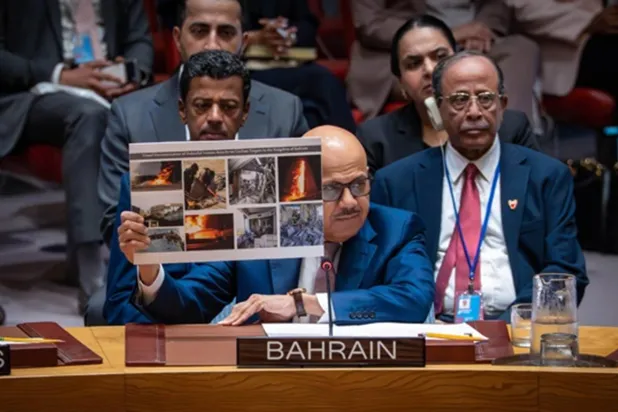
Abdullatif bin Rashid Al Zayani, Bahrain's Minister of Foreign Affairs, affirmed that Iran's aggressions were not random or accidental, but rather indicate deliberate, premeditated targeting carried out in a systematic manner.
Abdullatif bin Rashid Al Zayani, Bahrain's Minister of Foreign Affairs, affirmed that the Iranian aggressions against his country were not random or accidental, but rather indicate deliberate, premeditated targeting carried out in a systematic manner, not as immediate reactions, pointing out that the facts on the ground refute the claim that they target military rather than civilian presence, as the precision in selecting targets and the repeated targeting of specific entities reveal.
Al Zayani said, during an emergency session of the Security Council to discuss the repeated Iranian aggressions against Bahrain on Thursday, that these criminal aggressions with ballistic missiles and drones, which targeted vital areas populated by civilians, are not a transient incident, but rather an ongoing series of repeated aggressions that began on February 28 and continued even after the signing of the memorandum of understanding between the United States and Iran, and continue to this day.
The Minister of Foreign Affairs added that Bahrain took the initiative to request this emergency session, realizing the Council's inherent responsibility to maintain international peace and security, and confident that after it condemned the Iranian aggressions against the Gulf and Jordan in its resolution 2817, it will not remain a spectator to this blatant challenge to its will.
Al Zayani pointed out that Bahrain's territories have been targeted since the beginning of the war with a total of 808 aggressions, including 203 missiles and 605 drones, indicating that they targeted civilian objects, vital installations, and residential areas, resulting in 3 deaths and 465 injuries among peaceful civilians, including women and children.
Al Zayani stressed that the aggressions, according to reality, indicate deliberate, premeditated targeting, not as immediate reactions (BNA).
The minister pointed out that had it not been for the proactive measures taken by the competent authorities, the losses would have been more devastating, explaining that the effects of those aggressions were not limited to material and human losses, but extended to terrorizing peaceful people, spreading panic among the population, and disrupting their normal lives, an act prohibited by international humanitarian law, which criminalizes acts whose primary purpose is to spread terror among civilians.
Al Zayani said that the precision in selecting these targets and the repeated targeting of specific entities reveal that these aggressions were not random or accidental, but rather indicate deliberate, premeditated targeting carried out in a systematic manner, not as immediate reactions.
The Minister of Foreign Affairs questioned the justification for targeting a water desalination plant, populated residential areas, civilian installations, and vital facilities, adding that Bahrain has documented every aggression since its occurrence and submitted to the Secretary-General of the United Nations and the President of the Council official letters with all related documents, cutting off any claim of exaggeration or politicization.
Al Zayani stressed that these ongoing aggressions carried out by Iran and its proxies do not target Bahrain alone, but extend to threaten the security of the entire region, considering them a clear violation of the United Nations Charter and Security Council resolution 2817, which received support from 136 countries.
Bahrain's Minister of Foreign Affairs stressed that the aggressions of Iran and its proxies threaten the security of the entire region (BNA).
Bahrain's Minister of Foreign Affairs pointed out the continuation of Iran's attacks, even after it pledged, under the memorandum of understanding, a permanent cessation of military operations, but it violated this pledge within days, stressing that this is not an isolated incident, but part of a repeated pattern of non-fulfillment of international obligations, making the lesson not in who signs the agreement, but in who commits to its implementation.
Al Zayani called on the Security Council to reaffirm its condemnation of the repeated aggressions, to oblige the Iranian regime to stop them immediately and fully comply with resolution 2817 and its obligations under international law, and to adopt an effective mechanism for monitoring implementation and accountability, stressing that the Council's credibility is measured by its ability to protect safe states and deter the aggressor, and that the effectiveness of its decisions lies in their implementation, not merely their issuance, and that the beginning and end of the road is that these attacks stop immediately, and that the Council rises to this responsibility.
The minister stressed Bahrain's reservation of its legitimate right to self-defense, according to Article 51 of the Charter, while adhering to the highest levels of restraint and seeking peaceful solutions.
For his part, Jassim Mohamed Albudaiwi, Secretary-General of the Gulf Cooperation Council, renewed the Council's full solidarity with Bahrain and its support for all its measures to protect its security, stability, sovereignty, and territorial integrity, stressing that the security of the Gulf states is indivisible, and any aggression targeting one of them is considered an aggression against all.
Albudaiwi noted that Bahrain's briefing reflects its commitment to diplomatic and legal channels and to informing the international community of the seriousness of these developments and their repercussions on the security and stability of the region, and also confirms its approach based on respect for the rules of international law and the United Nations Charter, and its keenness to address challenges through international institutions, thereby contributing to enhancing regional and international security and peace.
The Secretary-General called on the international community, particularly the Security Council, to assume its responsibilities in maintaining international peace and security and to take a firm stance against these aggressions in a way that ensures the cessation of acts threatening the security of the region, respect for the principles of international law and the United Nations Charter, and enhances regional and international security and stability.
"); googletag.cmd.push(function() { onDvtagReady(function () { googletag.display('div-gpt-ad-3341368-4'); }); }); }
Original source: Asharq Al-Awsat



Comments (0)
Be the first to comment.