Kingdom Hosts 11 Species of Desert Skinks
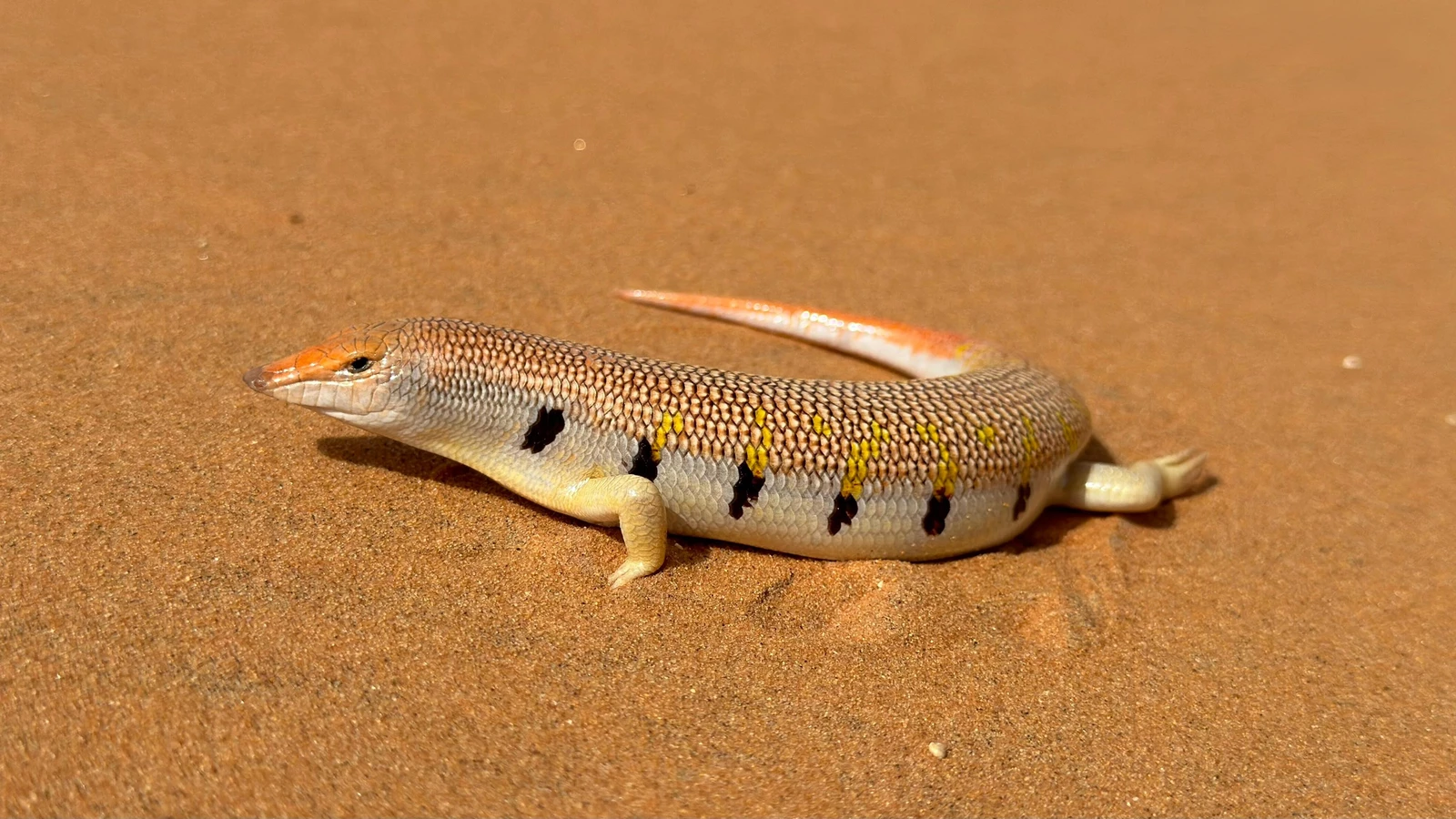
تضم صحاري المملكة 11 نوعاً من السقنقورات الصحراوية، تتسم بقدرة فريدة على السباحة داخل الرمال والاختباء من الأعداء. تتفاوت أحجامها وألوانها لتتناسب مع البيئات المختلفة، وتعتمد على الحشرات غذاءً رئيسياً.
Skinks are widespread across various regions of the Kingdom as one of the most diverse desert reptiles, comprising 11 species that vary in size, color, and natural habitats, while sharing a streamlined body covered with smooth, shiny scales, short limbs, and a high ability to adapt to different environmental conditions.
The recorded species in the Kingdom include the sand fish skink and the spotted sand skink, which are widespread in most sandy environments, along with the Asian snake-eyed skink, the Tihama sand skink, the golden skink, and other species distributed across various habitats within the country.
They also inhabit deserts, sand dunes, plains, valleys, oases, and areas with sparse vegetation, with some species found in lowlands and hard-packed sand near soft sand, each species possessing characteristics that help it adapt to its environment and lifestyle.
The species known as 'sand fish' earned this name due to their ability to move through soft sand quickly and flexibly, darting in various directions and depths with a motion resembling fish swimming in water, making them among the most adapted reptiles to the desert environment.
Some skinks have a strong cylindrical body covered with smooth scales that facilitate gliding through sand, in addition to a head that tapers forward, a pointed snout that helps them penetrate sand, a short broad-based tail, and four short limbs ending in toes with claws suitable for movement.
The body length in some species, from the tip of the snout to the vent, is about 14 centimeters, while sizes, colors, and patterns vary according to species, age, and environment. Sandy coloration tending toward yellow or orange predominates in desert species, with dark and yellow bands appearing in some adults.
Sand skinks rely on a behavior known as 'sand swimming,' as they can dig and dive into sand to a depth of up to 40 centimeters, with the sand flowing behind them to seal the path, providing an effective means of hiding from predators and protection from high temperatures.
Some species also sense vibrations made by their prey on the sand surface while they are beneath it. They primarily feed on insects, especially beetles and worms, in addition to arachnids and small organisms, while some species consume plant matter, and others enter periods of hibernation among plant roots.
Skinks contribute to maintaining ecological balance by reducing insect populations, and they represent an important element in the food chain within desert ecosystems. Their species are distributed in the Kingdom, the Arabian Peninsula countries, and Iran, and have undergone conservation status assessments at both regional and global levels.
Original source: Akhbaar24





Comments (0)
Be the first to comment.