Sahim Al-Dajani Chronicles Riyadh’s Culture Between Society and Empowerment
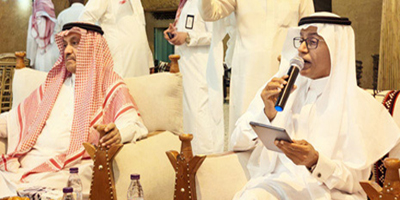
A cultural evening hosted by Diwaniyat Al-Mani' in Al-Qasab, organized by Riyadh Municipality, featured researcher Sahim Al-Dajani discussing the historical and contemporary cultural scene in Riyadh, including literary salons and municipal cultural initiatives.
Researcher Sahim Al-Dajani speaks alongside Dr. Othman Al-Mani'. Friday/Saturday, July 10, 2026. Cultural - Al-Qasab / Photo by Muhammad Al-Humaydi: The Diwaniyat Al-Mani' in Al-Qasab, under the patronage of the Riyadh Region Municipality represented by the General Administration of Culture, organized a dialogue evening blending conversation, history, culture, and the memory of historical literary salons. The literary evening was dedicated to discussing 'Riyadh’s Culture Between Society and Empowerment,' presented by cultural researcher, literary salon enthusiast, former director of the Hamad Al-Jasser Cultural Center, and well-known writer Mr. Sahim bin Dawi Al-Dajani. He presented a historical overview of the Riyadh Region Municipality’s efforts in caring for the cultural affairs of the region. The event took place at the 'Diwaniyat' of the sons of Abdullah Al-Mani' in the heritage district of Al-Qasab. The evening was introduced by Dr. Khaled Al-Khudhari and moderated by Dr. Othman bin Abdulaziz Al-Mani', former member of the Riyadh Region Council. The gathering was attended by a select group of intellectuals, writers, media professionals, and those interested in cultural affairs in Al-Qasab. The evening featured an open dialogue led by renowned media figure Dr. Khaled Al-Khudhari, who opened the meeting with an introduction to the guest and his longstanding relationship with literary salons. The guest had published the first specialized book on literary salons, titled 'Literary Salons in the Kingdom of Saudi Arabia: Observation and Documentation,' 21 years ago in 1427 AH (2006). He then supervised the preparation of a monthly page in the 'Arab Magazine' in 1423 AH (2002) under the editorship of Mr. Hamad Al-Qadi. His relationship with the Sheikh of the Peninsula, Hamad Al-Jasser, began before 1414 AH (1993), i.e., 33 years ago, as he attended Al-Jasser’s weekly Thursday morning sessions for over seven years. Later, he took over the supervision of Sheikh Hamad Al-Jasser’s Thursday salon when he became director of the Hamad Al-Jasser Cultural Center in 1423 AH (2002). The guest then had the opportunity to speak, and Al-Dajani reviewed the meeting’s topics, including: the history of public libraries in Riyadh, the historical origins of Saudi literary salons, the role of literary diwaniyas in the Saudi literary scene and the challenges they face, perspectives on Riyadh’s cultural scene, Riyadh as the Arab Capital of Culture, and the Riyadh Exhibition between yesterday and today. The researcher began by highlighting the Riyadh Region Municipality’s cultural efforts, including: establishing a General Administration for Culture in 2024, making it the only municipality in the Kingdom to dedicate a general administration to culture for the cultural movement across the Riyadh region; the 'Memory of Riyadh' project; forming a cultural committee comprising academics and cultural specialists linked to the office of His Highness the Mayor. His Highness Prince Dr. Faisal bin Ayyaf, Mayor of Riyadh Region, said in his first meeting with committee members: 'Our work for the ambitious future of Riyadh is linked to its heritage, and our aspirations are great to contribute to caring for Riyadh’s heritage, culture, and historical sites. We hope the committee will help enhance the cultural aspects of our work and various projects.' The researcher noted that in his book 'Literary Salons in the Kingdom of Saudi Arabia,' published in 1427 AH (2006), he documented more than 33 cultural diwaniyas across the country, including over 15 literary salons in Riyadh, some of which have ceased while others continue to contribute across various cultural fields by both male and female intellectuals. He affirmed to the audience that cultural salons are deeply rooted in Saudi culture, which is why the Riyadh Region Municipality cares for these salons through observation, documentation, support, and attendance. In fact, it launched 'Diwaniyat Al-Ghaleen' for the elderly in Riyadh. Before concluding his talk, the lecturer mentioned the 'Imara' magazine published by the Riyadh Region Emirate in 1430 AH (2009), 18 years ago, during the tenure of the Custodian of the Two Holy Mosques King Salman—may God support him—as Emir of Riyadh Region. The first issue featured an opening article by King Salman titled 'A Magazine Made by the Citizen.' He questioned: 'Is publishing a magazine concerned with citizens, their issues, and the history and geography of their city not part of culture and its support?' At the end of the meeting, the lecturer presented several proposals, including: documenting literary salons in Riyadh city and its governorates, building a database, and classifying these salons by target audience and issues discussed for easier utilization; organizing an annual meeting for salon owners in the Riyadh region to exchange experiences and convey the municipality’s message to salon owners, who are in fact national windows to reach citizens and residents in various neighborhoods; developing the Riyadh Diwaniya and implementing joint activities and signing memoranda of understanding with prominent literary salon owners; renovating the public library (Saudi Book House) opened by the municipality years ago and turning it into a historical museum documenting the beginnings of the Saudi cultural scene; building bridges of communication with several literary cafes in various governorates of the Riyadh region through collaboration with the Literature, Publishing, and Translation Commission to convey the municipality’s cultural message to younger generations; expanding the establishment of 'Diwaniyat Al-Ghaleen' in various neighborhoods of the capital; and developing programs to improve the environment of mosques and the future of neighborhoods and their cultural role.
The atmosphere of the heritage village added warmth, elegance, and calm, accompanied by quiet autumn breezes and the scent of coffee blended with the rhythm of the documentary narrative of historical salons in our country, turning the meeting into a cultural soiree.
Interventions:
• Mr. Abdullah Al-Shamari, Director of Culture at the Municipality, affirmed that the municipality has long been concerned with the cultural movement in the region and prioritizes reviving historical diwaniyas as part of the transformation the municipal sector is undergoing.
• Dr. Abdullah Al-Haidari, former head of the Riyadh Literary Club, mentioned the Riyadh Region Municipality’s support for the Riyadh Literary Club, which he witnessed during his presidency, and the great support he received from various municipal sectors in the region for the club and its cultural activities in our beloved capital and its affiliated governorates.
• Mr. Ahmed Al-Samari, the renowned novelist, proposed that the Riyadh Region Municipality focus on small-scale neighborhood events and suggested studying the idea of a 'cultural neighborhood' in Riyadh.
• Mr. Abdullah Al-Hassani described the municipality’s presence as befitting Riyadh’s culture and history, recalling the municipality’s proactive efforts in serving the cultural scene over the years.
• Mr. Abdulaziz Al-Eid pointed out the need to bring back children’s theater to public parks and emphasized the importance of the digital space for the General Administration of Culture at the municipality, calling for a workshop on this matter.
• Dr. Ahmed Al-Saadi, faculty member at Shaqra University, stressed the need to benefit from the 'Literary Partner' initiative.
• Mr. Raed Al-Humaid described the municipality’s cultural efforts as soft power that deserves development for greater cultural diversity serving the Riyadh region, not just the city of Riyadh.
• Dr. Ahmed Al-Sawad renewed his thanks to the municipality for this practical step toward historical diwaniyas, which has a significant impact on the cultural context in the Riyadh region and its affiliated governorates.
Original source: Al-Jazirah



Comments (0)
Be the first to comment.