Proposed Law Classifies Tunisia's Ennahda as 'Terrorist Organization'
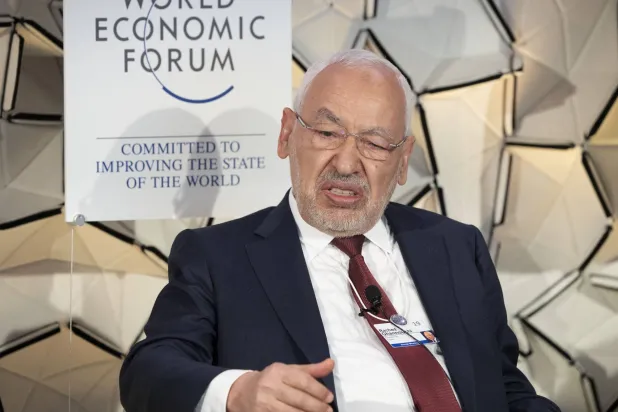
Tunisian parliamentarian Fatima al-Masdi announced the submission of a draft law on Thursday classifying the Islamic Ennahda movement as a 'terrorist organization'.
Egyptian Prime Minister Mostafa Madbouly witnessed on Thursday the installation of the reactor pressure vessel in the second unit of the Dabaa Nuclear Power Plant in the city of Dabaa, northern Egypt, a step that brings Egypt closer to its commitments to operate the plant and generate energy from it in 2028.
The Dabaa Nuclear Power Plant is a project being implemented by Egypt in cooperation with Russia to build an electricity generation plant. The two countries signed a cooperation agreement to build it on November 19, 2015, at a cost of $25 billion, provided by Russia as a soft government loan to Egypt. In December 2017, the two countries signed final agreements for its construction.
The Dabaa plant includes four nuclear reactors with a total capacity of 4,800 megawatts, at 1,200 megawatts per reactor. The first nuclear reactor is scheduled to begin operation in 2028, followed by the other reactors successively in 2030, according to the Egyptian Ministry of Electricity.
Officials from Egypt and Russia during the installation of the reactor pressure vessel for the second nuclear unit at the Dabaa plant (Cabinet of Ministers)
The installation ceremony for the reactor pressure vessel of the second unit was attended by senior statesmen from both Egypt and Russia, as well as the Director General of the International Atomic Energy Agency, Rafael Grossi, according to a statement from the Egyptian Cabinet.
'Dream' of the peaceful nuclear plant
The installation of the reactor pressure vessel for the second nuclear unit in Dabaa, located on the northwestern coast of Egypt, comes in parallel with the intensification of construction work at the plant according to the schedule to complete the four nuclear units and connect them to the national electricity grid, adding a production capacity of 4,800 megawatts. It also comes about seven months after the installation of the first unit's vessel.
According to the Egyptian statement, the installation of the reactor pressure vessel represents 'a major step in the project's implementation phases; it reflects the transition to a new stage of installing major nuclear equipment, paving the way for the completion of construction and preparation works in accordance with the highest internationally approved quality and nuclear safety standards.'
Madbouly said in his speech: 'This achievement represents a new step towards completing one of the most important national projects in the new republic, turning the dream of owning a peaceful nuclear power plant for electricity generation into a tangible reality.'
Egyptian energy professor Jamal al-Qalyoubi believes that the installation of the reactor pressure vessel highlights Egypt's commitment to the timetable for the reactor's operation.
He added, speaking to Asharq Al-Awsat: 'We are now continuing with the mechanical and electrical installations such as the reactor vessel, in addition to pumps, transformers, and electrical connections for the electricity transmission process itself.'
Nuclear safety standards
The reactor pressure vessel is classified as 'one of the most critical and sensitive components in any nuclear facility; it is a giant steel tank made of special high-strength alloys to contain the reactor core, where controlled chain nuclear fission reactions take place,' according to Russia Today on Thursday.
It added that this giant body, weighing hundreds of tons, 'was designed to comply with the highest international nuclear safety standards, making it capable of withstanding extreme temperatures, immense pressures, and continuous exposure to radiation throughout its intended operational life of over 75 years, extending safely until 2100.'
Russia Today quoted the Director General of the Russian company Rosatom, Alexei Likhachev, as saying that the equipment sent to Dabaa represents a fundamental pillar for the transition to operation processes in the first unit and for reaching the peak of civil construction work in the second unit.
He added: 'More than 25,000 workers are currently working full swing at the Dabaa site,' affirming that nuclear fuel will arrive at the plant in 2027, with the first nuclear electric current flowing into the Egyptian national grid in 2028, and the full project to be operational by 2030.
Egypt is seeking to expand its renewable energy production to reach 45% of the energy mix by 2028, instead of 42% by 2030, according to the Egyptian Ministry of Electricity.
Original source: Asharq Al-Awsat



Comments (0)
Be the first to comment.