Glide Bombs... The Weapon Reshaping Ukraine's Battles
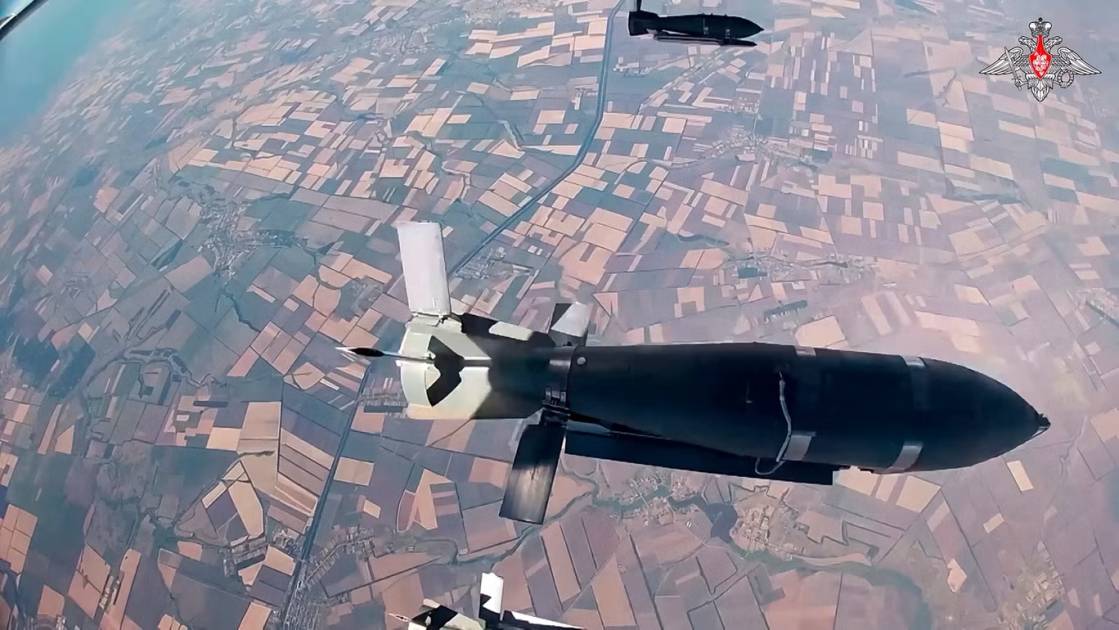
Summary: Glide bombs are emerging as one of the most prominent weapons of war in Ukraine due to their low cost and high destructive capability. With the declining effectiveness of traditional artillery, Moscow and Kyiv have turned to these munitions to enhance their battlefield superiority, in a new arms race that could directly impact the course of the war.
Ukrainian authorities announced the death of two people and the injury of at least 15 last week in a Russian glide bomb attack on the Ukrainian city of Zaporizhzhia, located in the southeast of the country.
In a post on the Telegram app, regional governor Ivan Fedorov wrote that Russian forces targeted the city with seven bombs over a period not exceeding 90 minutes.
In Zaporizhzhia, as across Ukraine generally, these strikes are increasingly carried out using glide bombs, low-cost munitions that experts say are redrawing the contours of the war in Ukraine.
Weighing between hundreds of kilograms and several tons, these conventional bombs equipped with wings and a guidance system have become one of the most effective Russian weapons since Russia's full-scale invasion of Ukraine in 2022.
Read more
Glide bombs: Moscow's means to destroy Ukraine's cities
Moscow raises fears of a 'dirty bomb' in Ukraine and the West denies
How Ukraine developed the range of its drones to reach deep into Russia?
Putin acknowledges difficulties in Ukraine... will he change the course of the war?
They have become particularly lethal recently, with thousands launched over the past months.
Hence, their ability to destroy an entire residential building in Zaporizhzhia or Kherson with a single bomb launched from inside Russian territory, away from Ukrainian air defenses, is a source of confusion and concern among Ukrainian commanders.
Such was the case until last May, when Ukraine announced it had succeeded in developing its own glide bomb.
Although Western allies had provided Ukraine with glide bombs, Kyiv expressed displeasure over the West's reluctance to provide sufficient supplies. Consequently, the country spent 17 months developing a domestically made bomb, named 'Vyrivniuvach,' meaning 'the equalizer.'
Keir Giles, associate fellow in the Russia and Eurasia Program at Chatham House and author of a book titled 'Who Will Defend Europe?' said, 'For a long time, there were no practical means of defense against Russian glide bombs, which greatly contributed to the increase in Ukrainian casualties along the front.'
What makes glide bombs a decisive battlefield weapon?
Despite their low cost and high reliability, both sides' use of this weapon was driven primarily by necessity, after traditional forms of artillery became less effective or were taken out of service.
According to the Military Balance website, drones across modern battlefields in Ukraine succeeded in tracking and destroying the vast majority of howitzers on both sides.
A massive fire from a Russian glide bomb strike on the city of Kupyansk in 2025 (Ukrainian State Emergency Service)
With the depletion of artillery pieces for both Moscow and Kyiv, 'long-range' munitions such as glide bombs emerged as a solution, given their ability to deliver large amounts of explosives to targets tens of kilometers away.
Recently, their use has accelerated, with Forbes magazine reporting that Russia launched more than 1,800 glide bombs in the first week of last June alone.
Low cost and ease of manufacturing
As with ready-to-use commercial drones and low-cost drones of the Bayraktar and Shahed types that have marked the course of the war, Russian and Ukrainian glide bombs are also characterized by low cost and ease of manufacturing.
The bulk of the Russian stockpile comes from Soviet-era bombs fitted with a simple system comprising folding wings, an inertial measurement unit, and a satellite guidance system known as the Universal Gliding and Correction Module (UMPK).
These bombs are designed to be launched by Russian fighter jets such as the Su-34 while flying at high altitudes, then glide for a distance ranging between 60 and 95 kilometers before dropping an explosive load weighing between 250 and 3,000 kilograms.
This distance between the launch point and the target, along with their lack of a thermal signature and their ability to descend rapidly from high altitude moments before impact, makes interception extremely difficult.
In contrast, Ukrainian glide bombs are much lighter than their Russian counterparts, weighing about 250 kilograms.
More destructive than drones
More importantly, both sides have not only used these munitions in strategic strikes against cities and industrial areas aimed at weakening morale and disrupting supply lines, but also deployed them in support of what is known as the 'fire concentration doctrine,' where artillery fire is tactically directed at enemy forward positions, whether to pave the way for ground attacks by weakening defenses or to destroy observation and reconnaissance positions.
Both sides have highlighted this use through videos recently posted on social media, showing glide bombs targeting the other side's positions during combat operations.
In this context, research analyst at the Royal United Services Institute (RUSI) Christoph Bergs said: 'Almost all Ukrainian artillery positions on the front lines are vulnerable to destruction.'
He added: 'It is true that quadcopters with first-person view (FPV) technology and tactical drones are capable of hitting targets, but they simply cannot match the destructive power of a 250 or 500-kilogram bomb.'
Original source: Independent Arabia



Comments (0)
Be the first to comment.