How does China describe its nuclear doctrine? And what do Western estimates say?
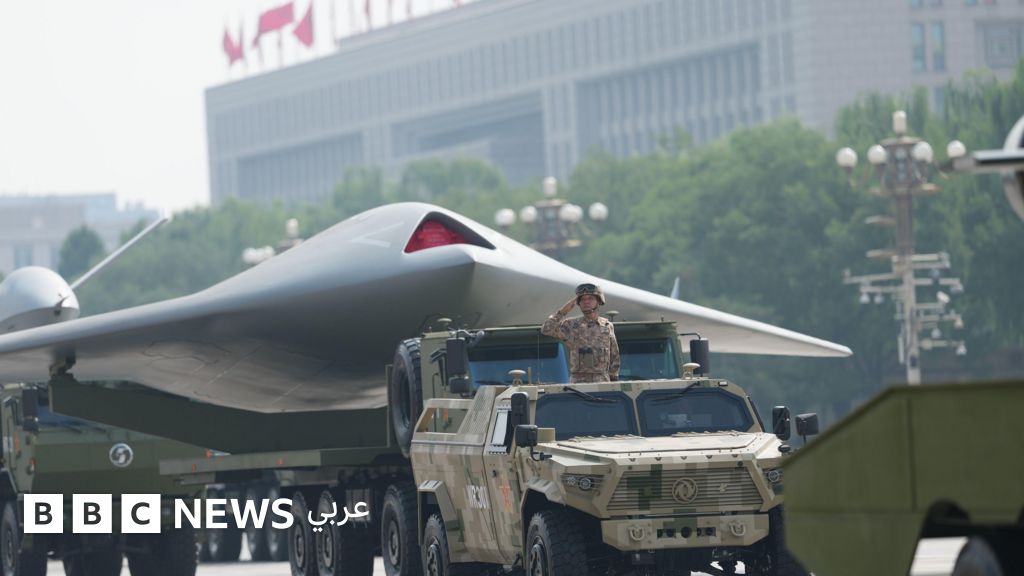
China says its nuclear program is defensive and limited to the minimum necessary for national security, but it faces Western estimates pointing to a rapid expansion of its nuclear arsenal and modernization of its capabilities, as Beijing continues to demonstrate its nuclear strength through tests and military displays.
How does China describe its nuclear doctrine? And what do Western estimates say?
Article Information
Author, Tom LamRole, BBC Media Monitoring Department
Published 28 June 2026
Reading time: 5 minutes
China has long been secretive about the size of its nuclear arsenal and its nuclear doctrine. Its official position emphasizes that the country's nuclear policy is primarily defensive, with a consistent emphasis on its historical commitment to the principle of 'no first use of nuclear weapons' and its repeated refusal to participate in calls for trilateral arms control talks with the United States and Russia.
However, Western observers have pointed to an acceleration in the modernization of China's nuclear capabilities in recent years, with estimates that China increased its nuclear warheads by about 100 annually between 2023 and 2025, before this growth slowed to only about 20 warheads over the past year.
Western media have also reported extensive development of Chinese missile silo fields to enhance the country's ability to conduct a second nuclear strike.
Beijing has not hesitated to display its nuclear capabilities as a deterrent, including launching an unarmed intercontinental ballistic missile into the Pacific Ocean in 2024, as well as the first display of what is known as China's 'nuclear triad', which includes land, sea and air launch platforms, during the military parade marking the 80th anniversary of victory in World War II in 2025.
China's official position
Beijing imposes strict secrecy on the details of the size of its nuclear arsenal, and insists that its nuclear policy is 'stable, consistent and predictable', that it is for self-defense, and that China has always maintained its nuclear capabilities at the minimum level necessary to ensure national security.
It also stresses that it has never entered a nuclear arms race and has contributed to maintaining global strategic stability, considering that talk of the expansion of its nuclear arsenal is nothing but 'baseless speculation and propaganda'.
China strongly promotes its commitment to the principle of 'no first use of nuclear weapons', affirming that it will not use nuclear weapons 'except in response to a nuclear attack'.
In 2024, it launched an international initiative in this regard, considering that adherence to this principle represents a 'practical step' to implement the Nuclear Non-Proliferation Treaty, and called on all nuclear states to adopt a policy of no first use of nuclear weapons and to conclude a treaty prohibiting the use or threat of use of nuclear weapons against non-nuclear states.
Skip most read and continue reading
Do you really need to avoid gluten?
"A meal I had during my holiday ended up with me infected with 38 parasites in my brain"
Ukraine strikes a major oil station in the Russian city of St. Petersburg
Funeral music and 'selected verses', how did social platforms read Khamenei's farewell ceremony?
Nevertheless, Beijing has repeatedly rejected US calls to participate in trilateral arms control talks with Washington and Moscow, especially after the expiration of the New START treaty between the United States and Russia in February last year.
Chinese officials described these demands as 'unfair, unreasonable and unrealistic', stressing that the United States and Russia possess the vast majority of global nuclear arsenals, and thus bear the primary responsibility for nuclear disarmament efforts.
Western assessment
Despite the secrecy surrounding China's nuclear program, Western observers believe that China is undergoing a rapid modernization of its nuclear capabilities.
The Stockholm International Peace Research Institute (SIPRI) estimated in its 2026 annual report that China's nuclear arsenal reached about 620 warheads by January 2026, compared to 600 warheads the previous year.
Six symbols tell the story of China's Cultural Revolution 60 years ago
"Made in China": A new wave of exports sweeps the world
Skip podcast and continue reading
Worth paying attention to
In-depth explanation of the most important events and topics, to help you understand the key changes around you and their impact on your life
Episodes
Podcast end
According to the institute, China added 90 nuclear warheads between 2023 and 2024, then 100 between 2024 and 2025, the fastest growth rate in the past decade, before the rate of increase began to decline.
A 2024 report by the US Department of Defense (Pentagon) predicted that China's nuclear warheads would exceed 1,000 by 2030, but did not repeat the estimate in its 2022 report which suggested the arsenal could reach about 1,500 warheads by 2035.
SIPRI noted that even if China surpasses the 1,000-warhead threshold by 2030, it would still be equivalent to about a quarter of the current nuclear arsenals of the United States and Russia.
The institute also pointed out that China has equipped hundreds of missiles inside three huge missile silo complexes in the north of the country, while completing the construction of 30 additional silos in three mountainous areas in eastern China.
In May last year, Reuters revealed a vast network of more than 80 launch pads, fortified bunkers and octagonal command centers in the Xinjiang desert in northwestern China, to support fixed and mobile missile launch platforms, which was seen as an indicator of enhancing China's ability to conduct a second nuclear strike.
Showcasing nuclear capabilities
Although official Chinese media refrained from commenting on Western estimates, Beijing has clearly displayed its nuclear capabilities in recent years.
In 2024, for the first time since 1980, it launched an unarmed intercontinental ballistic missile towards the Pacific Ocean.
What brings China and Russia together?
The United States and China play a waiting game - The Guardian
Although the Chinese Ministry of Defense did not disclose details of the operation, Chinese media reported that the missile, a DF-31AG, struck a specific target about 2,000 kilometers southeast of the Hawaiian Islands, after covering a total distance of 12,000 kilometers.
Those reports confirmed that the missile's full range allows it to cover the South Pole, the entire European continent, and all major cities on the US West Coast.
Chinese military expert Du Wenlong believed that the launch aimed to enhance strategic deterrence, demonstrate China's logistical capabilities and operational maps in the region, as well as its confidence in penetrating air defense and missile defense systems.
In contrast, Taiwanese military analysts considered that the timing of the launch coincided with a broad anti-corruption campaign within the People's Liberation Army, which included the dismissal of several senior commanders of the Rocket Force.
During the military parade organized by Beijing in 2025 to mark the 80th anniversary of the victory over Japan, it displayed for the first time the complete Chinese nuclear triad.
Chinese media described this achievement as representing a 'winning strategic power card', and the parade included long-range air-launched missiles, the JL-3 submarine-launched intercontinental ballistic missile, the DF-61 and DF-31 land-based missiles, and the new DF-5C intercontinental strategic missile fueled by liquid propellant, capable of delivering global-range strikes.
Skip short videos and continue reading
Short videos
Original source: BBC Arabic



Comments (0)
Be the first to comment.