Sudan’s Security and Defense Council acknowledges a 'negotiation path' with international mediation
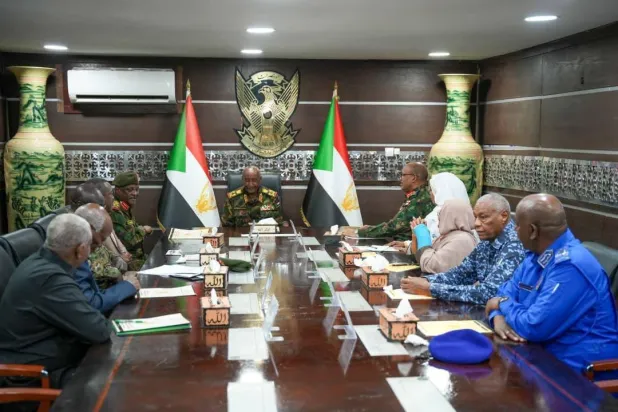
Sudan’s Security and Defense Council has acknowledged the existence of a 'negotiation path' officially engaged in by authorities, hours after leaks circulated regarding an American proposal for a 90-day truce.
Israel is expressing concern over the trajectory of Egyptian-Turkish rapprochement, coinciding with the first official visit of Egyptian Defense Minister Ashraf Salem Zaher to Ankara, amidst Israeli allegations that Turkey is shipping attack drones to Cairo.
The Israeli concern comes in the context of rapidly accelerating Egyptian-Turkish rapprochement following a rift that lasted more than ten years.
According to a military and strategic expert who spoke to Asharq Al-Awsat, this Israeli anxiety, manifested through 'flimsy claims,' will continue until the upcoming Israeli elections next October, as the current government seeks to find issues to occupy domestic public opinion.
The Hebrew platform 'Netsiv Net,' which specializes in military and intelligence affairs, alleged the existence of a Turkish air bridge transporting advanced attack drones to the West El-Obeid base in Egypt after they took off from a Bayraktar drone production center in Turkey, considering this 'evidence of deepening military cooperation between Cairo and Ankara in light of their involvement in regional crises.'
These are not the first allegations to emerge regarding the Egyptian-Turkish rapprochement, which grew in 2023 following understandings that ended a political rift lasting more than 12 years. Last June, the Israeli newspaper 'Maariv' alleged that American intelligence had detected unusual activity, suggesting that Egypt and Turkey were 'quietly working to strengthen large-scale military cooperation that might include arms deals changing the balance of power.'
In May, 'Maariv' also published an article by retired General Yitzhak Brick, who did not rule out Tel Aviv entering a 'difficult war' against a Turkish-Egyptian alliance as both countries bolster their military capabilities. He asserted then that any military rapprochement between Egypt and Turkey could redraw deterrence maps in the region and place Israel before new security challenges requiring a comprehensive reassessment of its military doctrine and defense strategies.
Israel's crisis
For his part, Major General Osama Kabir, an advisor at the Command and Staff College and a military and strategic expert, believes that Israel is facing an acute internal crisis whose repercussions will appear in October with elections that could lead to the ouster of the government unless the region witnesses wars, noting that 'Israeli allegations will continue until the election results, and will stop if Benjamin Netanyahu falls.'
Kabir emphasized that what Tel Aviv alleges regarding Egyptian-Turkish relations is 'rhetoric intended for domestic consumption, an attempt to create an imaginary danger to frighten the internal front, and to spread misinformation to sway Israeli public opinion and ensure the survival of the current government.'
Egyptian Defense Minister in Turkey at the head of a high-level military delegation (Turkish Ministry of Defense)
The new Israeli allegations come the day after the visit of the Egyptian Defense Minister, who held a meeting on Monday with his Turkish counterpart, Yaşar Güler, in Ankara, according to the Turkish Ministry of Defense via its Facebook page, where it published a photo showing the two ministers inspecting drone frames.
Turkish Ambassador to Cairo Salih Mutlu Şen stated that 'the two ministers signed a letter of intent for defense cooperation, within the framework of strengthening military cooperation relations between the two countries.'
At the beginning of this month, Mutlu Şen said in a press conference at the embassy that 'security cooperation and military relations between Turkey and Egypt are proceeding very well,' confirming that 'the growing relations between the Turkish and Egyptian armies will contribute, in a broader sense, to the peace, security, and stability of the region and the world at large.'
On Sunday, the Egyptian army announced in a statement that the Defense Minister 'left the homeland heading to the State of Turkey at the head of a high-level military delegation on an official visit at the invitation of the Turkish Defense Minister, to conduct a number of talks to support prospects for military cooperation between the armed forces of both countries in many fields.'
Last May, Egyptian Chief of Staff Ahmed Khalifa paid an official visit to Turkey, during which he met his Turkish counterpart Metin Gürak, as part of the fourth meeting of the joint military committee between the two countries, where they discussed ways to develop military cooperation, especially in the areas of training and exchange of expertise.
Development of cooperation
Military cooperation between Egypt and Turkey has witnessed remarkable development since 2023 with the return of full diplomatic relations and the exchange of presidential visits, which has reflected on the field of defense industries, as the countries resumed the joint 'Sea of Friendship' exercises and agreed on cooperation in the joint manufacture of drones, while Cairo also joined the Turkish fifth-generation stealth fighter 'KAAN' program.
A side of the meeting between the Turkish Defense Minister and his Egyptian counterpart in Ankara (Turkish Ministry of Defense)
In February, Egypt and Turkey signed a 'military cooperation agreement' in Cairo in the presence of Egyptian President Abdel Fattah el-Sisi and his counterpart Recep Tayyip Erdoğan, who was visiting the Egyptian capital at the time, and in August 2025, Egypt and Turkey signed an agreement for the joint manufacture of vertical take-off and landing drones.
Flourishing cooperation
Regarding the nature of the relationship between Cairo and Ankara, Osama Kabir confirms that Egyptian-Turkish cooperation is required and necessary, given the political, military, and historical weight of the two countries.
He stresses the need to distinguish between military cooperation and a military alliance; what brings Egypt and Turkey together is flourishing military cooperation that includes joint training, military manufacturing, the exchange of military attaches, and coordination on regional issues, rather than an alliance in the sense that would require them to enter into joint wars.
In this regard, he pointed to the 'Sea of Friendship' maneuvers, which were resumed between the two countries last September after a 12-year hiatus, in addition to reciprocal diplomatic and military visits and coordination between intelligence agencies and political leaders, asserting that it holds great importance in the framework of cooperation and ensuring the security and stability of the region.
These allegations coincide with previous Israeli warnings that any military rapprochement between Egypt and Turkey could redraw deterrence maps in the region and place Tel Aviv before new security challenges. Furthermore, the upcoming Israeli elections in October are pushing the current government to focus on external issues to preoccupy domestic public opinion, according to expert estimates.
Original source: Asharq Al-Awsat



Comments (0)
Be the first to comment.