Prisoner's Club: Escalating attempts to liquidate Abu Safiya in Israeli prisons
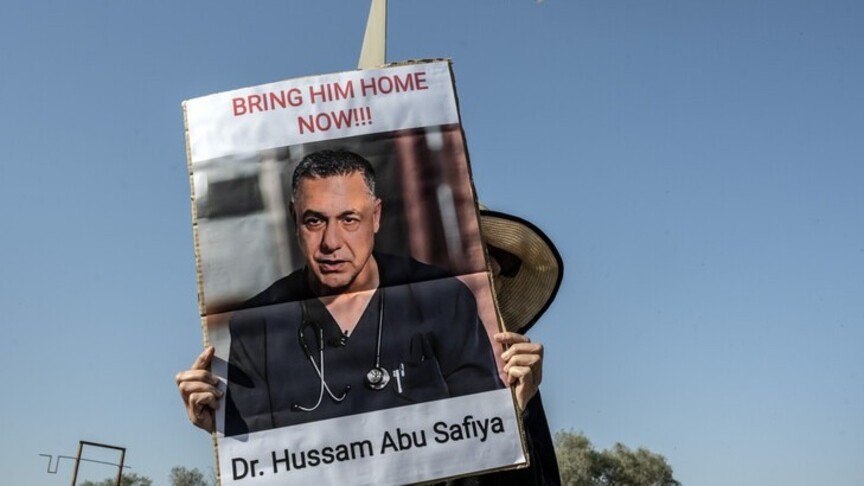
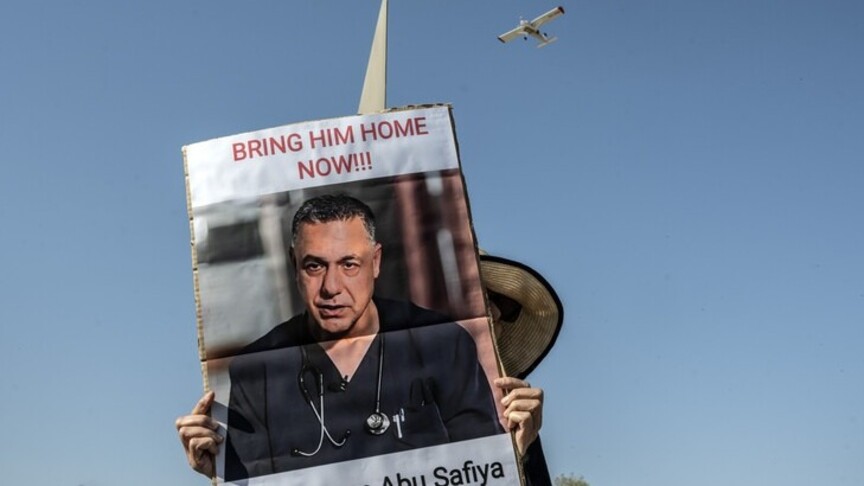
The Palestinian Prisoner's Club said that Dr. Hussam Abu Safiya is being subjected to 'a systematic torture system and harsh detention conditions aimed at draining him physically and psychologically.'
Ramallah / Anadolu
The Palestinian Prisoner's Club said that new information regarding Dr. Hussam Abu Safiya, the director of Kamal Adwan Hospital in the Gaza Strip who is detained by Israel, 'confirms the escalation of the occupation's attempts to liquidate him inside prisons.'
The club, a non-governmental organization, said in a statement on Saturday that the 'serious information' conveyed by Abu Safiya's lawyer, in cooperation with Physicians for Human Rights, 'conclusively reveals that the Israeli occupation authorities are proceeding with intensifying their direct targeting' of the Palestinian doctor.
It added that this targeting is carried out 'by subjecting him to a systematic torture system and harsh detention conditions aimed at draining him physically and psychologically, in a clear extension of attempts to liquidate him inside prisons.'
The Israeli army arrested Abu Safiya on December 27, 2024, during its storming of Kamal Adwan Hospital, where he served as director, amid Israel's genocidal war on the Gaza Strip.
On June 16, 2026, the Israeli Supreme Court rejected a request to release the Palestinian doctor, who remains detained without charge since his arrest.
The Prisoner's Club called on international human rights organizations, United Nations bodies, and the International Committee of the Red Cross to move from statements of condemnation and concern to practical and urgent steps to ensure immediate protection for the detained doctor and work for his release and the release of medical staff detained in Israeli prisons.
It added that transferring Abu Safiya to the 'Rekevet' section in Israel's 'Nitzan' prison, known for testimonies about torture, abuse, humiliation, isolation, and denial of medical treatment, represents a 'dangerous escalation' in his detention conditions.
It pointed out that the continuation of the policy of medical neglect and torture inside Israeli prisons endangers the lives of detainees at any moment.
The club said that repeated condemnation and warning statements over the past months have failed to stop violations against Palestinian prisoners, who face a 'systematic genocide policy' inside prisons.
It accused the Israeli authorities of using the prison system as a tool for 'slow death' through torture and medical neglect, according to the statement.
It added that the continued detention of Abu Safiya without charge, under the so-called 'Unlawful Combatant Law,' reinforces fears for his life and perpetuates his arbitrary detention.
The club stressed that the continued detention of Abu Safiya, one of the doctors who continued their work during the war on Gaza, reflects an ongoing targeting of medical staff through arrest, torture, and denial of treatment.
It held the Israeli authorities fully responsible for the life and fate of Abu Safiya and the rest of the Palestinian prisoners, calling for accountability of countries that provide support and protection to Israel.
According to the statement, the number of Palestinian prisoners in Israeli prisons is about 9,400 as of early July of this year, including 1,320 detainees classified by Israel as 'unlawful combatants,' in addition to administrative detainees held without charge or trial.
It added that hundreds of detainees from the Gaza Strip remain missing, as Israeli authorities continue to refuse to disclose their places of detention or health conditions.
The club pointed out that more than 100 prisoners have been killed inside Israeli prisons and camps since the start of the war, of whom 90 have been identified.
According to Al-Mezan Center for Human Rights, the Israeli Knesset approved in 2002 the 'Unlawful Combatant Law,' which allows for the detention of individuals for indefinite periods without filing an indictment or presenting sufficient evidence in court.
This law deprives detainees subject to it of the guarantees granted to prisoners of war under the Third Geneva Convention or to civilian detainees under the Fourth Geneva Convention of 1949, and grants Israeli courts broad powers to extend detention based on security suspicions, without obligating the authorities to disclose to the detainee or their lawyer the detailed reasons for arrest, according to the center.
Original source: Anadolu Agency



Comments (0)
Be the first to comment.