Somalia: Successive Strikes Against Al-Shabaab Bolster Security Gains
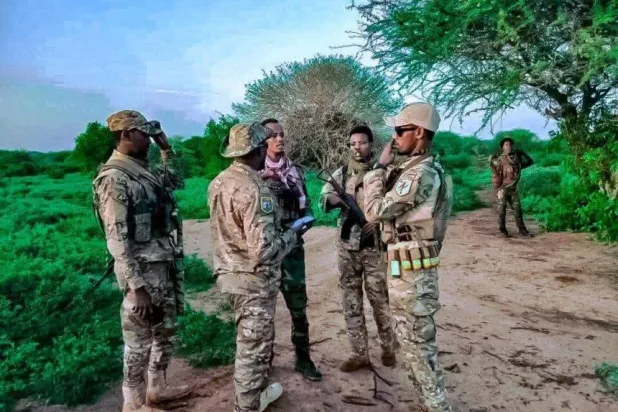
A major blow dealt by Somali authorities against the terrorist group Al-Shabaab, following the announcement of the killing of a prominent leader in the group linked to Al-Qaeda, which has been waging armed attacks against the state.
Somali authorities dealt a major blow to the terrorist group Al-Shabaab, following the announcement of the killing of a prominent leader in the group linked to Al-Qaeda, which has been waging armed attacks against the state for over a decade.
An expert in African and Somali affairs, speaking to Asharq Al-Awsat, sees the strike as important against the group, but it alone is not enough to bolster the security gains achieved by the killing of the prominent leader. He expects 'the group will try to retaliate, and in response, there will be greater political mobilization around the state in its confrontations, but that will not help resolve the political crisis the country is suffering without engaging in serious dialogue.'
The Somali army has been continuing its military campaigns against the terrorist group Al-Shabaab for over a decade, which the Somali government refers to as the 'Khawarij militia.' The group launches attacks aimed at overthrowing the Somali government to seize power and says it seeks to apply 'sharia strictly.'
Major Blow
Somali Defense Minister Ahmed Moalim Fiqi announced at a press conference in Mogadishu that a planned operation carried out jointly by intelligence agencies and the Somali National Army, with support from international partners, resulted in the killing of a prominent leader of the 'Shura Council of Al-Shabaab,' named Maalim Jinow Ibrahim, via an airstrike in the Sabyo area, after 14 months of tracking, according to the official Somali News Agency (SONNA) and local media on Tuesday.
Fiqi explained that Jinow was one of the founders of Al-Shabaab, the ninth member of the group's Shura Council, and played a prominent role in leading combat factions, collecting money from the public, and organizing the group's wars, as well as being a senior advisor and close to the leader of Al-Shabaab, Ahmed Diriye.
Somali President Hassan Sheikh Mohamud (Somali News Agency)
The Somali News Agency (SONNA) reported in July confirmations of the escalation of the military campaign against Al-Shabaab, pointing to the killing of dozens in more than one area of the country.
On July 7, Ahmed Moalim Fiqi and Brigadier General Ibrahim Mohamed Mahmoud, Chief of Staff of the Armed Forces, following a field visit to a military unit, affirmed 'continuous achievements in military operations aimed at eliminating the terrorist (Al-Shabaab) organization,' directing 'to double their efforts and continue progress in implementing operations, until the complete liberation of all areas where elements of the terrorist organization are still present, and the extension of state authority over the entire territory of the country,' according to SONNA.
The expert in African affairs, Director of the 'East Africa Studies Center' in Nairobi, Dr. Abdullah Ahmed Ibrahim, believes that despite the importance of the strike and its military effects in bolstering security gains, it is a 'temporary success' that needs other elements to establish security and stability.
He explained that any Somali strikes against Al-Shabaab elements will not achieve their purpose unless accompanied by a clear strategy on the ground, consisting of the continuous presence of ground forces with the capabilities and capacities to confront them, which are not yet available, in addition to the Somali government facing a lack of international and African support, which limits the continuation of strikes against Al-Shabaab.
Otherwise, according to Ibrahim, a comprehensive multi-dimensional approach, military, security, economic, and ideological, must be pursued for the liberated areas not under the control of the terrorist organization, expecting the group to try to retaliate against that major military operation.
Escalating Differences
The Somali announcement of the killing of a prominent leader in Al-Shabaab comes amid ongoing political differences between the federal government and the opposition.
The differences are summarized in the opposition's rejection of holding direct elections in the country while adhering to the clan system, and rejection of implementing the constitution in objection to the two articles reducing the powers of the regions and extending the presidency for one year, ending on May 15, 2027, instead of the current year, according to previous statements issued by the Somali opposition.
Dr. Abdullah Ahmed Ibrahim believes 'that political differences will only end through serious dialogue, but this strong strike may achieve greater mobilization around the state in confronting those terrorist elements, but dialogue is the beginning of the real solution to reach consensus and resolve the political crisis.'
Original source: Asharq Al-Awsat




Comments (0)
Be the first to comment.