"The Fentanyl King": Who is the Chinese man accused of creating a drug supply chain from China to Mexico and the US?
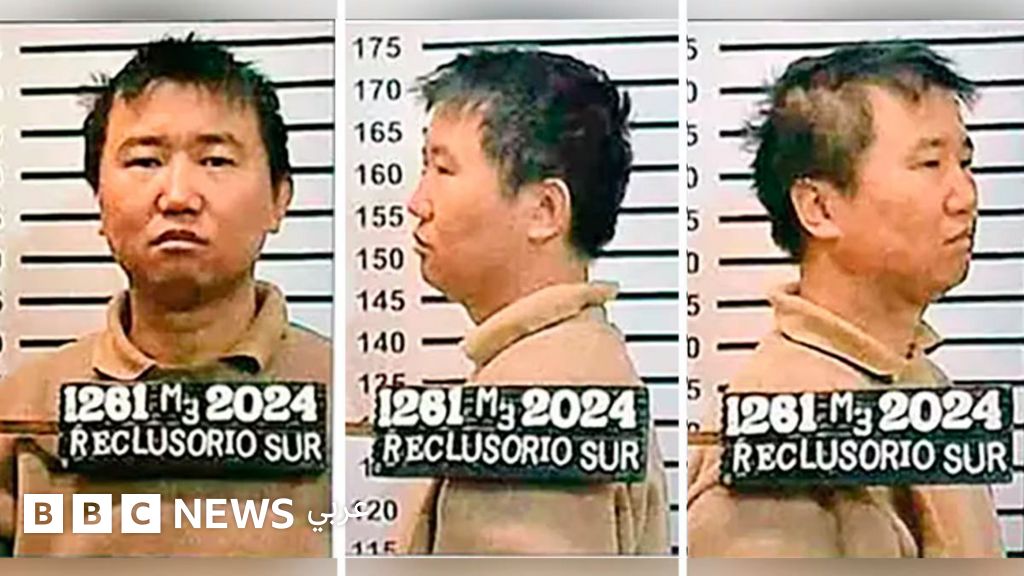
Cartel members and former associates of Zhang Zhidong reveal how he is believed to have connected chemical suppliers in China with drug manufacturing laboratories in Mexico.
"The Fentanyl King": Who is the Chinese man accused of creating a drug supply chain from China to Mexico and the US?
Image caption: Zhang Zhidong awaits trial in the United States on charges of drug trafficking and money laundering.
Article Information
Author: Shaun Yuan, Role: BBC Global China Unit, Reporting from: Culiacán, Mexico
Published: 1 minute ago
Reading time: 9 minutes
"Brother Wang was the number one man and the one with the most influence," says Enrique, a pseudonym for a man who describes himself as a high-level coordinator in the Mexican Sinaloa Cartel, one of the world's most powerful criminal organizations, before laughing in a way that suggests he knows more than he is letting on.
On the outskirts of Culiacán, the capital of Sinaloa state, Enrique sits inside a parked car in a location guaranteed to keep his conversation private, recounting how raw materials needed to manufacture fentanyl were shipped from factories in China, thousands of miles away, to secret laboratories in Mexico. He asserts that cartel members credit "Brother Wang" with establishing this supply chain.
"Brother Wang" is known in criminal circles as the "Fentanyl King." According to the US Department of Justice, his real name is Zhang Zhidong, a 39-year-old Chinese citizen. He was arrested in Mexico in 2024 but later managed to escape in a dramatic operation, before being re-arrested and extradited to the United States in 2025.
What is the story behind fentanyl, the drug that threatens America and is being targeted by Trump with tariffs?
Fentanyl is a synthetic opioid that is about fifty times more potent than heroin. It causes the deaths of tens of thousands of people annually, mostly in the United States, where the drug typically ends up after being manufactured. A dose as small as a few grains of salt can be enough to cause death.
Cartel: A term used for drug and criminal gangs in Mexico.
US President Donald Trump had described fentanyl dealers as "drug terrorists" and classified fentanyl and its components as weapons of mass destruction. He also used the drug trade as a justification for imposing tariffs on China, Mexico, and Canada.
Image caption: US Customs and Border Protection officers display fentanyl and methamphetamine seized in a truck crossing from Mexico into Arizona.
When Zhang appeared in court in New York in 2025, the then-acting US Attorney, Todd Blanche, described him as one of the "most dangerous drug traffickers in the world."
He also accused him of running a "global criminal network that pumped massive quantities of cocaine, fentanyl, and methamphetamine" into the United States, in addition to laundering "millions of dollars in drug proceeds."
New law in China to ease the burden of homework on children
Zhang has pleaded not guilty to all charges and is still awaiting trial. The BBC reached out to his lawyer, but he declined to comment due to ongoing judicial proceedings.
Cartel members and former colleagues of Zhang agreed to speak to the BBC, providing a rare glimpse into how they believe Zhang, a graduate of one of China's most prestigious universities, became a key link between chemical manufacturing companies in China and drug laboratories in Mexico.
Who is Zhang?
Zhang graduated from the prestigious Peking University in 2010 with a degree in Spanish, before traveling the following year to Mexico to work for a Chinese company involved in iron ore extraction. He quickly climbed the ranks to take on a senior position.
People who knew him during that time describe him as a smart, ambitious young man who was passionate about experiencing life outside his home country.
Alex, a pseudonym, who studied at the same university and later worked with Zhang at the mining company in Mexico, says that Zhang "was skilled at negotiating and had a great ability to find solutions and adapt to different environments."
He adds that Zhang spoke fluent Spanish, was proficient in street slang, and had the ability to converse with various people, though he retained a distinct Beijing accent.
Image caption: When Zhang first moved to Mexico, he worked for a Chinese-owned mining company.
Skip the podcast and continue reading
Worth noting
An in-depth explanation of the most prominent events and topics to help you understand the most important variables around you and their impact on your life.
Episodes
End of podcast
Alex says that doing business in Mexico sometimes required dealing with the criminal underworld, including drug cartels that exert influence over vast parts of the country. He adds that Zhang succeeded in building relationships with "everyone who had influence at the local level, whether on the official or unofficial side."
According to Alex, Zhang was fascinated by this side of life in Mexico. He paints a picture of a man drawn to risk and recklessness, recalling that he once crashed his boss's car without showing any concern for the consequences. He also recounts that one night, Zhang took him out of the city to shoot pistols at signs on an abandoned highway.
In 2013, the mining company they worked for went bankrupt. Alex returned to China, while Zhang decided to stay in Mexico.
Alex says that a year or two after staying in Mexico, Zhang began posting offers on the WeChat group for the Peking University Spanish department alumni to exchange dollars at preferential exchange rates. Alex believes those activities were a cover for money laundering operations.
For his part, Enrique, the cartel member, says that Zhang got involved in the drug trade. US court documents accuse him of running a "vast drug trafficking and money laundering network" since June 2016.
Enrique believes that Zhang entered into a romantic relationship with a relative of one of the cartel leaders, suggesting that this relationship helped him get closer to the inner circle of the organization's leadership.
Supply chain
Luis—a pseudonym for another cartel member who carried out tasks for the organization—remembers a hot afternoon in 2019 when his bosses asked him to guard a meeting attended by Zhang, who had come, according to him, "to show his products."
Luis says those "products" were chemical precursors, the basic materials needed to manufacture fentanyl. He believes that Zhang was the person who introduced him to the world of fentanyl and contributed to launching this activity within the cartel.
How did 'El Chapo's' son participate in the arrest of one of the most prominent drug barons?
Chemical precursors: A term used to refer to controlled substances used in the illicit manufacture of drugs.
He adds that he soon became responsible for manufacturing fentanyl inside a secret lab, noting that he saw at least five drug makers die before his eyes. He believes the reason was the leakage of chemicals through holes in the protective clothing they were wearing.
He says: "Sometimes people would suddenly lose consciousness, and we would have to carry them and take them out of the room."
Image caption: Chemicals used in fentanyl manufacturing are regulated but not prohibited in China, because they are used in legitimate industries.
Original source: BBC Arabic



Comments (0)
Be the first to comment.